Making a Splash: Essential Software for Pool Companies

Why Pool Business Management Software Matters for Your Bottom Line

Pool business management software is a digital platform that streamlines operations for pool service companies and facility managers by automating scheduling, billing, customer communication, and maintenance tracking. The best solution depends on your business model: field service platforms optimize routes and technician productivity for mobile pool services, while membership management systems handle access control and online payments for community pools and clubs.

Quick Comparison:

Business Type Best Software Type Key Features
Pool Service & Repair Field Service Platform Route optimization, mobile invoicing, chemical calculators, GPS tracking
Community Pools & HOAs Membership Management System Access control, online payments, reservations, member portals
Pool Management Companies Hybrid or Enterprise Solution Multi-location oversight, facility + service management, comprehensive reporting

The numbers tell a stark story about why this matters. The average pool professional spends 7.5 hours weekly on paperwork—that’s 390 hours per year that could be spent servicing more pools or growing the business. Even more concerning, 94% of pool businesses report missing appointments monthly, with each callback costing an average of $85 in unbilled time and fuel. And the cash flow pain? Pool businesses wait an average of 32 days for payment.

These inefficiencies aren’t just frustrating—they’re expensive. But modern pool management software addresses these pain points head-on. Businesses using specialized platforms report optimizing routes to reduce driving time by 31%, completing daily service routes 1-2 hours faster, and getting paid 3x faster through automated billing and online payments.

Whether you’re managing a team of mobile technicians servicing residential pools or overseeing member access at a community facility, the right software can transform your operations. The key is understanding which type fits your specific business model and needs.
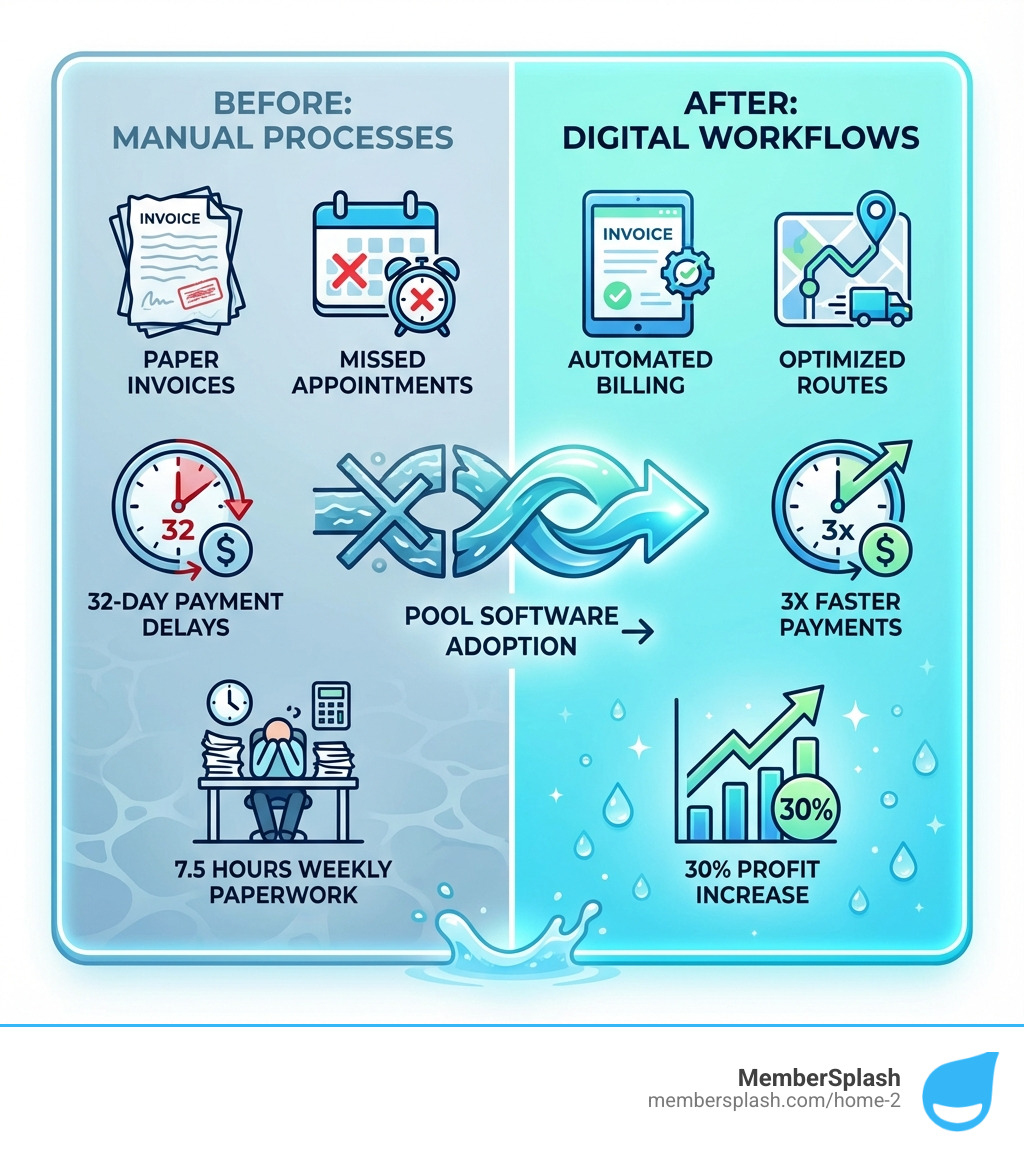
Infographic showing before and after pool software adoption: left side shows paper invoices, missed appointments, 32-day payment delays, and 7.5 hours weekly paperwork; right side shows automated billing, optimized routes, 3x faster payments, and 30% profit increase with digital workflows - pool business management software infographic

The Two Streams of Pool Business Software
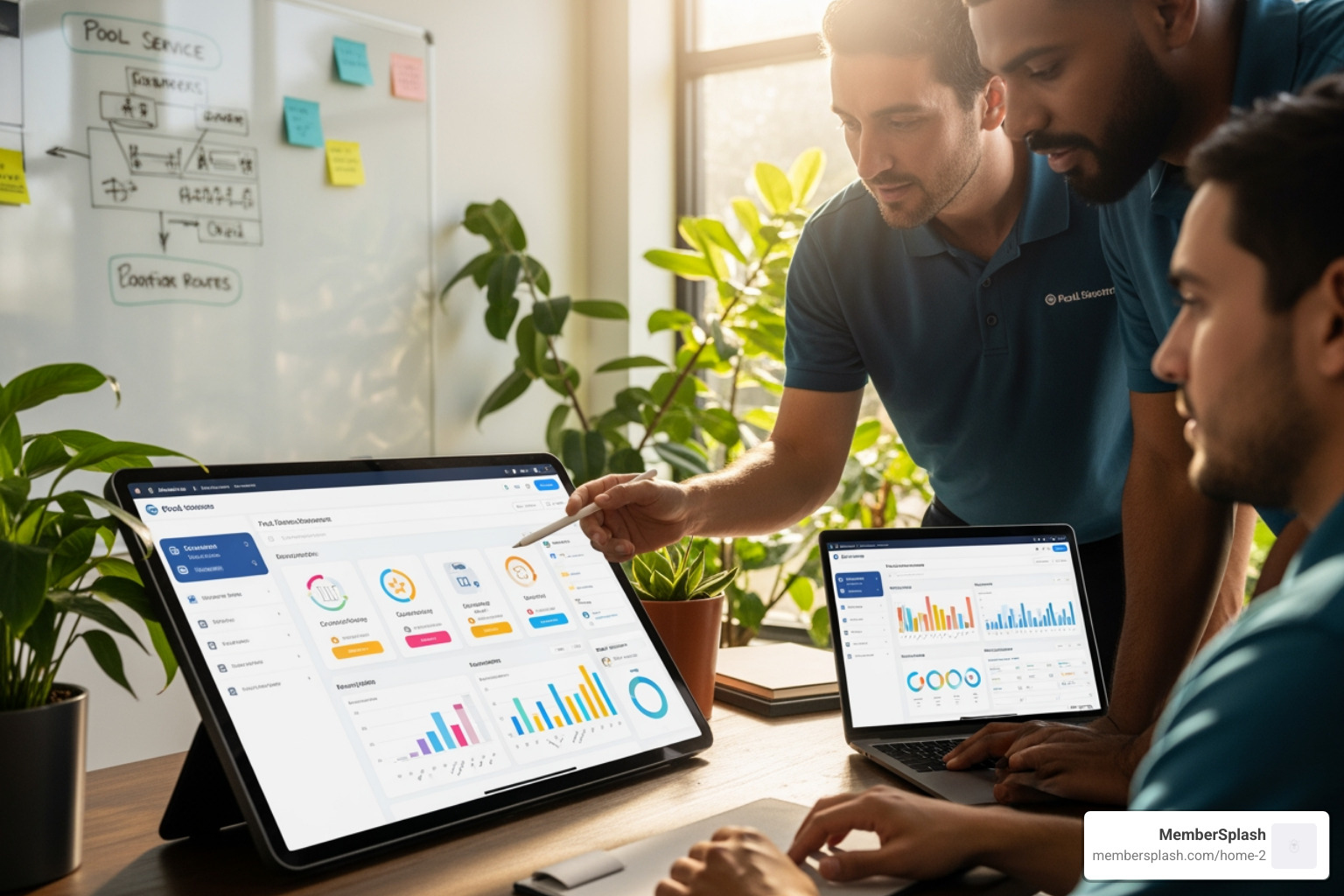
split screen showing a service route map on one side and a member check-in screen on the other - pool business management software

When we talk about pool business management software, it’s important to recognize that the “pool business” itself can take many forms. From the busy operations of a mobile pool service and repair company to the meticulous management of a community pool or HOA facility, each business model has unique demands. This is why the software solutions often diverge into two primary streams, each custom to specific operational needs. Understanding these differences is crucial for choosing the tool that will truly streamline your day-to-day and help your business flourish.

All-in-One Field Service Platforms

These platforms are the workhorses for pool service and repair professionals. If your business involves technicians on the road, visiting multiple properties daily, then a field service platform is likely the right choice for you. Our research shows that these systems are designed to optimize every aspect of mobile operations.

For instance, they excel at route optimization, helping businesses reduce driving time by a significant 31%. Imagine shaving hours off your technicians’ daily commutes, freeing them up to complete service routes 1-2 hours faster! Smart scheduling features allow for seasonal and recurring appointments, with the flexibility to adjust individual jobs without disrupting the entire series.

Chemical management is another cornerstone. With integrated chemical calculators, technicians can enter water readings directly into a mobile app and receive precise dosing recommendations, leading to a reported 23% reduction in chemical costs. In-field invoicing, often integrated with payment processing, means technicians can generate and send bills on the spot, helping businesses get paid faster. Mobile apps are central to these platforms, offering GPS tracking for routes, proof-of-service reporting with unlimited photos, and even offline functionality to keep technicians productive even without internet access.

Common features you’ll find in these platforms include:

  • Route optimization with GPS mapping
  • Automated scheduling and dispatch
  • Mobile apps for field technicians
  • In-app invoicing and payment processing
  • Chemical calculators and dosage recommendations
  • Inventory and purchasing management
  • Customer relationship management (CRM) for service history
  • Customizable post-service reports with photo uploads
  • Digital time tracking for staff

Membership and Facility Management Systems

On the other side of the coin, we have systems specifically designed for community pools, HOAs, and clubs. These are not about optimizing service routes, but rather about managing people, access, and facility usage. Our experience tells us that these systems are vital for organizations that need to ensure secure access, manage memberships, and facilitate communication with their patrons.

A robust membership management system provides a centralized database for all member information, making it easy to track profiles, usage, and monitor facility access with real-time data. This is particularly important for HOAs and community pools, where monitoring who visits community pools is essential for safety and compliance. Digital pool passes eliminate the need for manual check-ins, providing seamless and contactless entry for members.

Online payment processing is a key component, streamlining payments with online billing and recurring payment options. Reservation systems allow members to book facilities like tennis courts, cabanas, or poolside tables, while member engagement tools facilitate direct communication through bulk emails and customized notifications. We believe that a comprehensive system like ours offers more info about HOA solutions to help property managers save time and effort.

Key features for these systems often include:

  • Membership management and profiles
  • Automated access control with digital passes
  • Online payment processing and recurring billing
  • Reservation and facility booking systems
  • Member communication tools (email, SMS)
  • Guest tracking and management
  • Comprehensive reporting on usage and financials
  • Point-of-sale (POS) for concessions or merchandise
  • Online application and renewal processes

Core Features That Drive Efficiency and Profitability

At the heart of every successful pool business, whether it’s mobile service or facility management, lies efficiency and profitability. Pool business management software serves as the operational backbone, designed to boost productivity, lift customer service, and ultimately drive growth. Let’s explore the key functionalities that make this possible.

Optimizing Field Operations with your pool business management software

For field service professionals, time is money, and every mile driven counts. This is where the power of optimization truly shines.
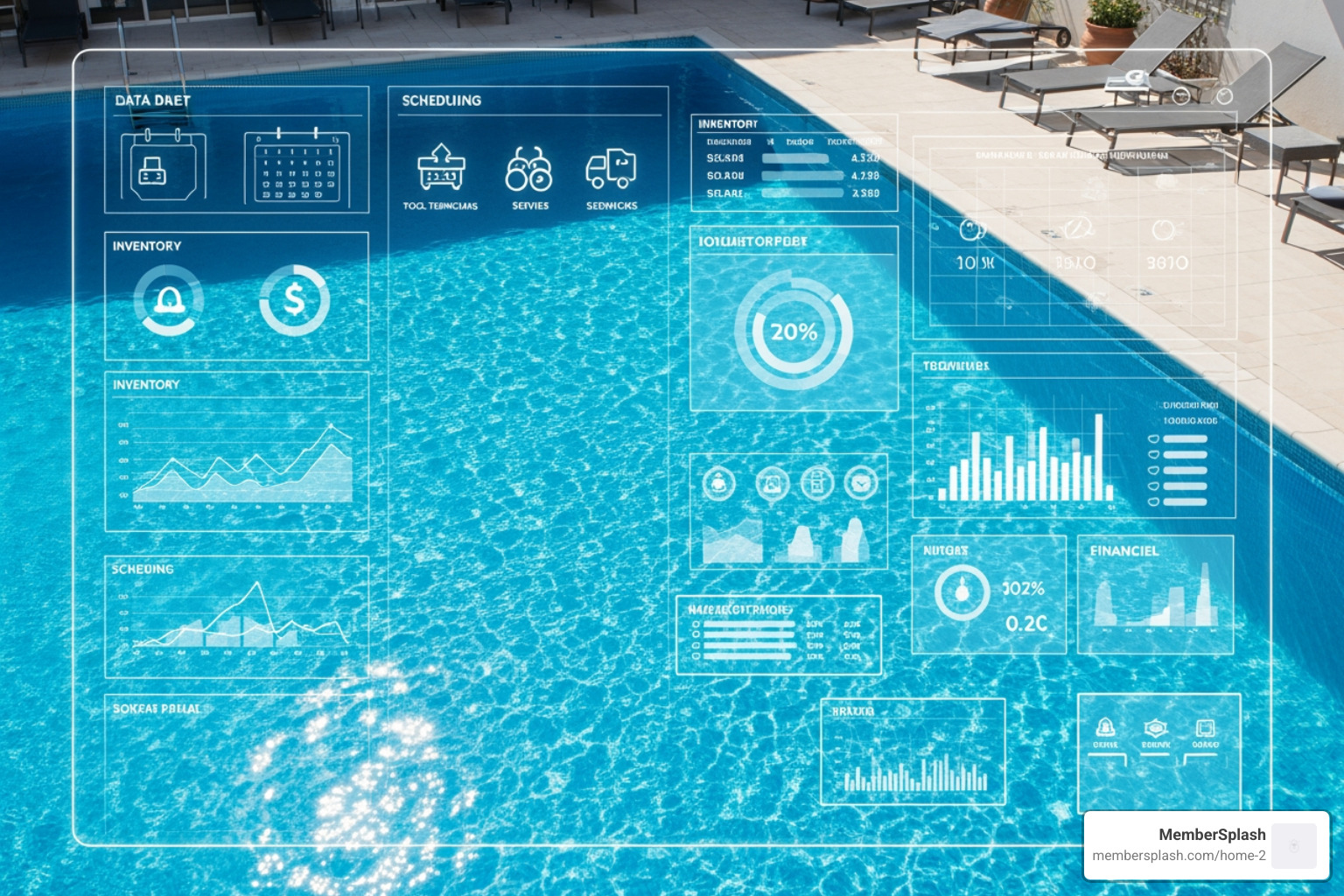
mobile app interface showing a technician's daily route and job list - pool business management software

Route optimization is a game-changer. Software can optimize routes to reduce driving time by 31%, meaning less fuel consumed (a 31% reduction in fuel expenses), less wear and tear on vehicles, and more time for actual service. With features like drag-and-drop scheduling, dispatchers can easily adjust routes in real-time, accounting for unexpected changes or urgent calls. This means technicians can complete daily service routes 1-2 hours faster.

GPS tracking provides real-time visibility across all locations, allowing managers to monitor operations and make data-driven decisions. Mobile accessibility is essential; technicians use mobile apps to access their daily route and job list, customer details, and update job statuses from the field. Many systems offer offline functionality, ensuring technicians remain productive even without internet access.

Beyond just routing, these platforms integrate critical tools for technicians:

  • Chemical calculators: These in-app tools allow technicians to enter water readings and automatically calculate the exact recipe and dose of chemicals needed, leading to precise dosing and a 23% decrease in chemical costs.
  • Inventory tracking: This eliminates warehouse scavenger hunts. Software can integrate barcode scanning to track supplies, providing a summarized inventory report and helping prevent last-minute supplier runs. This can lower inventory carrying costs by 26%.
  • Increased technician efficiency: By providing all necessary information and tools in one place, software can increase technician efficiency by 25% and significantly reduce new technician ramp-up time.

These features collectively eliminate a large percentage of unbillable return visits, improving your bottom line and technician morale.

Enhancing Customer Relationships and Retention

Happy customers are repeat customers, and they are also your best marketers. Pool business management software plays a pivotal role in nurturing these relationships.

A centralized customer database is the foundation. It provides a robust system where complete customer information and job history are stored, making it easy for technicians and office staff to view past services, equipment details, and custom preferences before arriving on site. This personalized approach fosters loyalty.

Automated communications keep customers informed and engaged. Email and SMS reminders for appointments, service updates, and billing notifications can reduce missed appointments and improve customer satisfaction. Customer portals empower clients to self-serve, allowing them to book appointments, access invoice history, check chemical readings, and pay for recurring services online.

Furthermore, many platforms facilitate online review generation. By automatically texting a direct link to customers as soon as a job is finished, businesses can acquire more positive reviews. Positive reviews, in turn, generate more customer referrals and fuel acquisition. The ability to communicate directly with your members by sending important updates, event reminders, and customized notifications is a powerful tool for retention, and we offer more info about communication tools to help you do just that.

Simplifying Financial Management

Managing finances can be complex, but pool business management software helps you handle it more efficiently.

Automated invoicing and billing are among the most valuable features. These systems enable in-app creation and sending of automated, repeating, or custom invoices in just a few clicks. This automation can help businesses get paid significantly faster and reduce the average payment collection time. Batch billing allows for processing multiple invoices simultaneously, saving valuable administrative hours.

Online payments are integrated, enabling customers to pay securely and conveniently, speeding up cash flow and reducing unpaid invoices. The software also helps with contract and service agreement management, allowing for customization of charges, opt-ins, and membership upgrades. It can automatically track labor, material costs, and net profits for customized agreements, helping ensure accurate invoicing for recurring services.

Quoting and estimates are streamlined with multi-option estimate builders that help technicians close more jobs at a higher average ticket. You can create quotes quickly to speed up approvals and close more repair jobs. Finally, robust financial reporting features track income and expenses, providing analytics for data-driven decisions and a clear picture of your business’s financial health.

Choosing the Right Pool Business Management Software

Selecting the perfect pool business management software is a significant investment decision that can shape your company’s future. It’s about more than just features; it’s about scalability, future-proofing your operations, and ensuring the tool aligns with your specific needs. Let’s explore the key considerations to make an informed choice.

Evaluating Pricing Models and ROI

Pricing models for pool business management software can vary widely, and understanding them is crucial for calculating your potential return on investment (ROI).

Here’s a breakdown of common pricing models:

Pricing Model Description Considerations
Per-Technician Flat fee per active user/technician. Good for businesses with consistent staff numbers; can become costly as you scale your team.
Per-Customer Fee based on the number of active customer accounts managed. Ideal for businesses with fluctuating service volume; scales directly with your customer base.
Flat Rate A single monthly/annual fee for all features and users. Predictable costs; may be less cost-effective for very small operations or extremely large ones.
Tiered Plans Different feature sets available at varying price points (e.g., Basic, Essentials, Premium). Allows you to choose features you need; can limit access to advanced tools at lower tiers.
Free Tiers Basic features offered for free, often with limitations (e.g., number of pools, processing fees). Great for testing the waters; often requires processing payments through the platform to maintain access.

When evaluating pricing, always consider the long-term ROI. Look beyond the monthly fee and consider the savings and revenue increases the software can generate. For example, a system that saves you 6.2 hours weekly on paperwork effectively pays for itself by allowing you to service more pools. Reduced chemical costs, optimized routes, faster payments, and increased customer retention all contribute to a significant ROI. Some businesses report increasing profits by 30% after implementing software. We believe in transparent pricing, and you can find more info about pricing models to help you compare.

Key Integrations for a Seamless Workflow

A standalone software system is good, but one that integrates seamlessly with your other essential business tools is even better. Integrations eliminate double data entry, reduce errors, and create a truly unified workflow.

Common and critical integrations include:

  • Accounting Software: Integration with platforms like QuickBooks (Online or Desktop) is paramount. This allows for automatic synchronization of invoices, payments, and financial data, simplifying your accounting procedures and ensuring accuracy without manual data transfer.
  • Payment Gateways: Secure integration with payment processors (e.g., Stripe) allows for online payments, automated billing, and faster cash flow directly within the software.
  • Water Testing Hardware: For pool service companies, integration with water testing devices (like Spin, Xpress Flex, or Palintest) means readings can be automatically imported into the software, feeding chemical calculators and creating a comprehensive service record.
  • Marketing Platforms: Connecting your pool business management software to marketing tools can automate campaigns, manage online reviews, and track marketing ROI, helping you acquire new customers and retain existing ones. For those looking to streamline their outreach, we have more info about automating marketing campaigns to help you get started.

Security, Data Privacy, and Support for your pool business management software

In today’s digital landscape, the security and privacy of your business and customer data are non-negotiable. When choosing a pool business management software, always prioritize platforms that are built on secure foundations.

  • Cloud-based systems offer flexibility and scalability, but ensure they use robust data encryption protocols to protect sensitive information.
  • PCI compliance is critical for any system handling credit card payments, safeguarding your customers’ financial data.
  • Secure member tracking ensures that personal information and facility access logs are protected against unauthorized access.

Beyond security, the quality of customer support and the onboarding process are vital. A good provider will offer:

  • Comprehensive onboarding: This includes data migration assistance, training resources (video tutorials, knowledge bases), and potentially a “white-glove setup service” for hands-on assistance.
  • Ongoing support: Look for responsive customer service through live chat, phone, or email. Industry expertise within the support team is a huge plus, as they’ll understand the nuances of your business. Our team provides supported implementation to ensure a smooth transition.

The right software partner offers not just a tool, but a commitment to your business’s secure and efficient operation.

Frequently Asked Questions about Pool Management Software

We know you’ve got questions, and we’ve got answers! Here are some common inquiries we encounter about pool business management software.

How long does it take to set up and learn the software?

This is a common concern, and the good news is that modern pool business management software is designed for ease of use. Many platforms boast intuitive interfaces, allowing users to start logging service visits or managing memberships within minutes of signing up.

For a full setup, including importing existing customer data, configuring billing, and setting up service protocols, it can range from a few hours to a few days. Providers often offer:

  • Onboarding support: This can include video tutorials, comprehensive knowledge bases, and live chat support.
  • Data migration assistance: Many systems can help transfer your existing customer and pool data, making the transition seamless.
  • Training resources: Detailed guides and personalized walkthroughs ensure you and your team become comfortable with the system quickly.

Essentially, while you might see immediate benefits from day one, expect to be fully optimized within a week or two, depending on the complexity of your operations.

Can this software really help my small business grow?

Absolutely! Pool business management software is a powerful catalyst for growth, whether you’re a solo operator or managing a small team. By eliminating inefficiencies, you free up valuable resources that can be reinvested into growth.

Consider these benefits:

  • Scalability: The right software scales with your business, allowing you to add technicians, manage more pools, and expand services without proportionally increasing administrative overhead. You can add 20-30% more service stops without hiring additional help.
  • Increased efficiency: Automating tasks like scheduling, routing, and invoicing means you can service more pools in less time. One business reported increasing their service capacity from 45 to 58 pools weekly, adding thousands in monthly revenue.
  • Data-driven decisions: Comprehensive reporting and analytics provide insights into your operations, helping you identify opportunities for cross-selling additional services (some see a 34% increase) and making informed decisions to maximize profitability.
  • Improved reputation: Improved customer service, consistent protocols, and automated online review generation lead to more positive reviews and referrals, attracting new clients.

Many businesses have successfully transitioned from struggling with manual processes for 40 pools to managing 65 or more with the same hours, all thanks to specialized software.

What’s the difference between generic field service software and a pool-specific platform?

While generic field service software can handle basic scheduling and invoicing for many industries, a pool-specific platform offers a distinct advantage due to its custom features and understanding of the unique demands of the pool industry.

Here’s why specialization matters:

  • Industry-specific features: A pool-specific platform includes tools like integrated chemical calculators, which are essential for precise water balancing. It might also integrate directly with water testing hardware, streamlining data input and recommendations.
  • Pool-centric workflows: These systems are designed around the typical service protocols of pool maintenance, repair, and cleaning. They understand seasonal appointments, recurring visits, and the need for detailed service histories that include water chemistry and equipment specifics.
  • Expert support: Often, the support teams for pool-specific software are comprised of industry experts who understand the nuances of pool maintenance and can offer relevant advice, not just technical assistance.
  • Cost-effectiveness: Generic software often charges per technician, which can become expensive. Pool-specific platforms might offer more flexible pricing models that better suit the varying needs of pool businesses.

A specialized platform acts like a knowledgeable partner, anticipating your needs and offering solutions that a generic system simply cannot.

Conclusion: Dive into a More Profitable Future

The journey from manual paperwork and missed opportunities to streamlined, profitable operations is well within reach with the right pool business management software. We’ve seen how these powerful tools can transform every facet of your business, from optimizing field routes and managing chemicals to enhancing customer relationships and simplifying financial tasks.

Imagine:

  • Reduced administrative work: Cutting down from 7.5 hours of paperwork weekly to just a fraction, freeing up valuable time.
  • Increased profits: Through faster payments, reduced costs (chemicals, fuel, unbillable visits), and higher technician efficiency, businesses can see profits soar by 30% or more.
  • Better customer service: A centralized database, automated communications, and convenient customer portals lead to higher retention and more glowing reviews.

The right software isn’t just a tool; it’s a strategic partner that helps your business scale, grow, and thrive. Whether you’re a mobile service professional in Annapolis, MD, managing an HOA pool in Baltimore, MD, or overseeing multiple facilities across the United States, there’s a solution designed to meet your specific needs. By embracing these innovative platforms, you’re not just making a splash; you’re diving into a more efficient, productive, and ultimately, more profitable future.

Ready to transform your operations? We invite you to explore how our solutions can help your business. Explore pool management solutions today and start making your own big splash!
Your HOA’s Hero: Finding the Right Management Partner

Why Every HOA Needs a Better Management Approach

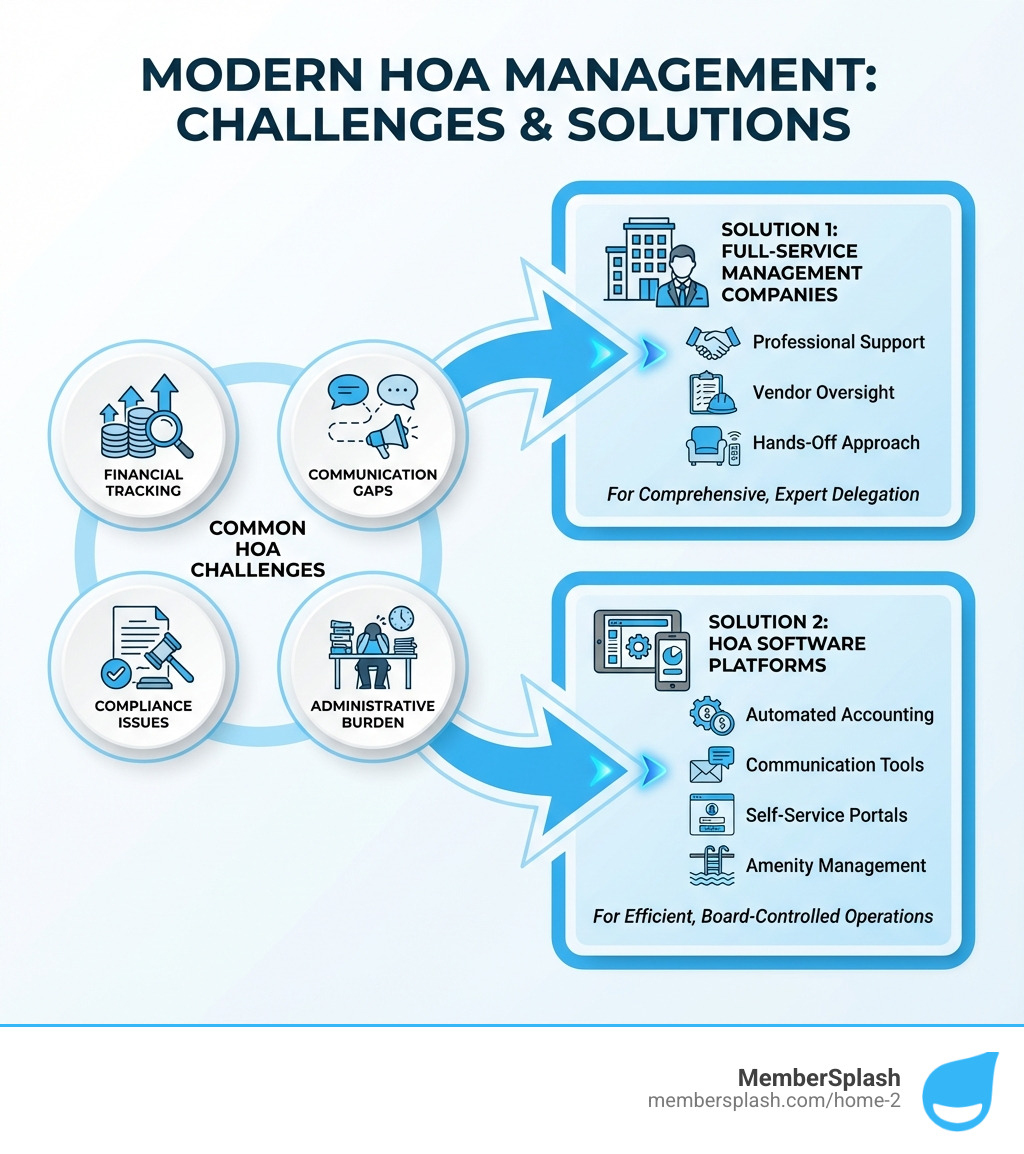
HOA management solutions come in two main forms: full-service management companies that handle operations for you, or software platforms that empower your board to manage the community more efficiently. Full-service options provide hands-off professional support but cost more, while software solutions offer greater control and cost savings but require board involvement.

Managing a homeowners association is hard work. Really hard. As many community managers will tell you, managing a community can feel like a difficult, thankless job.

If you’re a volunteer board member or manager, you know this reality all too well. You’re juggling accounting spreadsheets, chasing down late payments, fielding resident complaints, enforcing rules, and somehow trying to keep everyone happy. And you’re probably doing most of this in your spare time.

The stakes are high. Poor management doesn’t just create headaches. It can hurt property values and drive residents away. But effective management keeps your community thriving, your finances healthy, and your residents satisfied.

The good news: you don’t have to do it alone. Modern HOA management solutions can handle the grunt work, giving you back your time while improving your community’s operations. Whether you need a full-service partner to take everything off your plate or a powerful software platform to make your board more efficient, the right solution exists for your community.

The challenge is finding it.

infographic showing common HOA management challenges (financial tracking, communication gaps, compliance issues, administrative burden) with arrows pointing to two solution types: Full-Service Management Companies (professional support, vendor oversight, hands-off approach) and HOA Software Platforms (automated accounting, communication tools, self-service portals, amenity management) - HOA management solutions infographic

The Core Challenges of Modern HOA Management

We understand that running an HOA, whether you’re a dedicated board member or a professional manager, can often feel like an uphill battle. The sheer volume of tasks, coupled with the need to maintain community harmony and property values, presents a unique set of challenges. From the intricacies of financial management to the delicate art of resident communication and the steadfast enforcement of community rules, it’s a demanding role. Let’s dig into the primary problems we frequently encounter.

Financial Frustrations

Ask any HOA board, and they’ll likely tell you that financial management is one of their biggest headaches. The cycle of dues collection, budgeting, and reporting can quickly become overwhelming, especially for volunteer boards.

We often see communities struggling with:

  • Inaccurate Accounting: Manual spreadsheets or outdated systems lead to errors, obscuring the association’s financial health and undermining trust.
  • Chasing Payments: Manually invoicing, tracking, and reminding homeowners about late dues is a time-consuming struggle that can strain community relationships.
  • Lack of Transparency: Inaccessible or confusing financial records can make homeowners suspicious. Boards need to provide clear reports to foster trust.
  • Budget Variances: Without tools to compare financials against the budget, it’s hard to spot variances early, leading to unexpected shortfalls or overspending.
  • Manual Invoicing: Automating invoices for dues, fees, and fines saves immense time and eliminates a never-ending paper trail.

Modern HOA management solutions aim to simplify these processes, offering tools for online payment processing that can significantly reduce the burden. You can find more info about online payment processing services here.

Communication Breakdowns

Effective communication is the lifeblood of a thriving community, yet it’s often where HOAs struggle the most. Communication gaps can lead to frustrated residents, overwhelmed board members, and unresolved issues.

Common communication challenges include:

  • Disconnected Residents: Keeping every homeowner informed about community news, events, and important updates can be a logistical nightmare without a centralized system.
  • Board Member Burnout: Fielding endless emails, calls, and complaints from residents contributes significantly to board member fatigue.
  • Inefficient Messaging: Sending out mass communications manually is time-consuming and often lacks the immediacy needed for urgent announcements.
  • Dispute Resolution: Without clear channels for submitting and tracking requests or complaints, disputes can escalate and break down community spirit.
  • Lack of a Central Hub: Important documents, calendars, and contact information are often in disparate locations, making it hard for anyone to find what they need.

While personal interaction is invaluable, technology can vastly improve the efficiency and reach of communication, freeing up time for those vital face-to-face moments. Tools that offer bulk email capabilities are a game-changer. Find more info about bulk email communication services here.

Compliance and Operational Problems

Beyond finances and communication, the day-to-day operations and rule enforcement present their own set of challenges. HOAs are responsible for maintaining common areas, enforcing governing documents, and addressing resident requests, all while ensuring fairness and consistency.

Key operational and compliance issues we encounter include:

  • Enforcing Rules: Objectively enforcing community governing documents, rules, and regulations is crucial but can be a delicate task, requiring consistency and clear policies.
  • Tracking Violations: Identifying, documenting, and addressing violations efficiently is essential. Without a streamlined process, this can become inconsistent.
  • Managing Maintenance Requests: Maintenance requests need to be submitted, tracked, assigned, and resolved promptly, keeping homeowners informed throughout the process.
  • Architectural Reviews: Processing architectural modification requests involves multiple steps, approvals, and communication with homeowners.
  • Document Management: Storing and organizing all essential community documents—bylaws, CC&Rs, meeting minutes—in an accessible yet secure manner is vital for transparency.

As one source notes, a third-party manager can be the board’s best source for objective enforcement. However, whether managed internally or externally, robust systems are needed. These challenges highlight the need for HOA management solutions that can streamline operations and maximize efficiency. Learn more info about maximizing efficiency services here.

Comparing HOA Management Approaches: Full-Service vs. Software Solutions

When it comes to tackling the complexities of HOA management, communities generally have two main paths: engaging a full-service management company or implementing a dedicated HOA management software solution. Both offer distinct advantages and disadvantages, and the best choice ultimately depends on your community’s specific needs, budget, and the board’s desired level of involvement.

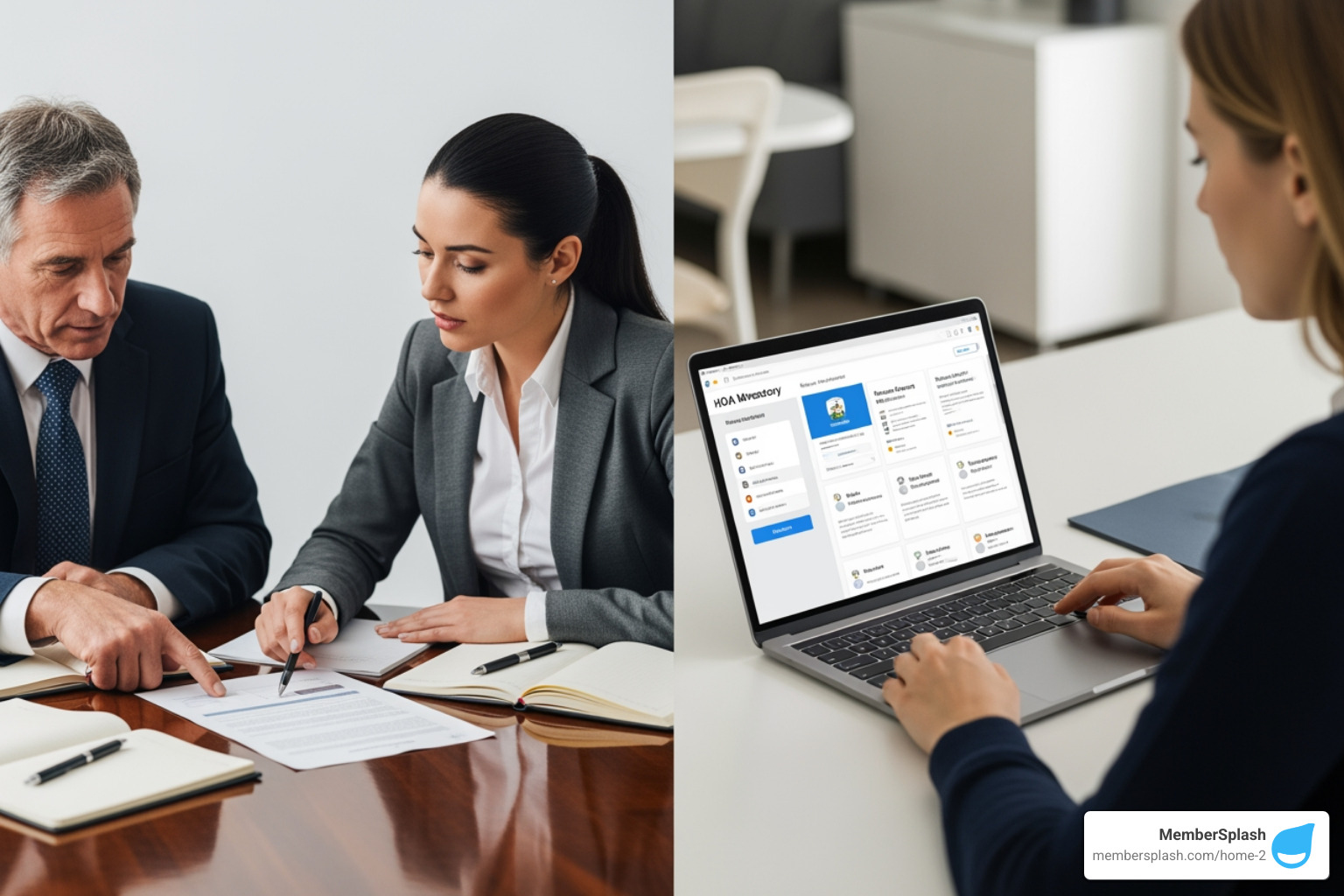
split screen showing a person working with a management partner vs a person using a laptop - HOA management solutions

Full-Service HOA Management Approach

A full-service HOA management company essentially takes the reins, handling most, if not all, of the day-to-day administrative, financial, and operational tasks on behalf of the board. These firms pride themselves on leadership and comprehensive support.

What it is: This approach means outsourcing your HOA’s management to a team of professionals. They act as the primary contact for homeowners, manage vendors, oversee finances, and ensure compliance with governing documents. For example, a company might handle all bookkeeping, including accounts, reporting, and banking, with precision and compliance. They might also serve as the primary contact person with contractors, routinely visiting the property to oversee maintenance.

Pros:

  • Hands-off Approach: Ideal for volunteer boards with limited time, as it significantly reduces the administrative burden.
  • Expert Guidance: Professional managers offer experience in legal compliance, vendor management, and crafting effective rules.
  • Vendor Management: They typically handle the negotiation and oversight of service providers, ensuring quality work at competitive prices.
  • Objective Enforcement: A third-party manager can provide objective enforcement of community rules, which can be difficult for volunteer board members who are also neighbors.

Cons:

  • Higher Investment: This option comes at a significant cost that may not be feasible for smaller communities.
  • Less Direct Control: The board relinquishes some daily operational control to the management company.
  • May Not Be Fully Custom: Their services might be standardized, potentially lacking the specific customization some unique communities desire.

If you’re considering this path, exploring how professional support can benefit your community is a great first step. You can learn more about HOA management support here.

HOA Management Software Solutions

The alternative is to empower your board and community with a dedicated software platform. This approach puts the tools and control directly into the hands of your association, enabling efficient self-management.

What they are: These are integrated digital platforms designed to streamline various aspects of HOA operations, from accounting and communication to amenity management and compliance. Many are “all-in-one” solutions designed to manage your community 100% online, often earning high ratings on software review platforms for their comprehensive features.

Pros:

  • Cost-Effective: Software subscriptions are typically more affordable than full-service management, especially for communities with engaged volunteer boards.
  • Greater Control: The board retains full control over all decisions and operations, with the software acting as an enabling tool.
  • Empowers Volunteers: It equips volunteer board members with professional-grade tools, making their tasks easier and more efficient. Features like automated invoicing and request workflows can save hours every week.
  • Customizable: Many platforms offer flexibility to tailor features and settings to your community’s unique needs.
  • Transparency: Centralized digital records and reporting features increase financial transparency for both the board and homeowners.

Cons:

  • Requires Board Involvement: While the software automates many tasks, the board still needs to actively manage the platform and make decisions.
  • Learning Curve: There might be an initial adjustment period as board members and homeowners learn the new system. However, many solutions offer hands-on onboarding and support to ease this transition.

For communities looking to leverage technology for more efficient self-management, exploring HOA property management software is a smart move. Find more info about HOA property management software here.

Must-Have Features in an HOA Management Solution

Choosing the right HOA management solution means looking beyond the basic offerings and identifying features that genuinely solve your community’s pain points. Whether you opt for a full-service provider or a software platform, certain capabilities are non-negotiable for efficient, transparent, and harmonious community living.

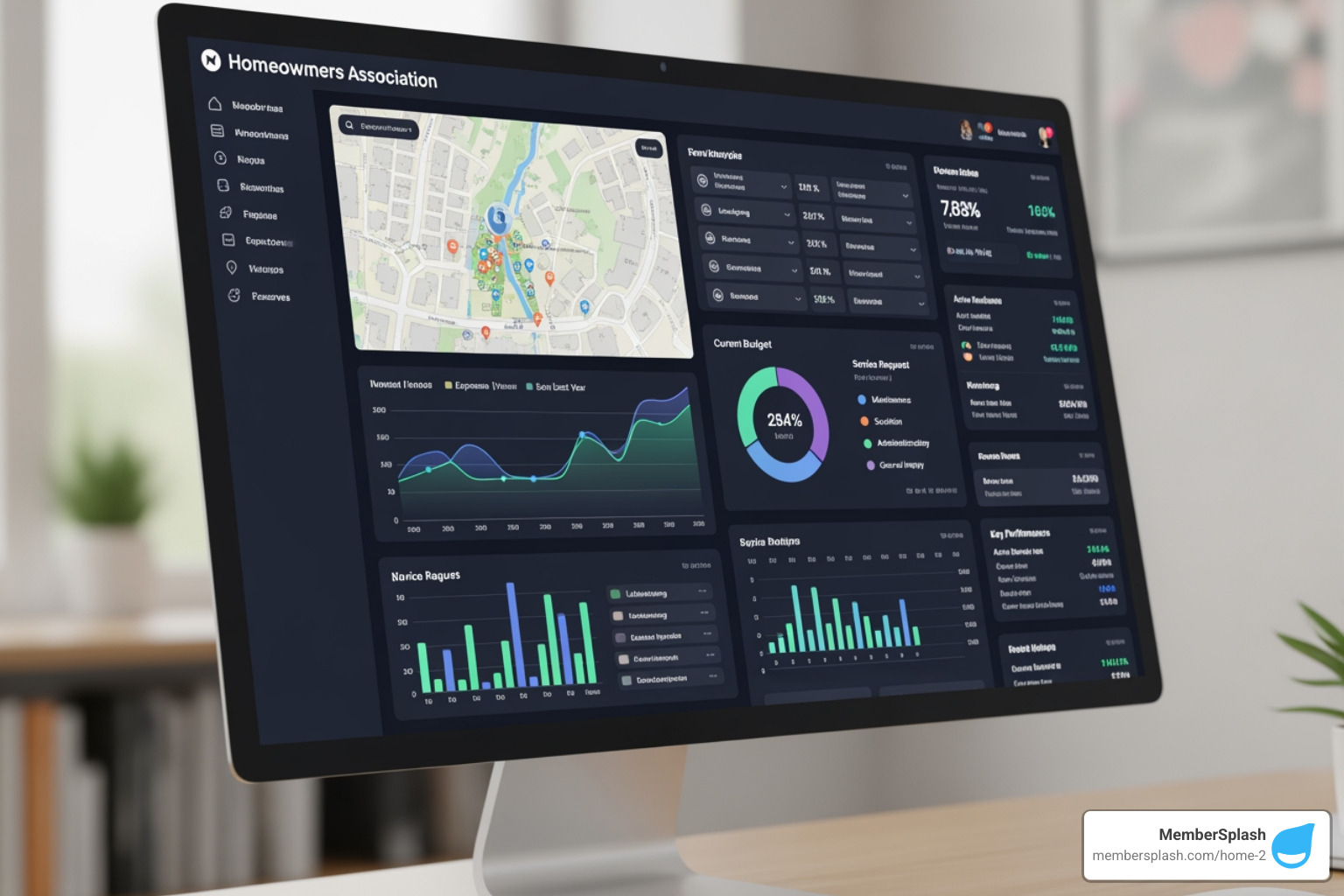
software dashboard showcasing multiple features - HOA management solutions

Streamlined Financial & Accounting Tools

At the heart of any well-run HOA is robust financial management. We can’t stress enough how crucial comprehensive accounting tools are for the health and stability of your community.

Look for solutions that offer:

  • Online Payments: Offering online payments and autopay for dues and fees improves cash flow and reduces collection efforts. Look for solutions that integrate securely with FDIC-insured banks, allowing direct deposits.
  • Automated Invoicing: Automatically generate and log invoices for all charges, saving countless hours and ensuring seamless ledger entries.
  • Dues Tracking: A system that clearly tracks who has paid what, and when, eliminating guesswork and simplifying follow-up for outstanding balances.
  • Financial Reporting: Real-time, accurate accounting that supports both cash and accrual reporting is essential. Solutions should generate audit-ready monthly financial statements and bank reconciliations.
  • Budgeting Tools: Features that assist in preparing annual budgets and monitoring expenditures against those budgets.
  • Vendor Payments: Automated accounts payable and smart bill entry ensure community services go uninterrupted by facilitating timely vendor payments.

Having a robust member account database is the foundation for these financial tools. Get more info about member account database services here.

Centralized Communication Hub

A connected community is a happy community. The right HOA management solution acts as the central nervous system for all communication, ensuring everyone is on the same page.

Essential communication features include:

  • Mass Emails & Texts: Send broadcast messages via text, email, or phone for timely announcements, reminders, and emergencies.
  • Resident Portal: A secure online portal where homeowners can access their accounts, view community documents, submit requests, and stay updated on community news.
  • Community Calendar: An interactive calendar for events, meetings, and amenity reservations keeps everyone informed and engaged.
  • Document Storage: A secure, centralized digital repository for all important documents—bylaws, CC&Rs, meeting minutes, policies—ensures easy access for authorized users.
  • Request Tracking: Homeowners should be able to submit maintenance requests, architectural review applications, or general inquiries online, with built-in workflows to track status.

A well-organized events calendar can transform how your community communicates and engages. Explore more info about events calendar services here.

Efficient Operations & Amenity Management

Beyond financials and communication, the daily operational aspects of an HOA, particularly those related to shared amenities, demand efficient management.

Key operational features to look for:

  • Violation Tracking: Mobile tools for tracking violations, documenting them with photos, and generating violation letters streamline compliance efforts.
  • Architectural Reviews: Online architectural review processes with in-app messaging simplify what can often be a complex approval process.
  • Work Order Management: A system to manage maintenance requests, from submission to completion, ensuring timely resolution and keeping all parties informed.
  • Amenity Reservations: For communities with pools, clubhouses, or other shared facilities, an amenity reservation system is crucial for managing capacity and enforcing rules.
  • Guest Tracking: Especially for amenities like pools, a system to track guests and manage guest passes can be vital for security and can even generate revenue from guest fees.

Effective reservation systems can dramatically improve the management of your community’s most valued assets. Find more info about reservation system services here.

The Long-Term Payoff: How the Right Solution Boosts Community Value

Implementing the right HOA management solution is a strategic investment that yields significant long-term benefits for the entire community. From bolstering financial health to fostering a vibrant living environment, the ripple effects are profound.

Achieving Financial Health and Transparency

A robust management solution is the cornerstone of an HOA’s financial stability. Transparency builds trust, and efficiency safeguards assets.

Here’s how the right solution contributes:

  • Real-time Reporting: Instant access to financial data means boards can make informed decisions quickly, eliminating the lag time of manual processes.
  • Audit-Ready Financials: Solutions that automatically log transactions and generate comprehensive reports make annual audits a breeze, demonstrating sound financial governance.
  • Improved Budget Adherence: By allowing easy comparison of financial statements against the annual budget, boards can identify variances early, preventing overruns and maintaining financial discipline.
  • Increased Revenue Capture: Automated dues collection, online payments, and efficient tracking of fees can significantly improve an HOA’s revenue. Some communities have seen guest revenues more than double due to better tracking, proving that smart management pays for itself.

The ability to generate custom reports further improves this transparency. Check out more info about custom reports services here.

The Role of Technology and Automation in Modern HOA Management Solutions

Technology is a necessity for efficient HOA operations. Automation and AI are changing the landscape of community management.

  • AI-powered Insights: Emerging AI can do the “grunt work,” analyzing data to identify trends or predict maintenance needs, freeing up human resources for strategic tasks.
  • Automated Workflows: The power of automation to save hours every week is undeniable. This includes automated invoicing, payment reminders, and routing of maintenance requests, which reduces manual errors and ensures consistency.
  • Mobile Access: Mobile apps empower board members, managers, and homeowners to access information and perform tasks on the go, even with offline access in areas with poor connectivity.
  • Data Security: Leading HOA management solutions employ bank-level encryption and adhere to industry-standard compliance to ensure data stays safe, private, and accessible.

By embracing these technological advancements, HOAs can maximize efficiency and achieve significant savings. Find more info about maximizing efficiency services here.

Boosting Resident Satisfaction and Property Values

The goal of effective HOA management is to create a desirable place to live. The right solution contributes directly to resident satisfaction and, consequently, to property values.

  • Better Communication: When residents feel informed and heard, their satisfaction soars. Centralized communication hubs reduce misunderstandings and foster a stronger sense of community.
  • Faster Issue Resolution: Streamlined request tracking and work order management mean maintenance issues are addressed promptly, leading to well-maintained common areas.
  • Well-Maintained Amenities: Efficient amenity management, including reservation systems, ensures that shared facilities are accessible, well-managed, and enjoyable for everyone.
  • Stronger Community Engagement: Easy-to-use platforms encourage resident participation in events and discussions, fostering a vibrant and cohesive community.
  • Increased Desirability: A well-managed, financially transparent, and engaged community is more attractive to potential buyers, boosting community pride and property values.

How to Choose the Best Solution for Your Community

The journey to finding your HOA’s hero—the perfect management solution—can feel daunting, but a structured approach can help you identify a partner that truly meets your community’s needs.

Step 1: Assess Your Community’s Unique Needs

Before looking at options, take an honest look at your community’s specific characteristics and challenges.

  • Community Size: Are you a small community or a larger association? Some solutions are designed for smaller HOAs, while others are built to grow with your community.
  • Amenities: Do you have a pool, clubhouse, or other facilities that require booking, access control, or guest management? This will influence the features you need.
  • Existing Challenges: What are your biggest pain points right now? Is it financial transparency, communication, or violation enforcement? Prioritize these to guide your search.
  • Board’s Technical Skill: How comfortable is your volunteer board with technology? Some solutions are incredibly intuitive, while others might have a steeper learning curve.
  • Volunteer Time Commitment: How much time can your board realistically dedicate to management? This will help determine if a software-only approach is viable.

Step 2: Understanding Pricing Models for HOA Management Solutions

Cost is always a significant factor. HOA management solutions come with various pricing structures, and understanding them is key to avoiding surprises.

  • Per-Unit Pricing: Many software solutions charge a monthly or annual fee per household, which scales with your community size.
  • Tiered Subscriptions: Some platforms offer different plans (e.g., Basic, Premium) with varying features and support levels at different price points.
  • Flat Fees: Full-service management companies might offer flat monthly fees or charge based on the scope of services.
  • Hidden Costs: Always ask about potential extra fees for payment processing, data migration, or advanced support. Look for solutions that are transparent about all costs.

Many providers offer discounts for annual plans. Importantly, look for solutions that offer flexibility, with no long-term contracts or cancellation fees, so you’re not locked in if it’s not the right fit. For a detailed breakdown, check out more info about pricing comparison services here.

Step 3: Evaluate and Select Your Partner

Once you have a clear understanding of your needs and budget, it’s time to evaluate potential solutions.

  • Request Demos: Don’t just read about features; see them in action. Request personalized demos to understand how the solution would work for your community.
  • Check Reviews: Look at independent review platforms for ratings and testimonials. Pay attention to feedback on ease of use, customer support, and overall satisfaction.
  • Ask About Support: What kind of support is offered? Is it chat, email, or phone? High-quality support can make all the difference during implementation and ongoing use.
  • Onboarding Process: How easy is it to switch from your current system? A dedicated onboarding specialist who handles data migration, setup, and training can make the transition seamless. Some companies can get organizations fully up and running in just a few days.

A supported implementation process is vital for a smooth transition and long-term success. Find more info about supported implementation services here.

Conclusion: Empower Your Board and Lift Your Community

We’ve explored the myriad challenges facing HOA boards and managers today—from the relentless pursuit of financial transparency to the delicate dance of resident communication and the systematic enforcement of community standards. We’ve also seen how modern HOA management solutions, whether in the form of full-service partnerships or powerful software platforms, offer a guide of hope, promising to transform these burdens into manageable tasks.

By embracing the right solution, your community can open up a wealth of benefits: achieving financial health and unwavering transparency, leveraging technology and automation to reclaim countless hours, and ultimately boosting resident satisfaction that translates into higher property values and a more desirable place to call home. Empowering your volunteer board members with intuitive tools means they can focus on the bigger picture, fostering community spirit rather than getting bogged down in administrative minutiae.

The future of HOA management is smart, connected, and efficient. It’s about giving your community the tools it needs to thrive. For a solution that champions these values, we invite you to explore how MemberSplash can be your HOA’s hero, providing the customizable platform and dedicated support to streamline your operations and lift your community experience.

To learn more about how we can help your community, get more info about HOA property management services here.

Beyond the Swipe: Ensuring Secure Payments for Your Business

Why Your Business Can’t Afford to Ignore Payment Security

Secure payment processing is the technology, infrastructure, and policies that protect sensitive financial data during transactions—keeping customer information confidential, preventing unauthorized access, and ensuring safe processing from checkout through data storage.

To ensure secure payments for your business, you need:

  1. Encryption – Scrambles sensitive data during transmission (via TLS/HTTPS)
  2. Tokenization – Replaces card numbers with worthless tokens
  3. Multi-Factor Authentication (MFA) – Verifies user identity with multiple factors
  4. PCI DSS Compliance – Meets global security standards for handling card data
  5. Fraud Detection Systems – Monitors transactions using AI and machine learning
  6. Secure Payment Gateways – Acts as a protected bridge between customers and banks

Here’s the reality: 79% of organizations were targeted by payment fraud in 2024. And when those attacks succeed, the average data breach costs a staggering $4.4 million.

For membership-based businesses like clubs, HOAs, and pool management companies, the stakes are even higher. You’re not just processing one-off transactions—you’re managing recurring payments, storing member information, and maintaining long-term relationships built on trust.

When a customer swipes their card or enters their payment details online, they’re trusting you with their most sensitive financial information. One security breach doesn’t just cost money in immediate losses and penalties. It damages your reputation, erodes member confidence, and can take years to recover from.

The good news? You don’t need to be a cybersecurity expert to protect your business and your members. Modern secure payment processing combines multiple layers of protection—from encryption and tokenization to fraud detection and compliance standards—that work together automatically.

This guide breaks down everything you need to know about secure payment processing in plain language. We’ll explain how each security component works, what to look for in a payment provider, and how to implement best practices that protect both your business and your members.

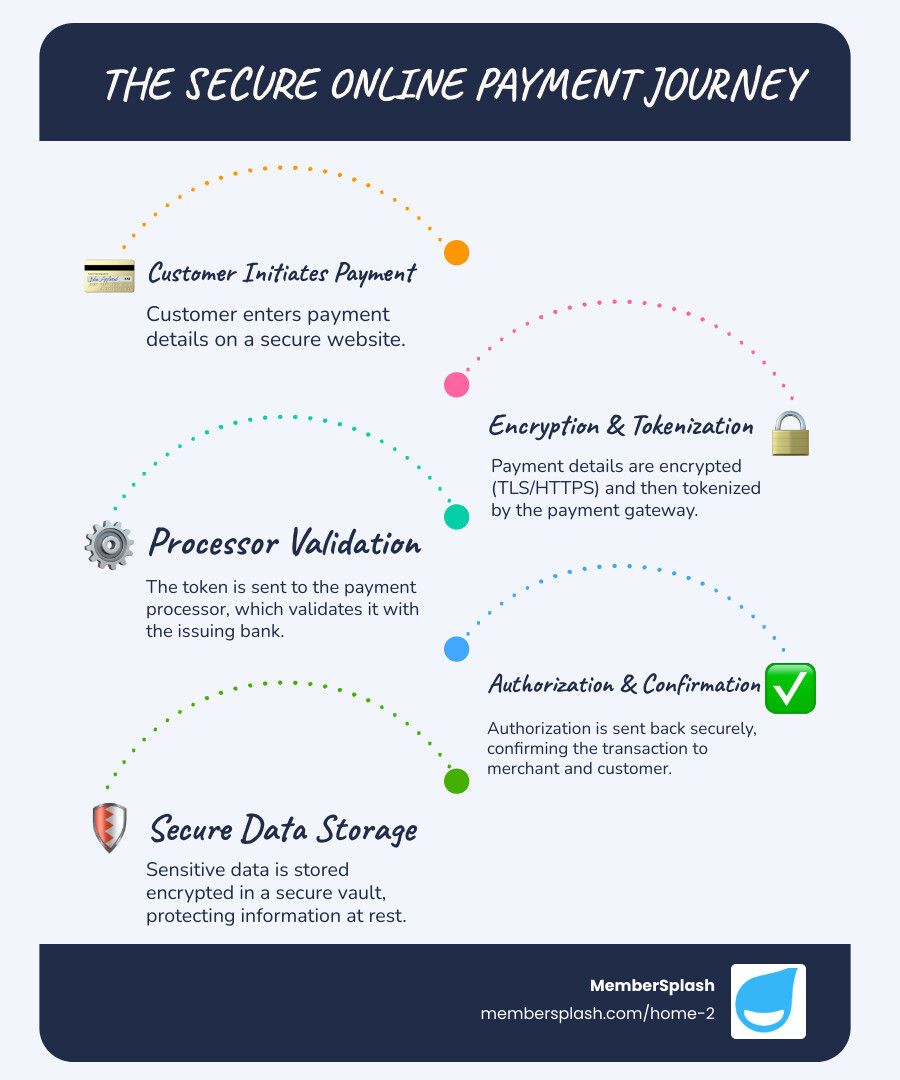
Infographic showing the flow of a secure online payment: Customer enters payment details on website → Data encrypted via TLS/HTTPS → Payment gateway tokenizes card number → Token sent to payment processor → Processor validates with issuing bank → Authorization sent back through secure channels → Confirmation to merchant and customer → Sensitive data stored encrypted in secure vault - secure payment processing infographic infographic-line-5-steps-blues-accent_colors

The Core Components of a Secure Payment System

Secure payment processing is a multi-layered defense system designed to protect financial data. Each component adds a layer of protection, ensuring information is safe whether it’s moving across the internet (in transit) or stored in a database (at rest). These foundational technologies are the backbone of modern payment security.

Illustrating the layers of payment security - secure payment processing

Encryption: Your Digital Armor

Encryption transforms readable data (“plain text”) into a scrambled, unreadable format (“ciphertext”) that can only be deciphered with a specific key. This is the foundation of digital security.

In payment processing, this is most visible with TLS (Transport Layer Security). When you see “HTTPS” in a website’s address bar, it means TLS is encrypting the connection between a customer’s browser and your server. This creates a secure tunnel that protects payment details from eavesdroppers during online transactions, ensuring confidentiality. To learn more about how we implement secure connections, you can find More info about our supported implementation.

Tokenization: Minimizing Your Data Risk

Tokenization replaces sensitive data, like a credit card number, with a unique, non-sensitive identifier called a “token.” This token is useless to fraudsters and cannot be reversed to reveal the original card details. When a customer pays, their information goes to a secure vault, and the merchant only ever handles the token. This drastically reduces risk and the scope of PCI DSS compliance. The benefits are significant: network tokenization has led to a 31% average decrease in fraud and an estimated $650 Million in fraud savings industry-wide since its introduction, with over 10 Billion+ Visa network tokens issued.

Payment Gateways: The Secure Transaction Bridge

A payment gateway is the secure digital bridge connecting your business to financial networks—the online version of a physical POS terminal. When a customer makes a purchase, the gateway securely captures and encrypts their payment information, transmits it to the payment processor, and relays the bank’s authorization or decline message back to your website. By acting as a protected intermediary, a payment gateway prevents sensitive card data from ever touching your servers, which offloads a significant security burden and helps maintain PCI compliance. For more details on how this works, we have More info about online payment processing.

Authentication and Modern Payment Methods

Beyond securing the data itself, another critical aspect of secure payment processing is verifying who is actually making the transaction. This is where authentication comes in, ensuring that only authorized individuals can initiate payments. Modern payment methods have evolved to integrate sophisticated authentication mechanisms, often balancing improved security with customer convenience.

The Crucial Role of Multi-Factor Authentication (MFA)

Passwords alone are no longer sufficient. Multi-factor authentication (MFA) is now crucial for secure payment processing, adding layers of security by requiring two or more verification methods to approve a transaction. This prevents unauthorized access even if a password is stolen.

MFA combines factors from different categories:

  • Knowledge: Something the user knows (e.g., a password or PIN).
  • Possession: Something the user has (e.g., a phone for a one-time code).
  • Inherence: Something the user is (e.g., a fingerprint or facial scan).

For membership businesses, MFA is vital for securing both payments and member accounts. For instance, our platform’s check-in photo verification feature adds a similar layer of authentication for physical access, reflecting the multi-layered security of digital MFA.

How Digital Wallets Improve Payment Security

Digital wallets like Apple Pay, Google Pay, Skrill, and Venmo significantly improve payment security. Users store their payment information in an encrypted environment on their device, enhancing safety in several ways:

  • Tokenization: Digital wallets replace your actual card number with a unique token for each transaction. The merchant never sees your real card details, making breaches far less damaging.
  • Biometric Authentication: Payments typically require a fingerprint, facial scan, or PIN, so a stolen phone doesn’t automatically mean stolen funds.

Accepting digital wallets offers customers a convenient checkout while leveraging the powerful, built-in security of these platforms to protect both your business and your customers.

EMV Chip Cards: Outsmarting Skimmers

The old magnetic stripe cards were easy targets for data theft. EMV chip cards—the global standard developed by Europay, MasterCard, and Visa—revolutionized in-person payment security.

Each EMV card has a microprocessor chip that creates a unique, one-time-use transaction code for every purchase. This dynamic data makes it nearly impossible to create counterfeit cards or reuse stolen transaction information, unlike the static data on a magnetic stripe. When a customer “dips” their card, the chip and terminal interact to authenticate the transaction securely.

By using EMV-compliant terminals, businesses in Annapolis and Baltimore help reduce card-present fraud, protecting their customers and their bottom line.

Proactive Defense: Fraud Detection and Compliance in secure payment processing

In the evolving landscape of digital transactions, waiting for fraud to happen is simply not an option. Secure payment processing demands a proactive stance, utilizing advanced technologies to detect and prevent fraudulent activities before they cause financial losses. This involves continuous monitoring and adherence to stringent industry standards.

Dashboard showing fraud detection alerts - secure payment processing

How Advanced Fraud Detection Systems Work

Advanced fraud detection systems (FDS) act as digital detectives, using algorithms and machine learning to spot and prevent fraud in real-time.

Here’s how they work:

  • Data & Pattern Analysis: FDS analyze transaction data (amount, location, time, device) to recognize normal patterns and flag deviations as suspicious.
  • Machine Learning: Modern FDS, like Stripe Radar, use AI trained on global data to identify and adapt to new fraud techniques.
  • Risk Scoring: Every transaction gets a risk score. High-risk transactions can be automatically blocked or flagged for manual review.

These systems provide a critical, adaptive defense that prevents financial loss and maintains the integrity of your secure payment processing.

What is PCI DSS Compliance and Why It Matters

The Payment Card Industry Data Security Standard (PCI DSS) is a mandatory global standard for any entity that handles cardholder data. Created by major credit card brands, it establishes a baseline for protecting consumer data and reducing fraud. You can learn more at the official Payment Card Industry Data Security Standard website.

For businesses in Annapolis or Baltimore, PCI DSS compliance is critical:

  • Protects Customers: It ensures secure data handling, which builds trust.
  • Avoids Penalties: Non-compliance can result in large fines and even the inability to accept card payments.
  • Reduces Breach Risk: Following its requirements significantly lowers your vulnerability to data breaches.
  • Improves Reputation: It demonstrates a serious commitment to data security.

Businesses maintain compliance through regular assessments, such as Self-Assessment Questionnaires (SAQs), proving their dedication to ongoing security.

The Role of Bank-Specific Security Systems

Beyond payment processors, banks add their own security layers to secure payment processing. These proprietary systems work alongside industry standards to bolster transaction safety.

Key contributions include:

  • Custom Authentication: Banks may use unique verification methods beyond standard MFA for their apps or high-value transactions.
  • Advanced Monitoring: Banks use their own deep-dive analytics to spot suspicious activity specific to an account holder’s history.
  • 3D Secure: Protocols like “Verified by Visa” or “Mastercard SecureCode” add an authentication step during online checkout, redirecting the user to their bank to enter a password or code. This directly verifies the cardholder and reduces merchant liability for fraudulent chargebacks.

These bank-level systems provide a vital, additional layer of defense in the payment security ecosystem.

A Practical Guide to Payment Security for Your Business

Now that we’ve explored the intricate layers of secure payment processing, let’s turn our attention to what you, as a business owner, can do to ensure your operations are as secure as possible. It’s about making informed choices, partnering wisely, and implementing best practices consistently.

Key Features to Look for in a Secure Payment Processing Provider

Choosing a payment provider is a critical security decision. Look beyond rates for these key features:

  • End-to-End Encryption: Data should be encrypted from entry to destination.
  • Tokenization Support: This prevents raw card numbers from being stored on your systems, reducing risk and PCI scope.
  • PCI DSS Level 1 Compliance: The highest level of compliance, indicating rigorous security audits. Partnering with a Level 1 provider offloads much of your PCI burden.
  • Advanced Fraud Tools: Look for proactive fraud detection with machine learning.
  • Multi-Factor Authentication (MFA): Essential for securing access to your merchant account.
  • High Uptime and Reliability: A secure system must also be a dependable one.
  • Regular Security Updates: The provider must consistently patch against new threats.
  • Transparent Security Policies: They should be open about how they protect your data.

A secure partner will offer these features and guide you on your own security responsibilities.

Best Practices for Implementing secure payment processing

Beyond your provider, your business plays an active role in secure payment processing. Implement these best practices for a strong defense:

  1. Conduct Regular Risk Assessments: Regularly review your payment infrastructure to identify and prioritize weak points.
  2. Develop Clear Security Policies: Create written guidelines for data handling, access controls, and incident response so your team knows the rules.
  3. Train Employees Thoroughly: Your team is your first line of defense. Train them on security best practices, phishing awareness, and proper data handling.
  4. Use Secure Integrations: Use hosted payment pages or tokenization APIs to minimize your exposure to sensitive data and reduce your PCI burden.
  5. Regularly Update Systems: Keep all software, plugins, and firewalls updated with the latest security patches.
  6. Monitor for Threats: Continuously monitor your networks and transactions for unusual activity or unauthorized access.
  7. Have an Incident Response Plan: Be prepared for a potential breach with a clear plan to minimize damage and recovery time.

For membership organizations, ensuring your reservation system is integrated with secure payment methods is another crucial step.

Choosing the Most Secure Payment Method for Your Needs

Understanding the security of different payment methods helps you protect your business. Here’s a quick comparison:

  • Digital Wallets (e.g., Apple Pay, Google Pay, Skrill, Venmo): Highly secure, using tokenization and biometrics. The actual card number is never exposed to the merchant.
  • EMV Chip Cards (in-person): Very secure for physical transactions due to dynamic, one-time transaction codes that prevent counterfeiting.
  • Credit/Debit Cards (online): Secure when processed through a reputable gateway using encryption and tokenization. Security depends on the merchant and gateway.
  • Bank Transfers: Security relies on the bank’s systems and user vigilance against scams. Usually involves strong bank-level authentication.
  • Paper Checks: The least secure method. Checks contain sensitive account information and are vulnerable to theft and fraud. In 2023, 65% of organizations experienced check fraud attacks.

Prioritize methods with tokenization and strong authentication for online payments, use EMV-compliant terminals for in-person transactions, and avoid paper checks whenever possible.

Frequently Asked Questions about Secure Payment Processing

What is the difference between a payment gateway and a payment processor?

A payment gateway and a payment processor have distinct roles in secure payment processing.

  • Payment Gateway: This is the technology that securely captures and encrypts customer payment data for a transaction. It acts as a secure tunnel, sending the information to the processor and relaying the authorization response back to the merchant.
  • Payment Processor: This is the company that facilitates the actual transaction, communicating between the merchant’s bank and the customer’s bank to manage the transfer of funds.

In short, the gateway secures the data transmission, while the processor handles the money movement.

Are mobile payments more secure than physical card payments?

Yes, mobile payments (via digital wallets like Apple Pay or Google Pay) are generally considered more secure than physical cards, including EMV chip cards.

Here’s why:

  • Tokenization: Mobile payments use a unique token instead of your actual card number, protecting your real data from the merchant.
  • Biometric/PIN Authentication: Each transaction requires user verification like a fingerprint or PIN, adding a strong security layer.
  • No Physical Exposure: The physical card is never shown or handed over, eliminating risks of skimming or visual theft.

While EMV cards are secure against counterfeiting, mobile payments add digital security layers that physical cards lack.

How can a small business afford to implement strong payment security?

Strong secure payment processing is affordable for small businesses in Annapolis or Baltimore. Here’s how:

  • Partner with a Secure Provider: The best approach is to choose a payment platform that has security built-in. A good provider includes encryption, tokenization, fraud detection, and helps with PCI DSS compliance, offloading much of the security burden and cost from you.
  • Use Built-in Tools: Modern POS and e-commerce platforms often have integrated security features. Use them.
  • Implement Best Practices: Free measures like strong passwords, regular software updates, and employee training are highly effective.
  • Reduce PCI Scope: Using tools like hosted payment pages from your provider can simplify compliance and lower costs.

Platforms like MemberSplash are designed for membership organizations to handle payments securely. We integrate secure payment processing directly, giving you enterprise-level security without the need for an in-house team.

Conclusion: Making Security Your Competitive Advantage

In an age where data breaches are common and payment fraud is a constant threat, secure payment processing is no longer just a technical requirement—it’s a fundamental pillar of trust and a competitive advantage. The statistics are stark: with 79% of organizations targeted by payment fraud in 2024 and the average data breach costing $4.4 million, businesses simply cannot afford to overlook this critical area.

We’ve explored the multi-layered defense that constitutes modern payment security, from the digital armor of encryption and the data-minimizing power of tokenization, to the crucial role of multi-factor authentication and the vigilance of fraud detection systems. We’ve also highlighted the non-negotiable importance of PCI DSS compliance and the added security provided by bank-specific systems.

For businesses like yours, particularly membership organizations in Annapolis and Baltimore, building and maintaining customer trust is paramount. By embracing a proactive approach to secure payment processing—choosing reputable providers, implementing best practices, and continuously monitoring for threats—you not only protect your financial bottom line and reputation but also reinforce the confidence your members place in you.

At MemberSplash, we understand that for membership organizations like yours, secure payment processing isn’t just a feature—it’s a foundation of trust. Our platform integrates robust security measures, from encrypted transactions to simplified PCI compliance, ensuring your members’ data and your revenue are always protected. It’s about empowering you to manage your community efficiently and securely, giving you peace of mind.

Contact us today to learn how MemberSplash can secure your payments and turn security into your ultimate competitive advantage.

From Communication to Portals: Your Guide to HOA Software

Why HOA Community Software Matters for Your Association

HOA community software is an all-in-one management platform that helps homeowners associations automate administrative tasks, manage finances, facilitate communication, and improve resident engagement. These systems eliminate manual paperwork and save managers significant time—in some cases, over 15 hours per week.

Top HOA community software solutions provide a range of powerful tools designed for different community needs. Key features often include robust accounting and payment processing, unlimited messaging capabilities, resident portals for self-service, and scalable pricing models that can accommodate both small and large associations.

If you’re a board member or HOA manager drowning in spreadsheets, email chains, and manual payment tracking, you’re not alone. One HOA manager described their experience: “I know one woman who runs her entire 1,500-member homeowner association by herself as a part-time staff member. That’s because she leaves most of the work up to her Homeowner Association Software—it essentially runs the organization for her.”

The challenges are real: collecting dues, processing maintenance requests, tracking violations, scheduling amenity reservations, and keeping residents informed all consume valuable time. Most HOA managers agree that the biggest issue with their association is the significant amount of time it requires.

That’s where specialized software comes in. The HOA software market is projected to grow to $1.5 billion by 2027, driven by associations finding they can automate nearly all administrative work. Modern platforms centralize everything—from accounting and online payments to communication tools and member portals—into one system that actually saves you time and money.

The goal isn’t just efficiency. It’s about creating a thriving community where residents feel connected, finances are transparent, and you’re not buried under paperwork. Whether you manage a small self-governed neighborhood or oversee multiple large communities, the right software transforms how your HOA operates.

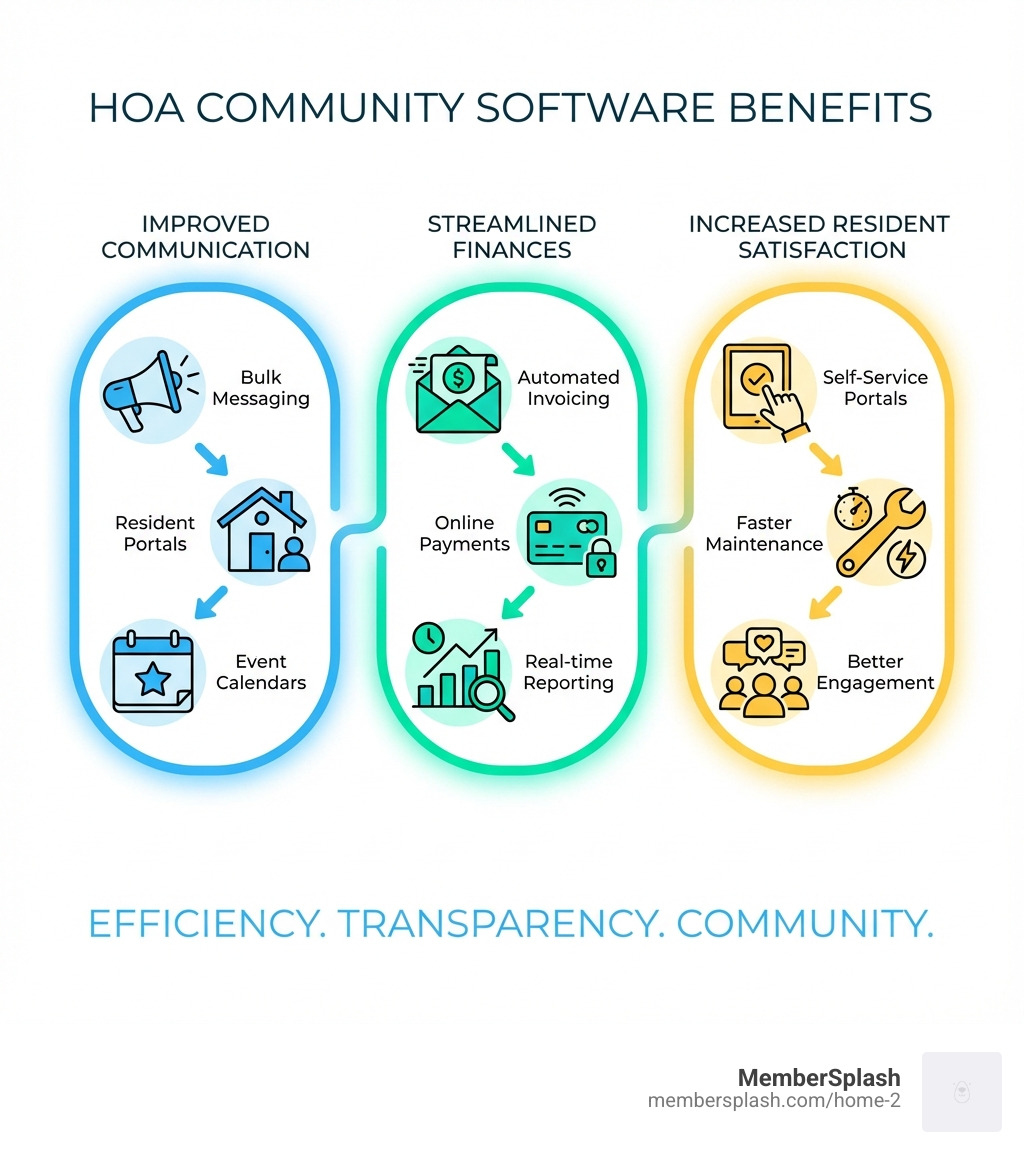
Infographic showing the three main benefits of HOA community software: 1) Improved Communication through bulk messaging, resident portals, and event calendars, 2) Streamlined Finances via automated invoicing, online payments, and real-time reporting, and 3) Increased Resident Satisfaction through self-service portals, faster maintenance responses, and better community engagement - HOA community software infographic

Core Features to Look for in HOA Community Software

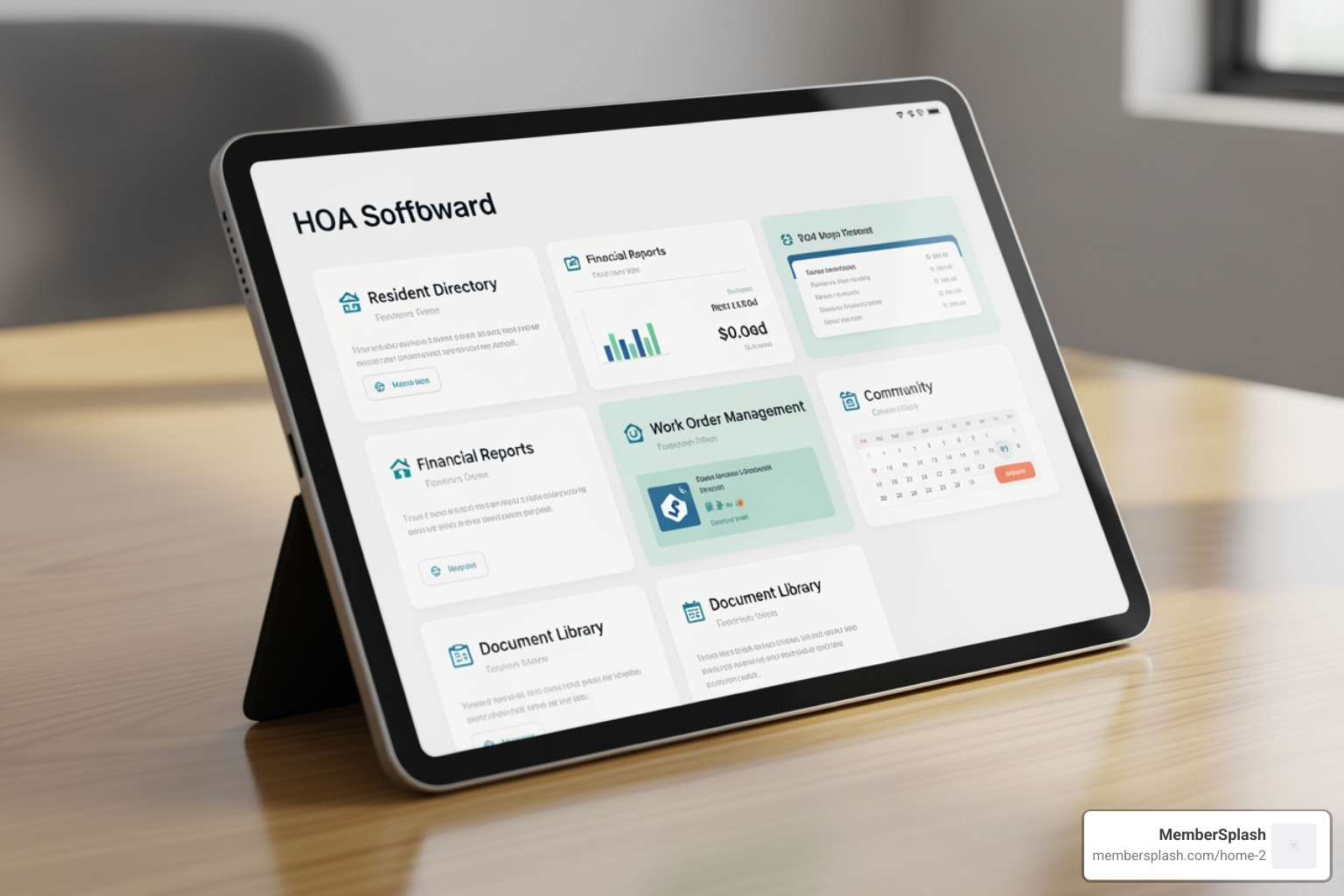
A clean, modern HOA software dashboard displayed on a tablet, showcasing various management modules. - HOA community software

When we talk about HOA community software, we’re discussing comprehensive, all-in-one platforms designed to bring every facet of your association’s operations into one central hub. The aim is not just to digitize processes but to genuinely improve efficiency and improve the member experience. Imagine a single system that handles everything from collecting dues to coordinating community events – that’s the power we’re looking for.

Financial Management and Online Payments

One of the most time-consuming aspects of HOA management is undoubtedly financial oversight. This is where robust accounting tools within HOA community software become invaluable. We need software that can manage accounts, automate invoicing for dues, fees, and fines (including late fees), and handle online payment processing. Homeowners will love the convenience of paying online and setting up autopay, which also significantly improves collection rates for the HOA.

Our ideal software will offer real-time, accurate accounting specifically custom for community associations, supporting both cash and accrual reporting. It should provide powerful reporting tools to give board members the visibility they need into the financial health of the association. Look for features like bank integrations, automated accounts payable, smart bill entry, customized reports, corporate accounting, multiple fund accounting, and vendor eCheck capabilities. These tools streamline financial management, making budgeting and financial transparency a breeze. More info about online payment processing can be found by exploring solutions that simplify these critical tasks.

Centralized Member Portal and Database

A cornerstone of effective HOA community software is a centralized member portal and database. This isn’t just a digital rolodex; it’s a dynamic hub for resident self-service and communication. A comprehensive member database allows us to easily search, filter, and update contact information, ensuring we always have accurate records.

The member portal empowers residents by giving them secure access to their accounts. Here, they can update their contact information, view their payment history, access important documents like bylaws and community rules, and even participate in opinion polling. This self-service capability reduces administrative inquiries and provides a convenient, 24/7 resource for residents. It also acts as a critical communication hub, fostering a more connected and informed community. More info about member account database reveals how these systems centralize and secure member information.

Communication and Engagement Tools

Effective communication is the lifeblood of any thriving community. HOA community software provides a suite of tools that make keeping residents informed and engaged easier than ever. We’re talking about more than just email; modern systems offer bulk email and text messaging capabilities, ensuring important announcements reach everyone quickly. Imagine sending out an urgent community alert or a friendly reminder about an upcoming event with just a few clicks. More info about bulk email communication highlights how these features simplify outreach.

Beyond one-way communication, look for features that foster engagement, such as community forums where residents can discuss local issues, share recommendations, and build connections. An integrated event calendar is crucial for managing and promoting community activities, from board meetings to holiday parties. Residents can view upcoming events, register, and even receive reminders. More info about events calendar details how these tools can boost participation. Surveys and polls are also excellent for gathering feedback and ensuring resident voices are heard on important community decisions.

Operations and Maintenance Management

The day-to-day operations of an HOA often involve managing a myriad of requests and ensuring community standards are upheld. HOA community software is a game-changer here, automating workflows that traditionally consume significant time and effort.

Key features include robust maintenance request tracking, allowing residents to submit issues online, often with photos, and then enabling our team to track the request’s progress from submission to completion. This transparency keeps residents informed and streamlines the entire process. Similarly, violation tracking and enforcement tools help us manage compliance efficiently, from issuing violation letters to tracking resolution.

Architectural review workflows are essential for maintaining community aesthetics, allowing residents to submit plans for approval and facilitating board member reviews. Work order management integrates seamlessly with maintenance requests, assigning tasks to vendors and tracking their completion. Finally, amenity reservations, like booking the clubhouse or a tennis court, can be managed effortlessly online, preventing double-bookings and maximizing usage. More info about reservation system can guide you through optimizing shared space management.

How to Choose the Right Software for Your Community

An HOA board member reviews software options on a laptop, comparing features and pricing. - HOA community software

Selecting the perfect HOA community software is a significant decision that can profoundly impact your association’s efficiency and resident satisfaction. It’s not a one-size-fits-all scenario, and a thorough evaluation process is essential. We need to consider our community’s unique characteristics, assess the software’s capabilities, and understand the different types of solutions available.

Assessing Your Community’s Unique Needs

The first step in choosing HOA community software is to look inward. What are the specific demands of your community?

  • Community Size: A small, self-managed neighborhood might have different needs than a large, multi-unit association. Some software is designed for small HOAs with pricing models that scale from just a few households, while other platforms are built to handle the complexities of larger or professionally managed communities.
  • Self-Managed vs. Professionally Managed: Self-managed HOAs often need more comprehensive, all-in-one solutions to handle tasks typically outsourced by managed communities. The research notes that HOA software can essentially run the organization for a part-time staff member in a 1,500-member HOA, highlighting its importance for self-managed groups.
  • Specific Amenity Needs: Do you have a community pool, tennis courts, or a clubhouse? If so, you’ll need software with strong amenity management features, including reservation systems, check-in capabilities, and guest tracking. This is particularly relevant for communities in Annapolis and Baltimore, Maryland, where community pools and recreational facilities are common.
  • Required Features: Make a list of your non-negotiables. Is online payment processing critical? Do you need robust financial reporting? Is a resident portal a must-have for communication? Don’t pay for features you won’t use, but also don’t compromise on essential functionalities. More info about solutions for HOAs can help you identify key functionalities.

Evaluating Key Software Characteristics

Once you understand your needs, it’s time to scrutinize the software itself.

  • Ease of Use: An intuitive interface is crucial. If the software is complicated, adoption rates will be low, and the benefits will diminish. Look for simple and intuitive dashboards.
  • Mobile App Availability: In today’s mobile-first world, a user-friendly mobile app for both managers and residents is a huge plus. This allows managers to conduct inspections and track violations on the go, and residents to access information and submit requests from their smartphones.
  • Data Security: This is non-negotiable. We need to ensure our community’s sensitive financial and personal data is protected. Look for bank-level encryption, adherence to industry-standard compliance practices, and PCI DSS compliance for payment processing.
  • Customer Support: What kind of support is available? Is it chat, email, phone, or 1-on-1 screenshare meetings? Timely and helpful support is critical for troubleshooting and maximizing the software’s potential.
  • Onboarding Process: How easy is it to switch? Look for providers that offer dedicated onboarding specialists who handle data migration, setup, and training to ensure a smooth transition.
  • Scalability: Can the software grow with your community? Ensure it can handle an increasing number of homeowners, messages, and data without performance issues.

Understanding Different Types of HOA Community Software

The market for HOA community software offers a variety of solutions, each with its strengths:

  • Comprehensive Platforms: These are all-in-one solutions that aim to cover every aspect of HOA management, from accounting and communication to maintenance and amenity booking. They centralize operations and offer a unified experience.
  • Feature-Rich Solutions: Some software excels in specific areas, such as financial management or resident engagement. If your HOA has a particular pain point, you might prioritize a solution known for its strength in that area.
  • Cloud-Based Options: The majority of modern HOA software is cloud-based, offering accessibility from anywhere with an internet connection and automatic updates. Some, like PoolPass, even offer an “internet optional” standalone mode for specific on-site needs.
  • Customizable Modules: Look for platforms that offer flexibility and customization, allowing you to tailor features to your community’s unique rules and preferences. This ensures the software truly fits your operational model.

The right software acts as a digital partner, empowering us to manage our communities more effectively and efficiently. Learn more about MemberSplash’s HOA software solutions to see how we can assist your specific needs.

The Impact of Software on Amenity and Access Management

For many HOAs, particularly those in areas like Annapolis and Baltimore with shared recreational facilities, managing amenities is a significant part of community life. HOA community software revolutionizes this aspect, bringing a new level of convenience, security, and efficiency to amenity and access management. We’re moving beyond clipboards and paper sign-up sheets to a seamless, contactless experience that benefits both residents and management.

Streamlining Access to Pools and Facilities

One of the most immediate impacts of HOA community software is how it streamlines access to shared facilities like pools, gyms, and clubhouses. Digital passes are becoming the norm, allowing residents to use their smartphones or RFID tags for quick and secure entry. This not only improves convenience but also provides a robust layer of security, ensuring only authorized members can access facilities.

Dedicated check-in software, like PoolPass, allows staff to quickly verify membership, track attendance, and manage guest access. It can even operate in an “internet optional” mode for facilities with limited connectivity. Photo ID verification adds an extra layer of security, ensuring the person checking in matches the member record. More info about check-in photo verification explains how this works.

Guest pass management is also simplified. Residents can obtain guest passes online, and the system tracks guest usage, ensuring compliance with community rules. This eliminates manual logs and reduces potential disputes. More info about guest tracking highlights the benefits of digital guest management. The ability to integrate with existing RFID tags or cards further streamlines the process, making entry swift and hassle-free.

Managing Reservations for Shared Spaces

Beyond simple access, HOA community software empowers us to efficiently manage reservations for shared spaces. Whether it’s the community clubhouse for a party, a tennis court, or a meeting room, online booking systems make the process transparent and fair. Residents can view availability, book slots, and receive confirmations instantly, all from their member portal.

Automated waitlists are a fantastic feature, especially for popular amenities. If a desired slot is taken, residents can join a waitlist and be automatically notified if it becomes available. More info about auto-waitlist management details how this maximizes amenity usage and resident satisfaction. This system prevents frustrating double-bookings and ensures equitable access for all members. By optimizing the use of shared resources, we can improve the overall value of living in our community.

Frequently Asked Questions about HOA Software

We understand that adopting new HOA community software can raise several questions, especially regarding implementation, security, and scalability. Let’s address some of the most common concerns we hear from HOAs like yours in Annapolis and Baltimore.

How difficult is it to switch to a new HOA software?

Switching to new software might seem daunting, but modern HOA community software providers have made the transition remarkably smooth. Most offer dedicated onboarding specialists who handle the heavy lifting for you. This includes basic data migration (importing units, owners, starting balances, and custom fields), system setup, and comprehensive onboarding training.

The goal is to minimize disruption to your community’s operations. Many organizations report being fully up and running on new software in just a few days. Look for providers that offer supported implementation to guide you through every step, ensuring a quick and efficient transition. The ease of switching is a testament to the user-centric design of today’s solutions.

Is my community’s data secure with this type of software?

Data security is paramount, especially when dealing with sensitive homeowner information and financial transactions. Reputable HOA community software employs robust security measures to protect your data. Key security features to look for include:

  • Bank-level encryption: This is a standard for protecting financial data, ensuring that all information transmitted and stored is highly secure.
  • Industry compliance standards: Providers should adhere to recognized industry standards and best practices for data protection.
  • PCI compliance for payments: If the software handles online payments, it must be PCI DSS compliant to securely process credit card information.
  • Data privacy: Strong privacy policies and measures are essential to safeguard personal information.
  • High system uptime: Reliable software ensures your data is always accessible when you need it, backed by secure infrastructure.

Thousands of communities trust their most important information to these systems, which are built with security at their core.

Are there limits on users, storage, or messaging?

Many modern HOA community software solutions are designed for scalability, meaning they can grow with your community without imposing restrictive limits. This is a crucial consideration for any HOA looking for a long-term solution.

Look for platforms that offer unlimited storage and messaging capabilities, ensuring you never have to worry about hitting a cap on the number of documents you upload or communications you send. Furthermore, the best solutions typically have no cap on the number of homeowners you can manage. As your community evolves and expands, the software should scale seamlessly alongside you, providing consistent performance and functionality regardless of size. This scalability ensures that your investment in HOA community software remains valuable for years to come.

Conclusion: Build a Better, More Connected Community

The journey from managing your HOA with manual processes to embracing HOA community software is a transformative one. As we’ve explored, these all-in-one platforms are not just about digitizing tasks; they’re about revolutionizing how your community operates, fostering engagement, and bringing peace of mind to board members and residents alike.

By centralizing financial management, streamlining communication, empowering residents with self-service portals, and simplifying amenity access, HOA community software delivers tangible benefits. We see increased efficiency, which can save managers over 15 hours a week, allowing more time for community-building initiatives rather than administrative burdens. Financial health improves through automated collections and transparent reporting. Most importantly, resident satisfaction grows as communication becomes clearer, requests are handled faster, and community amenities are more accessible and enjoyable.

Choosing the right software is about finding a digital partner that understands the unique needs of your HOA. It’s an investment in a more organized, efficient, and ultimately, a more connected community. We believe in the power of technology to simplify complex tasks and improve community living.

Are you ready to transform your HOA operations and empower your residents? Explore HOA management solutions to find the perfect fit for your community.

Sync and Succeed: Integrating Your Email Marketing Efforts

Why Email Marketing Integration Matters for Your Club or Association

Email marketing integration is the process of connecting your email platform with other business software—like your member database, payment system, or event registration tools—so data flows automatically between them.

Quick Answer: What Email Marketing Integration Does

  • Eliminates manual data entry by automatically syncing member information across systems
  • Triggers timely emails based on member actions (new sign-up, event registration, payment received)
  • Personalizes messages using data from your CRM and other tools
  • Tracks performance by connecting email results to revenue and member engagement
  • Saves time by automating repetitive communication tasks

Running a membership organization means juggling multiple systems. Your member database lives in one place. Your email tool sits in another. Payment records are somewhere else. This creates what experts call “data silos”—isolated pockets of information that don’t talk to each other.

The result? You’re copying and pasting member lists. Manually triggering welcome emails. Wondering which campaign actually drove renewals. It’s time-consuming, error-prone, and frustrating.

The good news: email marketing delivers an impressive ROI of $36 for every dollar spent. But you only capture that value when your systems work together. When your email platform syncs with your member database, point-of-sale system, and analytics tools, you create what the research calls “personalized, efficient communication with customers” and a “seamless experience.”

For clubs, HOAs, and pool management companies, this means new members get welcome emails automatically. Payment reminders go out without manual tracking. Event promotions target the right people based on past attendance. And you see exactly which emails drive revenue.

Infographic explaining the data flow from a member sign-up form, to a CRM, to a segmented email campaign. - email marketing integration infographic infographic-line-3-steps-colors

What are email marketing integrations?

At its heart, email marketing integration is all about getting your various digital tools to play nicely together. Think of it like a well-orchestrated team where every player knows their role and communicates seamlessly. Instead of siloed systems, where your member database holds one set of information and your email platform another, integration ties these systems, tools, and software together for seamless processes around email marketing.

This means unifying your data. When your marketing department can seamlessly tie systems and processes together, it allows us to unify our email marketing with our CRM, point-of-sale, and analytic tools. This eliminates the need for tedious manual data entry and ensures that the information used for your email campaigns is always up-to-date and accurate. Essentially, we’re breaking down those pesky data silos to create a single, comprehensive view of every member.

Why is email marketing integration crucial for modern businesses?

In today’s digital world, efficiency and personalization are not just buzzwords—they’re necessities. Email marketing integration is crucial for modern businesses, especially membership organizations like ours, because it directly impacts our ability to connect with members, streamline operations, and ultimately, grow.

Firstly, it’s about streamlining workflows and improving efficiency. Imagine the time saved when a new member’s details are automatically added to your email list the moment they sign up, rather than having to manually export and import lists. This automation means less manual effort, allowing our team to focus on strategy and creative content rather than repetitive administrative tasks.

Secondly, it enables hyper-personalization. With integrated data, we can send highly relevant messages to every member at the right moment. This leads to higher engagement and improved conversions, turning casual interest into lasting loyalty.

Thirdly, it improves analytics. By connecting email performance data with other business metrics, we gain a clearer picture of what’s working and why. This informed approach helps us optimize our campaigns, ensuring we’re always improving.

Finally, these benefits collectively lead to increased sales and engagement. Whether it’s driving registrations for an upcoming event, promoting club merchandise, or encouraging membership renewals, integrated email marketing helps us achieve our business goals more effectively, delivering on that impressive ROI.

How Integrations Streamline Workflows and Boost Efficiency

automated workflow diagram - email marketing integration

One of the most immediate and impactful benefits of email marketing integration is its ability to streamline workflows and dramatically boost efficiency. We’ve all experienced the frustration of manual tasks: copying data, sending individual reminders, or trying to piece together information from different platforms. Integrations put an end to this, freeing up valuable time and resources for our team.

By connecting your email platform with other software, we can reduce manual data entry and automate many routine communications. This means less time spent on administrative chores and more time focused on delivering exceptional experiences for our members. For example, Zapier highlights that email marketing automation allows us to automatically segment contacts, personalize messages, and schedule campaigns without manual effort, resulting in higher engagement, improved conversions, and significant time savings.

This seamless data flow also ensures consistent messaging across all member touchpoints. Whether it’s a welcome email or an event reminder, the information is always accurate and aligned with our club’s overall communication strategy. You can find more information about how we streamline member communications with our bulk email communication services.

Automating the Member Journey

For membership organizations, the member journey is a series of interactions, from initial interest to long-term engagement. Email marketing integration allows us to automate key touchpoints in this journey, making it smoother for members and simpler for our staff.

  • New Member Onboarding: The moment a new member signs up through our platform, integration can trigger a personalized welcome email series. This isn’t just a generic “hello”; it can be custom with specific information relevant to their membership type, club rules, and upcoming events. Klaviyo’s approach to welcome flows, for instance, involves saving email templates and triggering them based on “Added to List” actions, allowing us to deliver timely and relevant content.
  • Event Registration Confirmations: When a member registers for a club event, an automated confirmation email can be sent instantly, providing all necessary details. This can be followed by pre-event reminders, ensuring good attendance and reducing last-minute queries.
  • Dues Payment Reminders: Say goodbye to manually tracking overdue payments! Integrations can automatically send gentle reminders to members whose payments are approaching their due date or are overdue, improving collection rates and reducing administrative burden.
  • Automated Segmentation: Based on member actions or profile data, integrations can automatically segment our audience. For example, members who attend swim lessons might receive emails about advanced training, while those who frequent the tennis courts get updates on tournaments. This ensures every email is relevant.

Common Integration Workflows for Membership Clubs

Let’s look at some practical examples of how email marketing integration translates into real-world benefits for clubs, HOAs, and pool management companies:

  • New member signs up on website -> Add to CRM & “New Members” email list: When a prospective member fills out a contact form or completes registration on our website, their details are immediately captured and added to our CRM. Simultaneously, they are automatically subscribed to a “New Members” email list, triggering a welcome series that introduces them to the club’s amenities, rules, and community spirit. This is akin to a new lead from a social advert being added to a marketing app and triggering a sales campaign, but custom for our membership onboarding.
  • Member registers for an event -> Send confirmation & pre-event reminder emails: A member signs up for our annual pool party or a community BBQ. Our event management system, integrated with our email platform, instantly sends a confirmation email with event details. As the event draws near, automated reminders are dispatched, potentially with directions or last-minute tips, ensuring maximum attendance and engagement. This leverages the power of event-driven transactional emails and SMS, as highlighted by Mailchimp’s developer tools.
  • Member’s payment is overdue -> Trigger automated reminder sequence: Our payment processing system detects an overdue membership fee. This triggers an automated sequence of polite, yet firm, email reminders. These can be spaced out over several days or weeks, improving collection rates without requiring manual intervention from our staff.
  • Member’s birthday -> Send personalized greeting and offer: Imagine wishing every member a happy birthday with a personalized email, perhaps even including a special offer for a discounted guest pass or a free snack bar item. By integrating our member database, which contains birth dates, with our email system, we can easily set up automated birthday campaigns. This is a classic example of using CRM data to trigger personalized campaigns with a discount code, fostering member loyalty and a sense of belonging.

Opening up a 360-Degree Member View with CRM Integration

unified customer profile dashboard - email marketing integration

For any membership organization, truly understanding your members is the cornerstone of success. Email marketing integration with your CRM (Customer Relationship Management) system is the key to open uping a powerful 360-degree view of every individual. This holistic perspective means we’re not just seeing an email address; we’re seeing a complete member profile, including their membership type, payment history, event attendance, interests, and communication preferences.

Klaviyo emphasizes the power of a “CDP (Customer Data Platform) that gives you the full data story” and a “360-degree view of each customer.” This unified data empowers us to create highly personalized experiences, drive data-driven segmentation, and ultimately, increase member satisfaction and retention. When all member data resides in one accessible location, our ability to connect, engage, and serve our community is dramatically improved.

Benefits of Integrating Email Marketing with Your Member Database

Integrating our email marketing efforts with our member database (often our CRM) offers a multitude of benefits that directly impact our operational efficiency and member engagement:

  • Single Source of Truth: This is perhaps the most significant benefit. All member information—contact details, membership status, payment records, past event attendance, preferences, and communication history—resides in one central location. This eliminates data inconsistencies, reduces errors, and ensures that everyone on our team is working with the most current information. For more details on managing member data, explore our member account database services.
  • Hyper-Personalization: With a comprehensive member profile, we can move beyond basic personalization (like using a member’s first name). We can segment our audience based on specific behaviors, interests, or demographics. Imagine sending an email about upcoming swim team tryouts only to members with children in a certain age group, or promoting adult fitness classes to members who’ve attended similar events in the past. This ensures “every subscriber receives relevant content at the right moment,” leading to significantly higher open and click-through rates.
  • Targeted Campaigns: Instead of broadcasting generic messages, integration allows us to create highly targeted campaigns. We can segment our audience based on their membership tier, how long they’ve been a member, which facilities they use most, or even their past interactions. This means we can “segment our audience to stay relevant,” as Zapier suggests, sending messages that truly resonate.
  • Improved Member Engagement: When members receive emails that are relevant and timely, they feel understood and valued. This leads to increased interaction with our communications, higher attendance at events, and a stronger sense of community. This translates to “higher engagement, improved conversions,” which is the goal of any effective email strategy.

Leveraging Data for Increased Revenue

A 360-degree view of our members isn’t just about better communication; it’s a powerful tool for driving revenue and fostering loyalty. By leveraging the rich data housed in our integrated systems, we can identify opportunities for growth and tailor our offerings to maximize impact.

  • Targeted Promotions for Club Merchandise Sales: Let’s say our member database shows that a group of members frequently purchases items from our pro shop. We can send them an exclusive email promoting new merchandise arrivals or offering a special discount. This targeted approach is far more effective than a blanket promotion.
  • Upselling Membership Tiers: If a basic member frequently brings guests or expresses interest in additional amenities, our integrated system can identify this. We can then send them a personalized email highlighting the benefits and cost savings of upgrading to a higher membership tier.
  • Promoting Paid Events Based on Past Attendance: Members who have attended our annual gala or special workshops in the past are prime candidates for future paid events. Our integrated data allows us to identify these individuals and send them early-bird invitations or exclusive access, significantly increasing event participation and revenue.
  • Using Guest Tracking Data for Targeted “Bring a Friend” Campaigns: Our guest tracking data can reveal which members frequently bring guests. We can leverage this insight to send these “super-connectors” a special “bring a friend” campaign, offering incentives for new member referrals. This not only drives new memberships but also rewards our most engaged community members.

Choosing Your Tools: A Practical Guide to Email Marketing Integration

Starting your email marketing integration journey requires choosing the right tools to make those connections. The landscape of options is vast, from simple connectors to complex APIs. Understanding the different mechanisms and what to look for will ensure you choose the right path for your club or association.

At a high level, integrations are facilitated by:

  • APIs (Application Programming Interfaces): These are essentially sets of rules that allow different software applications to communicate with each other. They are the backbone of most custom and sophisticated integrations.
  • Connectors: These are pre-built links designed to connect two specific applications. They often require less technical expertise to set up.
  • Native Integrations: Many email marketing platforms offer built-in connections to popular CRMs, e-commerce platforms, or other tools. These are typically the easiest to configure.
  • Third-Party Integration Tools (e.g., Zapier): Platforms like Zapier act as a bridge between thousands of different applications, allowing you to create automated workflows (called “Zaps”) without writing any code. Zapier, for instance, can connect your email platform to “dozens of data sources” and over 3000+ apps, as SendX highlights.

Security considerations are paramount. When data is flowing between systems, we must ensure that it is protected and that we comply with all relevant data privacy regulations, such as anti-spam and privacy laws.

Key Considerations for Selecting Integration Platforms

When we’re looking to improve our email marketing with integrations, choosing the right platforms and tools is critical. Here are the key factors we consider to ensure a successful and sustainable integration strategy:

  • Scalability: Will the integration solution grow with our club? As our membership expands and our needs evolve, the chosen platform should be able to handle increasing data volumes and more complex workflows without breaking the bank or requiring a complete overhaul.
  • Ease of Use: Not everyone on our team is a developer, and that’s okay! We look for platforms that offer intuitive interfaces, often with drag-and-drop or point-and-click options. Many modern platforms offer “easy to use tools” that are “equally usable for a complete novice and an expert.”
  • Available Connectors: Does the platform already integrate with the tools we currently use, like our MemberSplash membership management system, payment processors, or event schedulers? Look for an “open API and hundreds of integrations” or even “350+ apps to connect” as some platforms boast. This reduces the need for custom development.
  • Cost and ROI: What’s the upfront cost, and what are the ongoing fees? More importantly, what’s the return on investment? We consider the time saved, the revenue generated from more targeted campaigns, and the improved member satisfaction. Email marketing has a strong ROI, but the integration needs to contribute positively to that.
  • Data Security: Protecting our members’ data is non-negotiable. We ensure any integration platform adheres to the highest security standards, encrypts data in transit and at rest, and helps us comply with relevant privacy regulations.
  • Customer Support: Should we run into an issue or need assistance, responsive and knowledgeable customer support is invaluable. We look for vendors that offer robust support channels.
  • For comprehensive support throughout your integration process, consider our supported implementation services.

The Technology Behind the Connection: APIs and Connectors

Understanding the technology behind email marketing integration, like APIs and connectors, helps explain how our systems communicate.

  • APIs (Application Programming Interfaces) Explained Simply: Think of an API as a digital waiter. You tell the API (the waiter) what data you want from another system (the kitchen), and it retrieves and delivers it. APIs define the rules for how software applications request and exchange information. Powerful Email APIs, like those highlighted by SendX, enable systems to talk directly. Mailchimp’s developer tools also emphasize how their APIs provide everything needed to integrate data with intelligent marketing tools.
  • How Connectors Work: While APIs are the underlying language, connectors are like pre-translated phrases or specific menu items. They are pre-built integrations designed to link two specific applications, often without requiring any coding. As the Glossary Entry states, email integrations are the “tying together of systems, tools, and software.” Connectors make this tying easier for common pairings.
  • Importance of an Open Developer Portal: For more complex or custom integration needs, a developer portal is invaluable. This is where developers can find documentation, tools, and resources to build bespoke connections using APIs. An open developer portal signifies a platform’s commitment to flexibility and extensive integration possibilities.
  • Native vs. Third-Party Integrations: Native integrations are built directly into a software by its vendor (e.g., your email platform has a built-in connection to a popular CRM). Third-party integrations use external tools (like Zapier) to connect applications that don’t have a direct native link. Both have their place, depending on the specific needs and technical resources available.

Email marketing integration offers immense benefits, but it’s not without potential challenges. Being aware of these can help you plan effectively and avoid future headaches.

  • Data Mapping Issues: This is a common hurdle. Different systems might call the same piece of information by different names (e.g., “Customer ID” in one system, “Member Code” in another). Ensuring that the data fields “map” correctly between systems is crucial to avoid errors and ensure accurate data transfer.
  • Maintenance Overhead: Integrations aren’t always a “set it and forget it” solution. Software updates, API changes, or even changes in our internal processes can sometimes break integrations. We need to be prepared for ongoing monitoring and occasional maintenance. Mailchimp’s best practices for developers recommend “logging and monitoring errors” to adjust code if issues persist.
  • Hidden Costs: Beyond the initial setup or subscription fees for integration tools, there might be hidden costs. These could include developer time for custom configurations, unexpected fees for high data volumes, or the cost of training staff on new integrated workflows.
  • Ensuring Data Privacy: As we consolidate and transfer member data across systems, maintaining privacy and security is paramount. We must ensure all integrated systems are compliant with regulations like GDPR or CCPA, and that we have proper consent for data usage.
  • Complying with Anti-Spam and Privacy Laws: This is a critical legal consideration, especially when automatically adding contacts to email lists. We must always ensure that our subscribers have explicitly consented to receive marketing communications from us. Failing to do so can lead to legal penalties and damage our club’s reputation.

Frequently Asked Questions about Email Marketing Integration

What’s the difference between email marketing automation and integration?

It’s a common point of confusion, but the distinction is quite simple. Think of it this way:

  • Email marketing automation is the action—it’s the process of setting up predefined rules and workflows to send messages automatically based on specific triggers (e.g., sending a welcome email when someone signs up, or a birthday greeting). It’s the “what happens.”
  • Email marketing integration is the connection that enables that action by allowing data to flow between different systems (e.g., connecting your member database to your email platform so the email platform knows when someone signs up). It’s the “how it happens.”
    As Zapier explains, email marketing automation is a subset of marketing automation, focused specifically on automating email campaigns, while integration is the essential link that enables these automated processes by sharing data between systems.

Can I connect my existing member database to an email platform?

Absolutely, and this is one of the primary and most beneficial use cases for email marketing integration! Connecting your existing member database to your email platform is fundamental for personalizing communications, automating workflows, and gaining a 360-degree view of your members. This can typically be achieved in a few ways:

  • Pre-built Connector (Native Integration): Many popular email marketing platforms offer direct integrations with common CRM or membership management systems.
  • Third-Party Integration Tool: Tools like Zapier specialize in connecting thousands of applications, often without requiring any coding. You can set up “Zaps” to transfer member data between your database and email platform.
  • Custom API Integration: For unique or highly specific needs, a custom integration can be built using APIs (Application Programming Interfaces) to establish a direct, custom connection between your systems.

How much technical skill is needed to set up an integration?

The amount of technical skill required for email marketing integration varies greatly depending on the complexity of the integration and the tools you choose:

  • No-Code/Low-Code Solutions: Many modern email marketing platforms and third-party integration tools (like Zapier) offer user-friendly interfaces that allow you to set up basic integrations with point-and-click or drag-and-drop functionality. For these, minimal technical skill is needed—mostly just a good understanding of your business processes and data. SendX, for example, highlights how easy their APIs and detailed documentation make integration.
  • Intermediate Skill: If you’re dealing with slightly more complex data mapping or custom workflows using a third-party tool, a general understanding of how data flows and logical thinking will be beneficial, but advanced coding is usually not required.
  • Advanced/Developer Skill: For highly customized integrations, working directly with APIs, or when connecting very specialized or proprietary systems, you will likely need the assistance of a developer or someone with strong technical expertise. Platforms often provide developer portals and documentation for this purpose.

Conclusion: Unify Your Systems, Amplify Your Success

In the dynamic world of membership organizations, from swim clubs to HOAs and pool management companies, effective communication is paramount. As we’ve explored, email marketing integration isn’t just a technical improvement; it’s a strategic imperative that transforms how we connect with our members and manage our operations.

By embracing integration, we open up a multitude of benefits:

  • Unprecedented Efficiency: Automating mundane tasks frees up our team’s time, reduces errors, and allows us to focus on what truly matters—our members.
  • Hyper-Personalized Engagement: Leveraging a 360-degree view of our members allows us to send highly relevant, timely messages that resonate, fostering stronger connections and loyalty.
  • Data-Driven Decisions: Integrated analytics provide clear insights into campaign performance, enabling us to optimize our strategies and maximize our ROI.

Email marketing integration changes email from a mere communication channel into a powerful, connected business tool. It’s about ensuring every dollar spent on email marketing works harder, delivering that impressive $36 for every dollar invested.

Our MemberSplash platform is designed to be the central nervous system for your club or association, making it easier than ever to integrate your email marketing efforts. We help you unify your data, streamline your workflows, and create a seamless experience for every member.

Take the Next Step

Imagine a world where new members are welcomed automatically, event promotions are perfectly targeted, and payment reminders go out without a second thought. This isn’t a dream; it’s the reality that email marketing integration offers. Unifying your club’s operations saves time, captures revenue, and improves the member experience. A connected system is key to growth and sustained success.

Ready to transform your club’s communication and management?

More info about how to maximize efficiency and savings.

Stay Warm, Stay Wet Finding Your Perfect Indoor Swimming Membership

Why Year-Round Swimming Access Matters

Finding an indoor pool membership near me is easier than you think, and the options might surprise you. Here’s how to get started:

Quick Start Guide:

  1. Check your local YMCA – They offer city-wide memberships with pool access, often with financial assistance available
  2. Visit community recreation centers – Many have affordable daily passes ($7.50) or monthly plans ($35-60)
  3. Explore private fitness clubs – Expect premium pricing ($55-280/month) but more amenities
  4. Ask about trial passes – Most facilities offer guest passes or tours before you commit
  5. Compare online – Use facility websites to check hours, schedules, and pricing upfront

When the weather turns cold or unpredictable, swimmers face a choice: give up their routine or find an indoor alternative. An indoor pool membership solves this problem completely. You get consistent water temperatures (typically 80-84°F), no weather cancellations, and year-round access to one of the best full-body workouts available.

Indoor pools aren’t just about staying in shape. They offer something rare in fitness: a low-impact activity that builds cardiovascular health, raises good cholesterol levels, and provides stress relief all at once. As one membership chair put it after switching to digital management: “Gone are the days of paper records, and here are the days of digital ease.”

Whether you’re managing a facility or searching for one, understanding your options helps you make the right choice. From $25/month impact memberships at the YMCA to premium $600/year family packages at specialty centers, there’s a membership structure for every budget and need.

Infographic showing the top 5 health benefits of indoor pool swimming: cardiovascular fitness improvement through aerobic activity, increased HDL good cholesterol levels for heart disease prevention, low-impact joint-friendly exercise suitable for all ages, full-body muscle strengthening and toning from water resistance, and stress reduction with muscle relaxation benefits - indoor pool membership near me infographic

The Perks of an Indoor Pool Membership

Diving into an indoor pool membership offers a splash of benefits for our health and well-being, far beyond just keeping fit. It’s about creating a consistent, enjoyable routine that supports our physical and mental health all year long.

First and foremost, swimming is a fantastic low-impact workout. This means it’s gentle on our joints, making it suitable for people of all ages and fitness levels—from vigorous athletes to those recovering from injuries or managing chronic conditions. The buoyancy of the water supports our body weight, reducing strain while still providing effective resistance for muscle strengthening.

Beyond being easy on the body, regular swimming significantly boosts our cardiovascular health. It’s an aerobic activity that gets our heart pumping, improving circulation and strengthening our heart muscle. Studies have even shown that due to its aerobic nature, swimming can help raise HDL levels, which is the “good” cholesterol that helps fight against heart disease. So, every lap we swim is a step towards a healthier heart!

But the benefits don’t stop at our heart. The resistance of water engages nearly every muscle group in our body, leading to excellent muscle toning. From our core to our shoulders, legs, and arms, swimming provides a comprehensive, full-body workout that builds strength and endurance. It’s like a gym session, but without the sweat (or at least, not the visible kind).

And let’s not forget the mental perks. There’s a unique tranquility to being in the water. The rhythmic strokes, the gentle sound of the water, and the focused breathing all contribute to significant stress relief. It’s a wonderful way to unwind, de-stress, and clear our minds after a long day. Many indoor pool facilities also feature amenities like saunas and spas, which improve this relaxation. Just 15 to 30 minutes in a sauna, three to four times a week, can help increase our overall wellness by promoting muscle relaxation, lowering blood pressure, and simply helping us feel more at peace.

For families, an indoor pool membership is a fantastic way to engage in a healthy, family-friendly activity together. It’s a place where kids can learn essential life skills, burn off energy, and have fun, while adults can enjoy their own fitness routines or relax by the water. The year-round access means no more worrying about scorching summers or freezing winters impacting our fitness plans. We can maintain our aquatic routine regardless of what the weather outside is doing.

Decoding Membership Options and Costs

When we start looking for an indoor pool membership near me, we quickly realize that options abound. From basic access to luxurious packages, understanding the different tiers and what they entail is key to finding the perfect fit for our needs and budget.

various membership cards for a pool - indoor pool membership near me

Special Programs and Discounts

Many facilities, including community centers and larger fitness organizations, offer a variety of membership tiers designed to cater to different demographics and usage patterns. These commonly include:

  • Individual Plans: Perfect for solo swimmers looking for personal fitness.
  • Family Packages: Often cover two adults and children, providing a cost-effective solution for households.
  • Seasonal Memberships: While indoor pools offer year-round access, some facilities might have seasonal rates or special passes tied to specific times of the year.
  • Pay-per-visit Passes (Daily Passes): Great for occasional use, allowing us to enjoy the pool without a long-term commitment.
  • Punch Cards or Scan Cards: These offer a bundle of visits at a reduced rate compared to daily passes, ideal for those who swim a few times a month. For instance, some centers offer 25-visit or 50-visit scan cards.
  • Reoccurring Monthly Passes and Annual Passes: These are the most common long-term options, providing unlimited access for a set period.

Beyond these standard structures, many facilities recognize the importance of accessibility and offer special programs and discounts. It’s always worth asking about these, as they can significantly reduce our costs:

  • Senior Discounts: Often available for individuals aged 55 or 60 and above, recognizing the importance of active living in later years.
  • Student Rates: Many centers provide reduced rates for college students or even younger students, encouraging healthy habits from a young age.
  • Military Discounts: A gesture of appreciation for active service members and veterans.
  • Corporate Memberships: If our employer has a partnership with a local facility, we might be eligible for discounted rates.
  • Third-Party Programs: Look out for programs like Silver Sneakers, Renew Active, or Prime Fitness. These are often health and wellness programs offered through insurance providers, covering or subsidizing gym and pool memberships for eligible members.
  • Off-Peak Memberships: Some clubs offer memberships with access restricted to certain non-peak hours, which can be a more affordable option if our schedule is flexible.

For clubs and facilities, managing these complex pricing structures, discounts, and member categories can be a challenge. That’s where robust membership management software comes in handy, helping streamline operations and ensure fair and accurate billing. Learn more about managing complex pricing.

Typical Costs for an indoor pool membership near me

The cost of an indoor pool membership near me can vary widely, much like finding a good cup of coffee – some are budget-friendly, others are a premium experience. Several factors influence the price tag:

  • Location: Urban areas or regions with higher costs of living generally have more expensive memberships.
  • Facility Type: Community recreation centers, YMCAs, and university-affiliated centers (like the Trinity Center for example, though not in our specific service area) often have more community-focused, accessible pricing. Private fitness clubs, luxury gyms, or specialized aquatics centers typically command higher fees.
  • Amenities Included: A basic lap pool membership will naturally cost less than one that includes access to a full gym, group exercise classes, a spa, sauna, steam room, and additional recreational features like water slides.
  • Membership Duration: Annual memberships are usually more cost-effective per month than month-to-month plans, but they require a larger upfront commitment.
  • Number of Members: Individual memberships are the baseline, while family memberships, though more expensive overall, offer a better per-person value.

While we can’t give exact figures for every location, we can provide general ranges we might encounter across the United States:

  • Community Centers & YMCAs: These often aim for affordability and community access. Daily passes might be around $7-10. Monthly individual memberships could range from $30 to $60, with family memberships typically running $50 to $100 per month. Some YMCAs also offer financial assistance to ensure everyone can access their facilities.
  • Mid-Range Fitness Clubs: If an indoor pool is one of several amenities in a general fitness club, individual monthly rates could be $50 to $100, with family options higher.
  • Premium & Specialized Aquatics Centers: Facilities boasting Olympic-sized pools, extensive spa services, or exclusive access might charge $100 to $200+ for individual monthly memberships, and family plans could exceed $200-$300 per month.

Many memberships also involve an initiation fee (sometimes called a joining fee), which is a one-time charge when we first sign up. These can range from $0 (often during promotional periods) to $200 or more. Some facilities may waive initiation fees for certain discounted rates, like senior or alumni memberships.

Here’s a simplified comparison of typical pass types:

Membership Type Typical Use Case Example Monthly Cost (Approx.) Commitment Level
Daily Pass Occasional visits, trying out the facility $7 – $15 per visit Low
Punch Card (25-50 visits) Regular but not daily use $5 – $10 per visit (pre-paid) Medium
Monthly Membership Consistent use, flexible commitment $30 – $150+ Medium
Annual Membership Dedicated swimmer, best value for frequent use $25 – $125+ High

Note: These are general estimates. Actual prices will vary significantly based on the specific facility, its location (e.g., Annapolis, MD or Baltimore, MD), and the range of services offered.

What to Look for When Choosing an Indoor Pool Membership Near Me

Finding the perfect indoor pool membership near me isn’t just about the price tag; it’s about finding a place that fits our lifestyle, meets our fitness goals, and feels welcoming. We want a place where we’ll actually enjoy spending our time.

When comparing facilities, we should consider the practical aspects first. Is the location convenient for our home or work commute? Will we actually make it there regularly, or will a long drive be a barrier? Beyond logistics, pay attention to the overall atmosphere. Is the facility clean and well-maintained? Are the staff friendly and helpful? A positive environment and a sense of community can make a huge difference in our motivation and enjoyment.

For example, a community facility like the Long Bridge Aquatics & Fitness Center (though not in our local area, it’s a good example of a comprehensive public facility) provides a wide range of offerings to cater to all ages and fitness levels. While we don’t have specifics on local facilities like Arundel Olympic Swim Center in Annapolis, MD, or Coppermine Meadowbrook near Baltimore, MD, we can expect similar community-focused approaches. It’s about finding a place where we feel comfortable and supported in our health journey.

Evaluating Amenities for an indoor pool membership near me

The range of amenities can transform an ordinary swim into an extraordinary experience. When we’re looking for an indoor pool membership near me, thinking about what we want beyond just a body of water is important.

a modern aquatics center with a lap pool, leisure area, and hot tub - indoor pool membership near me

Here’s a breakdown of common amenities and what to consider:

  • Lap Lanes: For serious swimmers or those looking for a structured workout, dedicated lap lanes are a must. Check the number of lanes, their length (e.g., 25 yards, 50 meters), and if they’re consistently available during our preferred swim times.
  • Leisure Pools & Water Slides: If we’re looking for family fun or a more relaxed experience, a leisure pool with warmer water, shallow entry, and perhaps even a water slide or lazy river (like some larger facilities might offer) can be a huge draw.
  • Whirlpools, Hot Tubs, Saunas, and Steam Rooms: These are fantastic for post-workout recovery, muscle relaxation, and general stress relief. A quick soak or steam can feel heavenly after a good swim.
  • Gym Access: Many indoor pool memberships are part of larger fitness centers, meaning our membership might include access to cardio equipment, strength training machines, and free weights. This allows for a more comprehensive fitness routine all under one roof.
  • Group Fitness Classes: Look for facilities that offer water-based classes (like Aqua Fit or water walking) and land-based group exercise classes (yoga, Zumba, spin) as part of the membership or for a small additional fee.
  • Locker Rooms: Clean, well-maintained locker rooms with showers, changing areas, and secure lockers are essential for convenience and comfort. Some premium memberships might even include access to upgraded “members-only” locker rooms.

Understanding Pool Schedules and Policies

Even the most beautiful pool is useless if we can’t access it when we want to. That’s why understanding the operating hours and specific pool schedules is crucial when selecting an indoor pool membership near me.

  • Operating Hours: Check the overall facility hours. Then, specifically look at the pool’s hours, as they might differ from the gym or other areas.
  • Pool Schedules: Indoor pools often have highly structured schedules. We’ll want to know:
    • Lap Swim Times: Dedicated periods for lane swimming. Some facilities, like some YMCAs, might require reservations for lap swimming or water walking to manage capacity.
    • Open Swim Hours: Times when the entire pool is open for recreational swimming.
    • Family Swim Sessions: Specific blocks of time designated for family fun, often with amenities like leisure pools or slides open.
    • Classes & Lessons: Be aware of when parts of the pool might be closed or restricted due to swim lessons, water aerobics classes, or swim team practices.

Many facilities now use online reservation systems to manage pool access, especially for lap lanes. This can be incredibly convenient, allowing us to book our spot in advance from our phone or computer. Explore how online reservation systems work and how they can improve our member experience.

Beyond schedules, understanding the facility’s policies is important:

  • Guest Policies: Can we bring a friend or family member for a day? What are the guest fees or limitations?
  • Age Restrictions: Are there age limits for unaccompanied minors, or specific areas (like hot tubs or steam rooms) that are adult-only?
  • Cancellation Policies: For memberships, understand the terms for freezing, canceling, or changing our plan.
  • Pool Closure Reasons: Facilities will close pools for various safety and operational reasons, including severe weather (even indoor pools might close if there’s lightning nearby or a power outage), water contamination, or staff training. Knowing these possibilities helps manage expectations.

Frequently Asked Questions about Indoor Pool Memberships

We know you’ve got questions, and we’re here to help you steer the waters of finding the right indoor pool membership near me.

How much does an indoor pool membership typically cost?

The cost can be as varied as the strokes in swimming! Generally, an indoor pool membership near me will depend on several factors: the type of facility (community center vs. private club), the range of amenities offered (just a pool, or a full gym, spa, and classes?), and our location.

In broader terms across the United States, we might find:

  • Basic access at a community center or YMCA: Often ranges from $30 to $60 per month for an individual, with family plans from $50 to $100. These usually have lower initiation fees, if any.
  • Mid-range fitness clubs with a pool: Expect individual memberships from $50 to $100 per month.
  • Premium or specialized aquatic centers: These can easily go upwards of $100 to $200+ for individuals monthly, and family memberships can be significantly more.

Annual commitments often provide a better monthly rate than flexible month-to-month options. Always ask about initiation fees and any special discounts you might qualify for!

Can I try a facility before buying a membership?

Absolutely, and we highly recommend it! Most reputable facilities understand that committing to a membership is a big decision and will offer ways for us to experience their space before signing up. Common options include:

  • Guest Passes: Many YMCAs and private clubs offer a complimentary day pass or a short trial period (e.g., 3-day pass). This is a fantastic way to test the waters (literally!) and see if the facility’s vibe, amenities, and schedule fit our needs.
  • Day Passes: If a free guest pass isn’t available, we can often purchase a one-day pass to use the facilities. This is a small investment to ensure we’re making the right long-term choice.
  • Facility Tours: Even if we can’t get a free trial, we can almost always request a tour. This allows us to see the pool, locker rooms, and other amenities, and ask staff questions about schedules and policies.

Don’t be shy about asking – it’s a standard practice!

Do I need to reserve a lane for lap swimming?

It really depends on the facility, but increasingly, the answer is yes, especially at popular times. Many indoor pools, particularly those in YMCAs or busy community centers, have implemented reservation systems for lap swimming or water walking. This helps them manage capacity, ensure fair access, and maintain a safe environment.

To find out for sure, we should:

  • Check the facility’s website or app: Most modern aquatic centers will post their pool schedules and reservation requirements online.
  • Call or email the front desk: If we can’t find the information online, a quick call will clarify their current policy.
  • Look for signage at the pool: Once we’re there for a tour or guest pass, any reservation requirements should be clearly posted.

It’s a good idea to get comfortable with online reservation systems, as they’re becoming the norm for many activities, not just swimming. This helps clubs manage their resources efficiently and ensures members have a smooth experience.

Conclusion: Dive Into Your New Fitness Routine

Finding the perfect indoor pool membership near me is an investment in our year-round health and happiness. We’ve seen how these memberships offer a unique blend of physical benefits—from boosting cardiovascular health and building muscle with a low-impact workout, to the mental reprieve that comes with stress relief and relaxation. No more letting unpredictable weather dictate our fitness schedule; with an indoor pool, the water’s always fine, and the routine is always on!

From understanding the diverse membership options—be it individual, family, or specialized passes—to navigating the typical costs and open uping potential discounts, we now have a clearer path forward. Remember to evaluate amenities like lap lanes, leisure areas, saunas, and gym access, and always familiarize ourselves with pool schedules and policies.

So, take that first step. Search for local options in Annapolis, MD, or Baltimore, MD, check out their websites, grab a guest pass, and experience the warmth and wellness an indoor pool membership can bring. Our journey to a healthier, more consistent fitness routine starts with a single splash. For clubs and facilities looking to create an even better member experience, we understand the challenges of managing memberships, reservations, and communications. Learn how MemberSplash helps clubs create a better member experience by streamlining operations, so you can focus on what truly matters: your members. Find the perfect fit for your lifestyle, and dive into a world of year-round aquatic fitness!

Collecting HOA Dues: Strategies for Success

Why HOA Dues Collection Matters for Your Community’s Financial Health

HOA dues collection is the process of gathering assessments from homeowners to fund community operations, maintenance, and amenities. Here’s what you need to know:

Essential HOA Dues Collection Strategies:

  • Establish a clear written policy with defined due dates, late fees, and collection timelines
  • Communicate proactively with homeowners before accounts become delinquent
  • Offer flexible payment options including online payments and payment plans
  • Escalate systematically from reminder notices to liens and legal action when necessary
  • Stay compliant with state laws and the Fair Debt Collection Practices Act

HOA fees typically range from $200-$300 per month in most states. These funds are essential to keeping your community clean, safe, and livable, covering everything from landscaping and pool maintenance to insurance and reserve funds for major repairs.

When homeowners fall behind on payments, the impact ripples through the community: operating funds dry up, maintenance gets deferred, and the homeowners who do pay on time may face special assessments or increased fees.

The good news? Most owners pay their dues on time. The challenge is managing the few who don’t—and doing it in a way that’s firm but fair. Whether you’re dealing with a handful of late payments or chronic delinquencies, having the right strategies in place makes all the difference.

This guide walks you through everything from establishing a solid collection policy to leveraging modern payment technology, so you can keep your community’s finances healthy without the administrative headache.

Infographic showing the lifecycle of delinquent HOA dues: 1) Payment due date passes, 2) Grace period expires, 3) Late fee applied and reminder notice sent, 4) First warning letter with consequences outlined, 5) Second warning letter mentioning potential lien or legal action, 6) Payment plan offered if applicable, 7) Lien filed on property, 8) Collection agency or legal action initiated, 9) Potential foreclosure proceedings, 10) Resolution through payment, sale, or foreclosure completion - HOA dues collection infographic pillar-5-steps

Understanding HOA Dues and the Cost of Delinquency

Community budget chart - HOA dues collection

An HOA operates like a mini-government for your community, and it needs funds to function. These regular payments, known as HOA dues or assessments, are the lifeblood of your community, funding everything that makes your neighborhood a desirable place to live. Paid monthly, quarterly, or annually, the amount is determined by the HOA’s annual budget, which projects the costs of maintaining common areas and amenities.

What Our HOA Dues Cover:
Our HOA dues cover a wide array of essential services and amenities, including:

  • Maintenance and Repairs: Landscaping, routine upkeep of common areas (lobbies, pools, roads), and repairs to shared structures.
  • Utilities: Common area utilities like lighting, water for irrigation, and sometimes trash and snow removal.
  • Insurance: General liability insurance for common areas, property insurance for shared buildings, and Directors & Officers (D&O) insurance to protect our volunteer board members.
  • Reserve Funds: A portion of dues is set aside for major, infrequent expenses like replacing a clubhouse roof or repaving roads. This proactive saving helps avoid sudden, large special assessments.
  • Administrative Costs: Day-to-day operational costs, including management fees, legal fees, and accounting services.

The average HOA fee in most states ranges from $200 to $300 per month. These funds are vital for maintaining property values and ensuring our shared spaces are well-kept.

What Are Delinquent HOA Fees and Why Are They Crucial?

When homeowners fail to pay their HOA dues on time, those unpaid amounts become “delinquent HOA fees.” This creates significant financial challenges for the entire association.

The consequences of delinquent payments are severe:

  • Budget Shortfalls: Unpaid dues directly deplete the HOA’s operating budget, leaving less money for routine maintenance and planned improvements.
  • Deferred Maintenance: When funds are scarce, the HOA may be forced to delay essential maintenance, leading to larger, more expensive problems later and making the community less attractive.
  • Special Assessments: To cover shortfalls, the HOA might have to levy special assessments, unfairly burdening homeowners who pay on time.
  • Decreased Property Values: A community with neglected common areas and an unstable financial footing often sees a decline in property values.
  • Strain on Paying Members: Delinquency creates resentment among homeowners who pay on time but see their neighbors benefiting from shared amenities without contributing their fair share.

Effectively managing HOA dues collection is not just about balancing books; it’s about preserving the quality of life and financial health of our entire community.

Developing a Proactive and Compliant Collection Policy

A well-defined collection policy is the cornerstone of effective HOA dues collection. It provides a consistent framework, protects the HOA, and ensures all homeowners understand their obligations and the consequences of non-payment. A written policy ensures fairness and transparency, treating all homeowners equally and providing a clear roadmap for the board.

Key Components of Our Collection Policy:
Our comprehensive collection policy should clearly outline:

  • Due Dates: The exact date assessments are due.
  • Grace Periods: A period after the due date during which payments can be made without penalty.
  • Late Fees: The specific amount charged for late payments, which must be reasonable and in line with governing documents and state law.
  • Interest Rates: Any interest charged on overdue balances, adhering to legal limits.
  • Collection Timeline: A step-by-step sequence of actions the HOA will take for delinquent accounts.
  • Adherence to Governing Documents (CC&Rs): The policy must strictly follow the rules outlined in our Covenants, Conditions, and Restrictions (CC&Rs) and bylaws.
  • Legal Review: It’s a best practice to have the policy reviewed by an attorney specializing in HOA law to ensure compliance with all relevant regulations.

Communication: The Key to Successful Collections

Even the best policy is ineffective without clear communication. How we communicate with homeowners about their dues can significantly impact collection success.

Best Practices for Communication:
Our communication strategy should prioritize clarity, consistency, and respect. While we must be firm, we should always treat homeowners with dignity. All communications should be formal, factual, and courteous, clearly stating the amount due and consequences of non-payment. Written communication is preferred as it creates a formal record.

It’s also important to distinguish between Dues Letters (late notices sent to homeowners) and Status Letters (legally binding documents, also called estoppel letters, requested during a property sale to certify the amount an owner owes).

We must keep meticulous records of all communications, including dates and delivery methods. This documentation is invaluable if legal action becomes necessary.

Incentivizing Payments and Showing Compassion

While a firm policy is necessary, we recognize that homeowners can face unexpected financial hardships. A compassionate approach can often lead to quicker resolutions.

Offering Payment Plans:
A payment plan is an excellent way to help struggling homeowners catch up over time. In some states, offering a payment plan may be a mandatory step before pursuing more aggressive collection actions. We should always review our governing documents and state laws to understand our obligations.

Waiving Penalties:
For homeowners who are genuinely trying to pay but are overwhelmed by late fees, offering to waive penalties if they commit to a payment plan can be a powerful incentive.

Working with Homeowners in Hardship:
We encourage homeowners experiencing financial difficulties to communicate with us as soon as possible. By understanding their situation, we can explore options together. A proactive, empathetic approach can turn a potentially adversarial situation into a collaborative solution.

A Comprehensive Guide to HOA Dues Collection Methods

Flowchart of HOA dues collection paths - HOA dues collection

When it comes to HOA dues collection, we have a range of tools at our disposal, from simple reminders to legal actions. Understanding these methods and when to apply them is crucial for our community’s financial stability.

Foundational HOA Dues Collection Methods and Unique Strategies

Our initial approach is a progressive escalation, starting with less severe measures.

Traditional Methods:

  • Reminder Notices: A polite reminder that payment is overdue, often with the initial late fee.
  • Late Fees: Applying late fees, as outlined in our collection policy, creates a financial incentive for prompt payment.
  • Revocation of Privileges: Our governing documents may allow us to restrict access to common amenities (like the pool or gym) for delinquent accounts.

While these steps are important, some homeowners may ignore them. At some point, we need more robust strategies, such as leveraging the sale of a property. When a delinquent homeowner sells, any outstanding HOA liens must typically be satisfied before the title can be cleared for the new owner.

Foundational HOA Dues Collection Methods: Liens and Foreclosure

When other efforts fail, HOAs have significant legal remedies, primarily through placing a lien on the property and, in severe cases, initiating foreclosure.

Placing a Property Lien:
This is one of the most powerful tools in our HOA dues collection arsenal. A lien is a legal claim against the property, making it collateral for the unpaid debt. This means the homeowner cannot sell or refinance their property without first satisfying the lien.

What Happens If You Don’t Pay HOA Fees?
The consequences escalate from late fees and loss of privileges to collection agency involvement, lawsuits, property liens, and ultimately, foreclosure. Foreclosure is the most severe consequence, where the HOA can force the sale of the property to satisfy the debt.

Judicial vs. Nonjudicial Foreclosure:
Depending on state law and governing documents, foreclosure can be judicial (court-supervised) or nonjudicial (without court intervention). Both have strict legal procedures. In Maryland, for example, HOAs can foreclose but must follow specific notice requirements and respect homeowner rights.

Homeowners do have potential defenses against foreclosure, such as the HOA failing to follow proper legal procedure, charging unreasonable fees, or not having the authority to foreclose in its governing documents. It’s crucial for our HOA to follow every step correctly to ensure our collection efforts are legally sound.

Advanced HOA Dues Collection: Lawsuits and Judgments

Beyond liens, HOAs can pursue civil lawsuits to obtain a money judgment against the homeowner. For smaller amounts, this can often be done in small claims court, which is a more streamlined process.

Money Judgments and Enforcement:
A money judgment is a court order declaring that the homeowner owes a specific amount. With a judgment, we can take further steps to collect the debt, such as:

  • Wage Garnishment: Petitioning the court to have a portion of the homeowner’s wages sent directly to the HOA.
  • Attachment of Bank Accounts: Seeking a court order to freeze and seize funds from the homeowner’s bank accounts.
  • Lien on Other Property: Using the judgment to place a lien on other real estate the homeowner owns.

Homeowner’s Obligation to Pay Is Independent of HOA Duties:
A critical legal principle is that a homeowner’s obligation to pay assessments is independent of the association’s duties. A homeowner generally cannot withhold dues as a defense because they believe the HOA has failed to perform its duties (e.g., maintain common areas). Their proper recourse is to file a separate legal action to compel the HOA to act, not to engage in “self-help” by withholding payments.

Leveraging Technology and Professional Support for Better Collections

Relying solely on paper notices and checks for HOA dues collection is inefficient and outdated. Modern technology offers powerful solutions that can revolutionize how we collect dues, benefiting both the HOA and our homeowners.

Advantages of Electronic Payments

Embracing electronic payment options is a strategic move that improves financial health and operational efficiency.

  • Convenience for Homeowners: Offering online payment options (credit/debit cards, ACH/eChecks) allows homeowners to pay anytime, anywhere, meeting modern expectations.
  • Increased On-Time Payments: The easier it is to pay, the more likely homeowners are to pay on time. Automatic recurring payments and automated reminders also reduce delinquencies.
  • Reduced Administrative Costs: Switching to electronic payments significantly reduces the costs associated with printing, postage, and manual processing of paper checks, freeing up valuable volunteer time.
  • Environmental Benefits: Reducing our paper footprint aligns with sustainable practices.
  • Automated Payment Processing: Digital platforms automate invoicing, payment application, and integration with accounting software, reducing errors and providing real-time financial visibility.

Choosing the Right Platform for Your Community

Selecting the right platform is crucial. We want a system that is robust, secure, and user-friendly.

Types of Platforms:

  • Bank Portals: Many banks offer basic online payment services but may lack HOA-specific features like comprehensive reporting.
  • Specialized Payment Platforms: Some services focus solely on payment processing, offering features like lockbox services or mobile check scanning.
  • All-in-One HOA Management Software: This is often the most comprehensive solution. Platforms like MemberSplash provide a customizable system that integrates online payments with membership management, facility reservations, communication, and reporting. This holistic approach streamlines operations and saves time and money.

Key Features to Look For:
When evaluating platforms, prioritize security, comprehensive reporting, seamless member database integration, ease of use, and automation features like recurring payments and late fee application.

Even with the best technology, HOA dues collection can be complex. Sometimes, bringing in outside expertise is beneficial.

Role of HOA Management Support:
Professional HOA management companies often provide comprehensive dues collection services. They have established processes and expertise to handle everything from sending reminders to managing payment plans, freeing up the volunteer board.

When to Seek Legal Counsel:
Legal guidance is indispensable for complex collection scenarios. An HOA attorney can review collection policies, advise on liens and foreclosures, and represent the HOA in court. They can also ensure compliance with the federal Fair Debt Collection Practices Act (FDCPA), which protects consumers from unfair collection practices. While HOAs collecting their own debt are often exempt, using a third party (like a lawyer or collection agency) can bring these rules into play.

Hiring a Third-Party HOA Collection Agency:
Turning over delinquent accounts to a specialized collection agency can be an effective step. Homeowners often take the debt more seriously when contacted by a professional agency. However, these agencies charge a fee and must be carefully vetted to ensure they treat residents with dignity and comply with all laws.

Frequently Asked Questions about HOA Dues Collection

We understand that HOA dues collection can raise many questions. Here are answers to some of the most common inquiries.

Can an HOA really foreclose on my home for unpaid dues?

Yes, in most states, including Maryland, an HOA can initiate foreclosure for unpaid dues. This is a severe but legal right granted to HOAs to ensure financial stability. The process typically involves placing a lien on the property first. If the lien remains unpaid, the HOA can pursue foreclosure. While this is a powerful tool, there are strict notice requirements and homeowner protections under Maryland law. The best way to avoid this is proactive communication with the HOA if you’re facing financial difficulty.

What should I do if I can’t afford to pay my HOA dues?

If you can’t afford your HOA dues, the most important step is to communicate with the board proactively. Don’t wait until you’re deeply delinquent.

  1. Contact the Board/Management: Reach out to our HOA board or management company as soon as possible.
  2. Request a Payment Plan: Explain your situation and ask to enter into a payment plan. Many HOAs are willing to work with homeowners to establish a manageable repayment schedule.
  3. Explore Options: Discuss any available resources with us. The goal is to find a solution that prevents further penalties and legal action.

Ignoring the problem will only make it worse. Open communication is key.

Can I withhold dues if the HOA isn’t maintaining the property?

Generally, no. In most states, including Maryland, a homeowner’s obligation to pay HOA assessments is considered independent of the HOA’s duties. This means you cannot legally withhold your dues as a form of protest, even if you believe the HOA is failing in its responsibilities.

Courts consistently uphold this principle to prevent the breakdown of HOA finances. If you believe the HOA is not fulfilling its obligations, the proper recourse is to express your concerns to the board in writing, attend meetings, and, if necessary, file a separate lawsuit to compel the HOA to perform its duties. However, you must continue to pay your dues while pursuing this action.

Conclusion: Streamlining Your Collection Process for a Healthier Community

Effective HOA dues collection is more than just a financial task; it’s a vital function that underpins the health, vibrancy, and property values of our entire community. By adopting a balanced approach that combines clear policies, proactive communication, and modern technology, we can steer the challenges of delinquency with greater success and maintain a harmonious living environment.

We’ve explored the importance of understanding HOA dues, the significant costs of delinquency, and the necessity of a robust, legally compliant collection policy. From traditional methods like notices and liens to advanced legal actions and the strategic use of payment plans, a comprehensive strategy is key. Furthermore, leveraging electronic payment options not only streamlines our operations and reduces administrative burdens but also improves convenience for our homeowners, leading to increased on-time payments.

For HOAs in Annapolis, Baltimore, and across the United States, managing HOA dues collection efficiently and fairly is paramount. By investing in the right tools and professional support, we can ensure consistent cash flow, protect our community’s assets, and foster a positive relationship with our residents.

To simplify and optimize your HOA’s management and collection processes, including seamless online payments and comprehensive member management, we invite you to learn more about MemberSplash’s management solutions.

Learn more about MemberSplash’s management solutions

Cut Costs, Not Corners Smart Solutions for Financial Efficiency

Why Smart Cost Saving Solutions Matter More Than Ever

Cost saving solutions are strategies that help organizations reduce expenses while maintaining quality and operational effectiveness. For clubs, HOAs, and pool management companies, these solutions can transform inefficient processes into streamlined operations that save both time and money.

Quick Answer: Top Cost Saving Solutions

  1. Automate repetitive tasks – Payment processing, membership renewals, and reporting
  2. Optimize your technology stack – Eliminate redundant software and consolidate tools
  3. Renegotiate vendor contracts – Review agreements annually for better terms
  4. Implement flexible work arrangements – Reduce facility overhead costs
  5. Focus on employee retention – Avoid the $4,700 average cost of new hires
  6. Use data analytics – Identify spending patterns and cost drivers
  7. Streamline operations – Apply lean principles to eliminate waste

82% of businesses reported missing their annual cost reduction targets in 2023. Many organizations approach cost cutting reactively, slashing budgets without understanding where money actually goes or how to optimize spending strategically.

The difference between thriving and struggling often comes down to understanding two concepts: cost reduction (cutting existing expenses) and cost avoidance (preventing future costs). Both matter, but most organizations focus only on the first.

For membership-based organizations like yours in places such as Annapolis and Baltimore, the challenge is even more specific. You are managing complex pricing structures, tracking member accounts, processing payments, and handling administrative tasks that consume hours of staff time. Every inefficient process represents leaked revenue and wasted resources.

The good news is that small, strategic changes compound over time. Companies that adopt automation report ROI of up to 200% in the first year. Organizations that optimize their software spend save an average of 30%. Even simple contract renegotiations yield savings of 9.2% on total contract value.

This guide breaks down practical, proven cost saving solutions across four key areas: operations, technology, human capital, and vendor management. The focus is on actionable strategies you can implement starting today.

infographic showing four pillars of cost savings: Operations (process improvement, lean principles, inventory management), Technology (automation, cloud solutions, software optimization), Human Capital (flexible work, cross-training, retention programs), and Vendors (contract negotiation, supplier consolidation, strategic partnerships) - cost saving solutions infographic checklist-dark-blue

First, Find the Leaks: Analyzing Your Cost Structure

Before you can plug the leaks, you need to know where they are. That means diving deep into your current cost structure. Think of it like a financial detective mission. Start by categorizing expenses into fixed costs (like rent or salaries) and variable costs (like utilities or supplies that fluctuate with usage). Identifying your key cost drivers, the activities or resources that cause costs to increase, is essential.

Benchmarking your costs against industry standards is another powerful tool. A report by PWC highlights that benchmarking is a strategic tool to assess performance and cost position relative to competitors and industry standards. This helps you see if you are paying too much for certain services compared to similar organizations in Annapolis, Baltimore, or elsewhere in the United States. Data analytics then becomes your magnifying glass, helping you spot spending patterns, identify inefficiencies, and make informed decisions.

A great way to challenge existing spending habits is through Zero-Based Budgeting (ZBB). Unlike traditional budgeting, which often just tweaks the previous year’s figures, ZBB requires every expense to be justified from scratch. It asks, “If we were starting fresh, would we still spend money on this?”

Feature Traditional Budgeting Zero-Based Budgeting (ZBB)
Starting Point Previous year’s budget Zero (every expense must be justified)
Focus Incremental adjustments, control over spending Justification of every expense, resource allocation efficiency
Review High-level, often focuses on variances Detailed, deep dive into activities and costs
Flexibility Limited, tends to perpetuate past inefficiencies High, encourages innovation and elimination of non-value activities
Outcome Cost control, often misses opportunities for significant savings Cost optimization, strategic resource allocation, efficiency gains

How to conduct a cost-benefit analysis

Once you have identified potential areas for savings, you need to evaluate them. This is where a cost-benefit analysis comes in. It helps you weigh potential savings against the effort and resources required for implementation. Identify opportunities, then rank your strategies based on their potential impact and ease of execution.

For example, implementing a new member management software might have a high upfront cost but offer significant long-term savings in administrative time and increased revenue capture. You might test changes on a small scale, perhaps with one club location, to identify any hidden costs or unforeseen challenges before rolling them out widely. Tools that provide custom reports, like MemberSplash, can be invaluable here, offering granular data to track the real impact of your decisions. You can learn more about how custom reports can help you track these metrics.

Uncovering unconventional savings with shadow budgeting

Beyond the obvious, there are often unconventional avenues for cost savings. One such strategy is shadow budgeting. This involves creating a secondary “what-if” budget for every major project or initiative to anticipate unplanned expenses. By comparing this shadow budget to your actual expenses, you can identify patterns in unexpected spending and pinpoint ways to eliminate them in the future.

For instance, if you are planning a pool renovation, a shadow budget would include contingencies for unexpected material costs, labor overruns, or permit delays. Over time, this practice helps you adapt project scopes, renegotiate contract terms, or adjust resource allocation to prevent future cost surprises. It is about foresight, not just hindsight.

Streamline Your Operations and Workforce for Maximum Efficiency

Efficiency is a cornerstone of effective cost saving solutions. By streamlining operations, you reduce waste, optimize resource utilization, and ultimately save money.

hybrid team collaborating - cost saving solutions

Process improvement is central to this. You can adopt lean principles, which focus on eliminating waste in all its forms, whether wasted time, materials, or effort. Methodologies like the 5S methodology (Sort, Straighten, Shine, Standardize, Sustain) help organize physical and digital workspaces, leading to greater productivity and fewer errors.

Inventory management is another critical area, especially for clubs or HOAs that stock supplies for maintenance or concessions. Keeping too much inventory ties up cash and increases storage costs, while too little can lead to stockouts and lost sales. A just-in-time (JIT) inventory system helps balance these needs by ensuring you receive supplies only when needed, minimizing storage and waste.

Even your physical environment offers opportunities. Strategically managing expenses related to real estate, facilities, and utilities can yield significant savings. Conducting energy audits, for example, can reveal areas where you can improve efficiency, such as upgrading to LED lighting or optimizing HVAC systems, leading to lower utility bills. For organizations with multiple locations, like pool management companies in Maryland, these savings can really add up.

Optimizing human capital without sacrificing morale

People are a critical asset, and it is important to optimize human capital without compromising employee morale or productivity. This is not about cutting corners on your team; it is about working smarter.

Flexible work arrangements are a prime example. Offering remote or hybrid work options, when applicable, can significantly reduce overhead costs tied to office space and utilities. One study found that employees were 24% more productive after switching from office to fully remote work. Productive employees are less likely to leave, and that is a major cost saver, because hiring a new full-time employee costs $4,700 on average. Focusing on employee retention through competitive benefits, career development, and a positive work culture helps you avoid these significant recruitment and training costs.

Cross-training employees is another smart move. It ensures that if one team member is absent, others can cover their tasks, preventing downtime and the need for expensive external help. Strategic staffing, using data to match your workforce to demand, also helps avoid overstaffing during slow periods. For managing member accounts, a robust member account database can help streamline processes and reduce the manual effort required from your team.

The impact of remote and hybrid work models

The shift to remote and hybrid work models has important implications for business costs. For many organizations, it means reduced overhead from smaller office footprints, lower utility bills, and fewer office supplies. In the United States, nearly 35% of Americans in management, professional, and related occupations are hybrid or exclusively working from home.

While a full-time remote model might not be feasible for all aspects of club or pool management, embracing hybrid options where possible can be a game-changer. Beyond cost savings, flexible work arrangements can lead to increased job satisfaction, which in turn can reduce turnover and support a more stable, productive workforce. Investing in technology to keep remote teams connected and productive helps maintain seamless operations regardless of location.

The Ultimate Guide to Cost Saving Solutions Through Technology

Technology is not just about innovation; it is a powerful engine for cost saving solutions. By strategically leveraging digital tools, you can automate processes, reduce errors, and gain valuable insights into your spending.

dashboard showing automated workflows - cost saving solutions

A thorough software stack audit is a great place to start. Identify applications with overlapping functionality, tools with low user adoption, and licenses for former employees. Replace legacy software that requires expensive maintenance and frequent patches with modern, cloud-based solutions that offer better security, scalability, and consistent updates. Gartner states that organizations can cut software costs by 30 percent by optimizing configurations and recycling licenses.

Cloud cost management is also vital, especially for organizations utilizing public cloud infrastructure. More than three-quarters of enterprises estimate that between 21% and 50% of their cloud spending is wasted due to inadequate management. You can implement strategies like rightsizing (aligning cloud instances with workloads), using reserved instances for predictable usage, and leveraging spot instances for non-critical tasks to optimize cloud spend. Robust cybersecurity measures are also a cost-saving solution, protecting you from costly data breaches and reputational damage.

Leveraging automation for powerful cost saving solutions

Automation is one of the most impactful cost saving solutions available today. Repetitive tasks, from data entry and invoicing to membership renewals and report generation, are prime candidates for automation. These are often low-impact tasks that consume significant staff time.

The potential return on investment is substantial. According to a meta-analysis conducted by the London School of Economics, accounting automations can yield an ROI of up to 200% in the first year. Robotic Process Automation (RPA), for instance, can handle these routine tasks with improved accuracy, freeing up team members to focus on higher-value activities that require human judgment and creativity. For your members, this can mean faster online payment processing and quicker service.

Optimizing your digital toolkit and subscriptions

It is easy for a digital toolkit to become bloated. Many organizations sign up for free trials, forget about them, and then realize they have been paying for subscriptions they do not use. Optimizing your digital toolkit means regularly reviewing and reducing unnecessary subscriptions.

Look for opportunities to consolidate tools that perform similar functions and eliminate redundant software. Recycling licenses for software when employees leave or roles change is another simple yet effective cost saver. It is also helpful to review subscription tiers to ensure you are not paying for premium features you rarely use. For membership organizations, tools that offer check-in photo verification can streamline operations and reduce potential fraud, leading to indirect cost savings.

Master Your External Spending: Vendors, Marketing, and Contracts

Your relationships with external partners, including vendors, suppliers, and marketing channels, represent significant spending. Managing these areas effectively is crucial for comprehensive cost saving solutions.

Supplier consolidation can lead to better pricing through increased volume. Instead of working with multiple vendors for similar products or services, you can centralize purchases with fewer, more reliable partners. E-procurement software can automate the purchasing process, improve spend visibility, and help identify opportunities for consolidation or negotiation. Building strategic partnerships, rather than just transactional relationships, can also open up added value beyond pricing alone.

When it comes to marketing and sales, the goal is to maximize ROI. Use CRM data to understand customer segments and tailor marketing efforts for maximum impact. Effective communication with members, for example through bulk email communication, helps retain them and avoid the higher costs of acquiring new ones.

The art of renegotiating contracts and leases

Many businesses overlook the potential within their existing contracts. Conducting an annual contract review with vendors and service providers can uncover major savings. This is not just about asking for a lower price; it is about leveraging buying power, understanding current market conditions, and negotiating for better terms or added value.

The potential savings from successful contract renegotiation can be significant. According to a World Commerce & Contracting study, companies can save an average of 9.2% on their total contract value through effective negotiation. This might involve extending payment terms to improve cash flow or even reducing total square footage if an office lease allows for it, especially if you have adopted hybrid work.

Effective marketing and sales cost saving solutions

Marketing and sales are essential for growth, but they do not have to consume your entire budget. Focus on achieving better ROI for your spend. This often means concentrating on high-ROI channels, which for many membership organizations include digital marketing and targeted outreach.

Use data-driven campaigns so every dollar spent works harder. Customer segmentation helps you reach the right audience with the right message, avoiding wasteful broad-stroke advertising. Sales force optimization, through training and efficient processes, ensures your team is converting leads effectively. Leveraging a cold emailing tool can also streamline lead generation efforts by enabling targeted outreach, automating follow-ups, and tracking engagement to convert prospects more efficiently.

Making Savings Stick: Metrics, Culture, and Overcoming Problems

Implementing cost saving solutions is one step; making them a permanent part of your business strategy is another. This requires diligent tracking, a cost-conscious culture, and proactive problem solving.

Use a suite of financial metrics, such as gross profit margin, operating profit margin, and ROI, to measure the direct impact of your initiatives. Beyond finances, track operational KPIs like labor productivity, cycle time, and resource utilization. Customer satisfaction scores, such as Net Promoter Scores (NPS), are critical to ensure cost-cutting measures are not negatively impacting the member experience. It is also important to monitor employee engagement and turnover rates, because a demotivated workforce can quickly erode any savings.

Implementing new strategies always comes with challenges. Change management is often the biggest hurdle. You can address this by being transparent with your team about the “why” behind cost-saving efforts and involving them in the process. Quality control should be maintained by focusing reductions on inefficiencies, not on essentials. Address employee morale proactively so your team feels valued and understands how these changes contribute to shared success.

How to foster a cost-conscious culture

An effective cost-saving strategy is not just top-down; it is embedded in organizational culture. Aim to foster a cost-conscious culture where every employee feels empowered and responsible for identifying savings opportunities.

This starts with leadership buy-in and clear communication. Explain why cost management is important for long-term stability and the ability to invest in growth and your team. Involve employees in the process, solicit their ideas, and provide training on cost-saving practices relevant to their roles. Recognition programs that reward innovative cost-saving suggestions can reinforce this mindset. Transparency in your financial situation, shared in an accessible way, helps everyone understand the impact of their actions. The objective is to cultivate a continuous improvement mindset where efficiency is a shared goal, not just a directive.

Frequently Asked Questions about Cost Reduction

What is the difference between cost reduction and cost avoidance?

This is a key distinction! Cost reduction refers to eliminating or decreasing existing expenses. For example, renegotiating a vendor contract to pay less for the same service is cost reduction. It directly impacts our current bottom line.

Cost avoidance, on the other hand, is about preventing future costs from occurring. For instance, investing in preventive maintenance for our pool equipment avoids the much larger, unexpected cost of a major breakdown or replacement. Similarly, implementing a new member management software now might prevent the future costs of hiring more administrative staff as we grow. Both are crucial for our financial health, but they address different aspects of spending.

How can a small business start saving money today?

For a small business, starting with high-impact, low-effort changes is best.

  1. Audit subscriptions: Cancel any unused software or services.
  2. Renegotiate small contracts: Even phone or internet bills can often be reduced.
  3. Go paperless: Reduce printing and mailing costs.
  4. Energy efficiency: Turn off lights, unplug electronics, use smart thermostats.
  5. Review processes: Look for any manual, repetitive tasks that could be simplified or automated.
  6. Track spending: Use a simple expense tracking tool to see where money is actually going.

These small steps can quickly add up and build momentum for larger cost saving solutions.

What are the biggest mistakes companies make when cutting costs?

One of the biggest mistakes is making impulsive, across-the-board cuts without a thorough analysis. This often leads to cutting “muscle” instead of “fat,” impacting quality, employee morale, or crucial growth initiatives. For example, cutting staff without optimizing processes first can lead to burnout and decreased service quality.

Another common error is failing to measure the impact of cost reduction strategies. Without proper metrics, we don’t know if our efforts are actually saving money or causing unintended negative consequences. Lastly, neglecting to foster a cost-conscious culture means that any savings achieved are often temporary, as old habits quickly creep back in. True savings come from strategic, data-driven decisions and an engaged, efficient team.

Conclusion: Building a Future of Financial Efficiency

Navigating the financial landscape requires foresight, agility, and a commitment to continuous improvement. This article has explored a wide array of cost saving solutions, from analyzing expenditures and streamlining internal operations to leveraging technology and managing external spending.

The key idea is that true financial efficiency does not come from arbitrary, across-the-board cuts, but from smart, strategic adjustments. It is about optimizing resources, eliminating waste, and equipping your team with the tools and culture needed to thrive. For membership-based organizations, this means embracing solutions that simplify complex tasks, capture revenue efficiently, and free up valuable human capital for what truly matters: serving members.

By implementing these strategies, your organization can become more resilient, profitable, and sustainable. To explore how MemberSplash can support these goals, see how it can help you maximize efficiency and savings with the right management solution.

Beyond the Buzz: Choosing the Right SMS Platform for Your Business

Why Every Business Needs an SMS Communication Platform

An SMS communication platform is a software tool that enables businesses to send, receive, and manage text messages at scale with customers and members. These platforms provide features like mass texting, two-way messaging, automation, and analytics to streamline communication and boost engagement.

Key capabilities of SMS communication platforms:

  • Two-way messaging – Have real conversations with customers, not just broadcast messages
  • Mass texting – Send bulk SMS to large contact lists efficiently
  • Automation – Schedule campaigns, set up drip sequences, and trigger messages based on actions
  • Segmentation – Target specific groups based on demographics, behavior, or purchase history
  • Analytics – Track open rates, click-through rates, and campaign performance
  • Compliance tools – Manage opt-ins, opt-outs, and regulatory requirements like TCPA and GDPR

If you’re managing a club, HOA, or pool facility, you know the pain of chasing down members about renewals, sending reminders, and trying to get important updates actually read. Email often fails you – buried in inboxes, filtered to spam, or simply ignored.

SMS changes that equation dramatically. Text messages boast a 98% open rate compared to just 20% for emails. Even better, 9 out of 10 people read texts, and 45% reply – often within minutes. When you need members to see a facility closure alert, a payment reminder, or a registration deadline, SMS gets the job done.

The challenge isn’t whether SMS works. It’s choosing the right platform that fits your needs without drowning you in complexity or hidden costs. Some platforms are built for enterprise marketing teams with massive budgets. Others are developer tools that require technical expertise. And many promise simplicity but nickel-and-dime you with confusing pricing.

This guide cuts through the noise to help you understand what matters when evaluating SMS platforms – especially if you’re trying to reduce administrative burden while ensuring you never miss capturing revenue.

Infographic comparing SMS vs Email communication showing 98% open rate for SMS messages versus 20% for email, 45% response rate for SMS versus 6% for email, and average read time within 3 minutes for SMS versus several hours for email - SMS communication platform infographic

Key Features of a Modern SMS Communication Platform

When we look for an effective SMS communication platform, we’re seeking more than just a way to send texts. We’re looking for a comprehensive tool that acts as a central hub for our member and customer interactions. The best platforms streamline processes, improve engagement, and ultimately help us achieve our operational and revenue goals.

Here are the key features that truly make a difference:

  • Two-Way Messaging: This isn’t just about sending announcements; it’s about fostering conversations. A robust platform allows members to reply to your messages, whether it’s to ask a question about an event or confirm an appointment. This immediate feedback loop is invaluable.
  • Mass Texting: The ability to send bulk SMS to large lists of recipients efficiently is foundational. Whether it’s an urgent facility closure or a special holiday promotion, reaching everyone at once is critical.
  • Automation Workflows: Imagine sending a welcome message to a new member, a reminder about an upcoming payment, or a notification about an expiring membership – all automatically. Automation saves immense time and ensures consistency.
  • Personalization: Generic messages often get ignored. A good platform lets us personalize texts with member names, specific reservation details, or custom offers, making each message feel more relevant and valued.
  • Audience Segmentation: Not all messages are for everyone. Segmenting our audience based on interests, membership type, or past interactions ensures that our messages are targeted and effective.
  • Analytics and Reporting: We need to know what’s working. Tracking open rates, click-through rates, and overall campaign performance allows us to refine our strategies and improve over time.
  • MMS Support: Sometimes, a picture truly is worth a thousand words. The ability to send multimedia messages (MMS) allows for richer communication, whether it’s a photo of a newly renovated pool area or a visual for an upcoming event.

A clean SMS platform dashboard showing a unified inbox for messages and various analytics widgets - SMS communication platform

Facilitating Two-Way Conversations and Support

One of the most powerful aspects of a modern SMS communication platform is its ability to facilitate true two-way communication. Unlike traditional one-way alerts, these platforms enable genuine conversations, making members feel heard and valued.

  • Shared Inbox: For clubs and HOAs, this means a centralized place where our team can manage all incoming and outgoing messages. No more scattered texts across personal phones! Everyone on the team can see conversation history, ensuring seamless support and preventing duplicate responses.
  • Real-time Chat: When a member has a quick question about pool hours or a tennis court booking, a real-time text chat is often far more convenient for them than a phone call or email. We can provide immediate answers, improving member satisfaction.
  • Customer Feedback: SMS can be an excellent channel for gathering quick feedback. A simple text survey after an event or a facility visit can provide valuable insights.
  • Automated Replies: While encouraging conversations, we can also set up automated replies for common queries or after-hours messages. This ensures members always get a response, even when staff aren’t immediately available.
  • Templates: To ensure consistency and efficiency, platforms offer message templates. These can be pre-approved responses for FAQs or standard messages for various scenarios, saving our team time.
  • Member Database Integration: For organizations like ours, integrating SMS with a robust member database is crucial. This allows us to link conversations directly to member profiles, access their information, and ensure all communications are personalized and context-aware. Learn more about how a comprehensive member account database can transform your communication.

Automation and Scalability

Automation is the secret sauce for efficiency, especially when managing memberships, events, and facilities. A strong SMS communication platform allows us to set up intelligent workflows that handle routine tasks, freeing our team to focus on more complex member needs.

  • Scheduled Campaigns: We can plan and schedule messages in advance for things like event announcements, payment reminders, or seasonal promotions. This ensures timely delivery without last-minute scrambling.
  • Drip Campaigns: For new members, a series of automated welcome messages can introduce them to facilities, rules, and upcoming events. This helps onboard them smoothly and keeps them engaged from day one.
  • Keyword-Based Autoresponders: Imagine a member texting “HOURS” to our dedicated number and instantly receiving our operating hours. Or “EVENTS” for a list of upcoming activities. These autoresponders provide instant information and reduce inbound calls.
  • API Access: For more advanced needs, API access allows us to integrate SMS functionality directly into our existing systems or custom applications, providing ultimate flexibility.
  • Triggered Messages: These are powerful. A message can be triggered by a specific action, such as a payment confirmation after a successful transaction, or a notification when a spot opens up on a waitlist. This is particularly useful for managing popular amenities. Find how automated waitlist management can keep your operations smooth and fair.

The ability to scale these automations means that whether we have 100 members or 10,000, our communication remains efficient and personalized without increasing our administrative burden.

How Businesses Leverage SMS for Growth

SMS isn’t just for quick alerts; it’s a powerful engine for business growth. By leveraging a robust SMS communication platform, we can significantly improve customer engagement, drive sales, improve our return on investment (ROI), and boost overall operational efficiency. SMS marketing boasts an impressive average ROI of $42 for every $1 spent, making it a highly cost-effective channel.

A graphic illustrating an automated SMS workflow for an appointment reminder, showing a calendar event triggering an SMS send, which is then delivered to the customer's phone - SMS communication platform

Marketing and Promotions

For clubs, HOAs, and pool facilities, SMS opens up a direct, high-impact channel for marketing and promotions that members actually see.

  • Promotional Offers & Flash Sales: Want to fill a last-minute tennis clinic or offer a discount on guest passes? A quick SMS can reach members instantly, often resulting in immediate uptake.
  • Loyalty Programs: We can use SMS to announce new loyalty rewards, track points, or send exclusive offers to our most engaged members, encouraging continued participation and spending.
  • Text-to-Win Contests: Running a contest via text is simple and drives engagement. “Text ‘SWIM’ to 555888 to enter our summer raffle!” This is a fun way to interact with members and grow our contact list.
  • Abandoned Cart Recovery: For businesses with online stores (e.g., club merchandise), if a member adds items to their cart but doesn’t complete the purchase, an automated SMS reminder can gently nudge them to return and complete their order.
  • Bulk Communication: Beyond individual messages, the ability to send bulk email and SMS communication allows us to quickly disseminate newsletters, important updates, or event invitations to segmented groups of members, ensuring high visibility for our most critical messages.

Operations and Customer Service

Beyond marketing, SMS is an indispensable tool for daily operations and improving customer service, especially for membership-based organizations.

  • Appointment Reminders: Reduce no-shows for tennis court bookings, personal training sessions, or facility reservations with automated SMS reminders. This saves time and ensures optimal resource utilization.
  • Order Confirmations: Whether it’s a new membership purchase or an event registration, an instant SMS confirmation provides peace of mind and reduces inquiries.
  • Payment Notifications: Alert members about upcoming payment due dates, successful transactions, or overdue balances. This can significantly improve cash flow and reduce administrative follow-ups.
  • Customer Support: For urgent issues or quick questions, SMS provides a fast and convenient support channel. Our team can respond efficiently, leading to higher member satisfaction.
  • Reservation Systems: Integrating SMS with our reservation systems allows for automated confirmations, reminders, and even waitlist notifications, ensuring members are always informed about their bookings.
  • Shipping Updates: If we operate a club shop that ships merchandise, automated SMS updates can keep members informed about their order status, from dispatch to delivery.

By integrating SMS into these operational workflows, we not only improve member experience but also significantly reduce the manual effort required from our staff.

While the benefits of an SMS communication platform are clear, it’s crucial to steer the regulatory landscape and adhere to best practices. Ignoring compliance can lead to hefty fines and damage to our reputation. For businesses operating in the United States, like those in Annapolis, MD or Baltimore, MD, understanding regulations like the TCPA and the new A2P 10DLC requirements is non-negotiable.

Compliance is paramount in SMS marketing. We must ensure our communication practices protect member privacy and adhere to legal standards.

  • Explicit Consent: We must always obtain explicit consent from our members before sending them any text messages. This means they must actively opt-in, typically by filling out a form or texting a keyword. Simply having their phone number isn’t enough.
  • Clear Opt-Out Instructions: Every marketing or promotional SMS must include clear instructions on how to opt-out, usually by replying “STOP.” Our platform must automatically manage these opt-out requests promptly.
  • TCPA (Telephone Consumer Protection Act): This US federal law governs telemarketing calls and texts. It requires prior express written consent for marketing messages and provides strict rules for automated dialing systems.
  • GDPR (General Data Protection Regulation): While primarily a European regulation, if we have any members who are EU citizens, we need to be mindful of its stringent data protection and privacy rules, particularly regarding consent and data handling.
  • A2P 10DLC Registration: As of August 2023, businesses sending texts to customers in the US need to register with The Campaign Registry. This system is for Application-to-Person (A2P) messaging over 10-Digit Long Codes (10DLC). Unregistered phone numbers are likely to be blocked by carriers, meaning our messages won’t reach our members. Our chosen SMS communication platform should guide us through this essential registration process to ensure our messages are legitimate and delivered.

Best Practices for Successful Campaigns

Beyond legal compliance, following best practices ensures our SMS campaigns are not just delivered, but also effective and well-received by our members.

  • Message Timing: Consider when our members are most likely to read and respond. Urgent alerts might be immediate, but promotional offers might be better received during business hours or evenings.
  • Clear Call-to-Action (CTA): Every message should have a purpose. Do we want them to click a link, reply with a keyword, or visit our facility? Make it crystal clear.
  • Message Personalization: Using a member’s name or referencing their specific membership status can significantly increase engagement. Our platform should easily integrate with our member database for this.
  • Conciseness: SMS is about brevity. Get straight to the point. While longer messages are possible, they can incur additional charges and might lose the reader’s attention. A standard SMS is 160 characters.
  • Using a Dedicated Business Number: A dedicated business SMS number (like a local 10-digit number, a toll-free number, or a short code) improves professionalism and allows for two-way communication. Using a personal mobile number for business is unprofessional, lacks scalability, and complicates compliance.
  • Analytics and Reporting: Regularly reviewing custom reports on message delivery rates, open rates, and conversion rates helps us understand what works best for our audience and continuously optimize our campaigns.

Selecting the ideal SMS communication platform can feel like a daunting task given the myriad of options available. However, by focusing on key criteria like integration capabilities, pricing models, and how the platform aligns with future trends, we can make an informed decision that truly benefits our business.

Pricing Model Description Best For
Pay-as-you-go You pay a set price for each message sent or received. There are no monthly fees, offering maximum flexibility. Businesses with infrequent or unpredictable messaging needs, or those just starting with SMS and wanting to test the waters without commitment.
Monthly Subscription You purchase a bundle of message credits or a plan with a set number of messages for a fixed monthly fee. This often provides a lower per-message cost than pay-as-you-go. Businesses with consistent, predictable monthly messaging volume. This model simplifies budgeting and rewards regular usage.
Tiered Plans Multiple subscription levels are offered, with each tier providing more messages and/or advanced features for a higher price. Growing businesses that need scalability. You can start on a lower tier and easily upgrade as your contact list and messaging needs expand.

From Lanes to Logistics: Mastering Swim Club Management

Why Swim Club Management Matters More Than Ever

Swim club management involves coordinating memberships, billing, communication, events, and volunteers—all while keeping swimmers happy and operations running smoothly. For managers and board members, it’s the difference between drowning in spreadsheets or running a thriving, efficient club.

Quick answer for optimizing swim club operations:

  1. Centralize member data – Stop juggling multiple spreadsheets and disconnected tools
  2. Automate billing and payments – Eliminate manual invoicing and chasing down dues
  3. Streamline communication – Use bulk email and SMS to reach members instantly
  4. Simplify event coordination – Manage meets, volunteers, and facility bookings in one place
  5. Choose the right software – Match features to your club’s size, budget, and needs

Running a swim club today is more complex than ever. As one Reddit user searching for alternatives put it: they needed “an all-in-one system for roster management, meet entry, volunteer coordination, lessons, billing, and communications.” That’s not an unreasonable ask—it’s the minimum needed to run a modern club efficiently.

The reality? Most swim clubs are still drowning in manual processes. Paper forms pile up. Email threads spiral out of control. Volunteer treasurers spend hours reconciling payments in Excel. Parents miss important announcements because messages get buried.

This chaos has real consequences. Modern software reduces admin time by 65% and increases member engagement by 60% compared to spreadsheets, according to industry research. The swim club software market is exploding—projected to grow from $0.93 billion in 2023 to $2.5 billion by 2032—precisely because clubs recognize they need better tools.

The good news? You don’t have to accept this chaos as normal. The right swim club management platform can transform your operations from overwhelming to streamlined, giving you back countless hours while actually improving your members’ experience.

Infographic showing the top 5 challenges swim clubs face without dedicated software: 1) Administrative overload from manual data entry and paperwork, 2) Communication breakdowns leading to missed announcements and frustrated members, 3) Payment collection difficulties and revenue leakage, 4) Volunteer burnout from time-consuming tasks, 5) Member data scattered across multiple disconnected systems - Swim club management infographic

The Modern Swim Club’s Biggest Problems

Running a swim club is often a labor of love, but that love can quickly turn into frustration when faced with the sheer volume of administrative tasks. We’ve seen it time and again in clubs across the United States, including those right here in Maryland. The primary challenges are often rooted in outdated methods and a lack of integrated solutions.

Stressed volunteer surrounded by paperwork and a laptop - Swim club management

One of the most significant problems is administrative overload. Picture this: a dedicated volunteer, surrounded by stacks of paper registration forms, trying to manually enter data into a spreadsheet. Then, they have to cross-reference that with payment records, often from different systems or even checks. This manual data entry is not only time-consuming but also highly prone to errors. Before adopting a modern solution, one club reported using Google Sheets, Docs, and long Gmail threads for sign-ups and parent communication, highlighting the fragmented nature of their operations. This kind of setup makes tracking responses and managing member information incredibly difficult.

Next up is inefficient communication. In today’s world, parents and swimmers expect instant, reliable information. Yet, many clubs still rely heavily on mass emails that often get lost in crowded inboxes, or worse, fragmented communication across various platforms. The average person uses nearly seven social platforms monthly, and clubs often mirror this by juggling multiple communication tools. This leads to missed announcements, confusion about practice schedules or meet details, and ultimately, frustrated members. Imagine the chaos when a last-minute pool closure isn’t communicated effectively!

Financial mismanagement and chasing payments are also major headaches. Collecting dues, meet fees, and even concession sales can be a relentless task. Manual invoicing, tracking payments, and reconciling accounts consume countless hours. One club candidly shared that their billing was “chaotic” before adopting an integrated system. This doesn’t just affect the treasurer’s sanity; it can lead to significant revenue leakage and impact the club’s financial health. We’ve often heard stories of clubs struggling with guard shortages, and without accurate attendance data or efficient payment collection, it’s hard to allocate resources effectively or even know how many members the club can truly support.

Perhaps the most heartbreaking challenge is volunteer burnout. Swim clubs, especially here in Annapolis and Baltimore, rely heavily on the passion and dedication of volunteers. When these individuals are bogged down with tedious, repetitive administrative tasks, their enthusiasm wanes. The constant struggle of juggling multiple disconnected tools—one for scheduling, another for communication, a third for billing—exacerbates this problem. Volunteers spend more time managing systems than engaging with members or focusing on the core mission of the club.

Finally, member data disorganization is a silent killer of efficiency. When member profiles, payment histories, emergency contacts, and skill progression are scattered across various spreadsheets, paper files, and disparate systems, it’s impossible to get a holistic view of your club. This fragmentation makes it difficult to engage members effectively, track performance, or even ensure safety.

The good news is that these problems are not impossible. We can help you steer these challenges and transform your club’s operations. For more insights on maximizing your club’s financial health and operational efficiency, explore our guide on maximizing savings.

Key Features of Top-Tier Swim Club Software

So, how do we tackle these persistent problems? The answer lies in embracing modern swim club management software designed to streamline operations through a centralized platform. This isn’t just about digitizing existing processes; it’s about automating them, making them more efficient, and ultimately enhancing the entire member experience.

Software dashboard showing member profiles and schedules - Swim club management

When we talk about top-tier swim club software, we’re looking for solutions that bring together all the disparate functions of your club into one coherent system. Imagine handling billing, registrations, communication, rosters, and volunteers—all from a single, intuitive dashboard. This consolidation is crucial for eliminating the chaos of juggling multiple tools and ensuring that everyone, from administrators to coaches to parents, has access to the information they need, when they need it.

Let’s explore the essential features that make this change possible.

Streamlined Registration and Member Database

The first step to a well-managed club is a robust and easy-to-use registration system. Forget the days of paper forms and manual data entry. Modern software offers:

  • Online forms: These allow new and returning members to register from the comfort of their homes, often available 24/7.
  • Customizable fields: Clubs have unique needs, and the ability to customize registration fields ensures you collect all necessary information, from medical history to preferred practice times.
  • Digital waivers: Legal documents like waivers and liability forms can be signed electronically during registration, saving paper and ensuring compliance.
  • Family accounts: For families with multiple swimmers, a single family account simplifies registration, billing, and communication.
  • Emergency contacts: Crucial safety information is collected upfront and easily accessible to authorized staff.
  • Photo verification: Some systems even allow for photo uploads during registration, which can be useful for facility access control.

Our goal is to provide a centralized member database that serves as the single source of truth for all member information. This not only makes data management effortless but also powers other features like targeted communication and reporting. Furthermore, for popular programs, an automated waitlist management system can keep things fair and efficient, automatically notifying members when a spot opens.

Automated Billing and Financial Tools

Financial health is paramount for any swim club. Automated billing and financial tools are game-changers, addressing the “chaotic billing” many clubs experience. Key features include:

  • Secure online payments: Accepting payments via credit card or ACH through a secure portal simplifies transactions for members and ensures timely collection for the club.
  • Recurring billing: For membership dues or monthly program fees, automated recurring billing ensures consistent cash flow without manual intervention.
  • Automated invoicing: Generate and send professional invoices automatically, reducing administrative burden.
  • Dues collection: Streamlined processes for collecting membership dues, making it easier for members to pay and for the club to track.
  • Meet fees: Integrate meet registration with fee collection, so all payments are handled within the same system.
  • Concession sales: An integrated Point of Sale (POS) system allows for easy tracking and processing of sales at the pool snack bar or pro shop, ensuring all revenue streams are captured.
  • Financial reporting: Generate detailed reports on revenue, expenses, outstanding balances, and more, giving you a clear picture of your club’s financial standing.

These tools drastically improve payment timeliness and can even lead to increased monthly income by making it easier for members to pay. We believe in providing secure online payments that are seamless for your members and robust for your club’s financial management. Many platforms also offer features for club merchandise sales, further streamlining revenue.

A Centralized Communication Hub

Effective communication is the lifeblood of a thriving swim club. A centralized communication hub ensures that messages reach the right people at the right time, minimizing confusion and maximizing engagement. Look for features such as:

  • Bulk email tools: Send newsletters, important announcements, and updates to your entire membership or specific groups.
  • SMS text alerts: For urgent messages like last-minute practice cancellations or weather delays, SMS is invaluable. Research shows that SMS has a 98% open rate, far above typical email open rates. This makes it an incredibly effective tool for critical communications. For more on this, check out Email vs. SMS marketing statistics.
  • Push notifications: If the software includes a mobile app, push notifications can deliver instant alerts directly to members’ phones.
  • Mobile app access: A dedicated mobile app allows members to access schedules, messages, and their account information on the go.
  • Targeted messaging by group: Segment your communication by squad, program, or volunteer role to ensure messages are relevant to the recipient.

Automated communication can save administrators and coaches countless hours, often reported to be 10+ hours per week, by reducing repetitive inquiries and ensuring clarity.

Powerful Event, Volunteer, and Resource Coordination

Swim clubs are busy with events, and they run on the dedication of volunteers. A comprehensive management system needs to simplify these complex areas:

  • Interactive events calendar: A central, up-to-date calendar accessible to all members for practices, meets, social events, and facility closures.
  • Meet declarations: Streamline the process for swimmers to declare their attendance and events for upcoming meets.
  • Volunteer sign-up sheets: Easily create and manage volunteer opportunities for meets, social events, or daily operations, allowing members to sign up online.
  • Hour tracking: For clubs with volunteer hour requirements, the software can track hours contributed by each family, reducing manual logging and disputes.
  • Facility reservation system: For clubs with multiple lanes, tennis courts, or other facilities, members can book specific times or resources online.
  • Lane booking: Especially useful for lap swimming or private lessons, allowing members to reserve specific lanes.

These features ensure smooth event execution, fair distribution of volunteer duties, and optimal use of your club’s resources, all while minimizing administrative effort.

Choosing the Right Platform for Your Swim Club Management

Selecting the ideal software for your swim club management is a pivotal decision that can significantly impact your club’s efficiency, member satisfaction, and long-term success. It’s not a one-size-fits-all scenario; what works for a small recreational club might not suit a large competitive team, and vice-versa. We encourage a thoughtful approach, much like a board member carefully reviewing options on a tablet.

When making this choice, consider not just the features, but also the implementation planning and data migration. Many providers offer supported software implementation to guide you through the transition, which can be invaluable, especially when moving from old systems or spreadsheets.

Assessing Your Club’s Unique Needs

Before you even start looking at software, take a good, honest look at your club.

  • Club size: A small, volunteer-run club with 50 members will have vastly different needs than a large, multi-squad competitive team with 500 members. Smaller clubs might prioritize ease of use and affordability, while larger clubs might need more robust reporting and customization.
  • Budget constraints: Your budget will naturally narrow down your options. Be realistic about what you can afford, but also consider the long-term ROI of investing in a good system.
  • Competitive team vs. recreational club: Competitive teams often require specialized features like integrated meet management, performance tracking, and complex roster management. Recreational clubs or summer leagues might prioritize simple registration, clear communication, and easy event scheduling.
  • Swim school focus: If your primary focus is on swim lessons and skill development, you’ll need software with strong class management features, student progression tracking, and instructor scheduling.

For clubs that also manage other facilities, like tennis courts, specialized solutions that cater to both can be highly beneficial. Explore options for solutions for swim and tennis clubs to see how integrated management can work for you.

Understanding Pricing Models in Swim Club Management

Pricing can be a tricky area, and it’s where “hidden costs” often lurk. Most clubs in the US can expect to spend $30–150/month on software, but this can vary significantly based on your club’s size and the features you need. Here’s what to look out for:

  • Subscription fees: This is the most common model, usually monthly or annual. It might be a flat fee, tiered based on member count, or a combination.
  • Per-member pricing: Some platforms charge a small fee per active member, which can add up quickly for larger clubs but offers scalability.
  • Hidden costs: This is where you need to be vigilant. Many clubs underestimate software implementation costs by as much as 27%.
    • Setup fees: A one-time fee, often ranging from $100–500, for initial configuration, data migration, and onboarding.
    • Payment processing fees: This is almost universal. Expect to pay 1–3% of transactions processed through the software’s payment gateway. While not a “hidden” fee, it’s an ongoing cost that significantly impacts your budget.
    • Additional modules/features: Some vendors charge extra for advanced features like meet management, mobile apps, or custom reporting.
    • Support costs: While basic support is usually included, premium support or dedicated account managers might come at an extra cost.

Always ask for a detailed breakdown of all potential costs before committing. We believe in transparent pricing, and you can view pricing plans to understand the different tiers and what’s included.

Key Considerations for Volunteer-Run Swim Club Management

The backbone of many swim clubs, especially in our communities in Maryland, is volunteer power. Therefore, the software you choose must cater to this reality.

  • Ease of use: This is paramount. As one club president wisely put it, “The software needs to be simple enough that my 65-year-old treasurer can use it without calling for help every week.” An intuitive interface reduces frustration and onboarding time.
  • Minimal training required: Volunteers often have limited time. A system that is easy to learn and requires minimal training will be adopted more readily.
  • Accessible customer support: Even the most intuitive systems can present questions. Responsive and helpful customer support is vital, especially for volunteers who might be managing the system outside of typical business hours.
  • Mobile accessibility for on-the-go tasks: Coaches and administrators are rarely tethered to a desk. A robust mobile app allows them to manage schedules, send communications, and track attendance from the pool deck or on the go. This also helps volunteers feel more confident in their roles, knowing that the system supports them.

Choosing software that prioritizes simplicity and support for volunteers ensures that their valuable time is spent on engaging with members and furthering the club’s mission, rather than wrestling with complex technology.

The Long-Term Payoff: Why Investing in Software Pays Dividends

Investing in comprehensive swim club management software isn’t just about solving immediate problems; it’s about securing your club’s future. The long-term benefits extend far beyond administrative convenience, offering a significant return on investment (ROI) that impacts every facet of your organization.

One of the most immediate and tangible payoffs is increased efficiency. We’ve already noted that modern software can reduce administrative time by a remarkable 65%. Imagine what your dedicated volunteers and staff could achieve with two-thirds of their administrative burden lifted. This time can be redirected towards coaching, member engagement, program development, or even much-needed rest. This efficiency isn’t just about saving time; it translates directly into cost savings by reducing the need for excessive manual labor and minimizing errors.

Beyond efficiency, you’ll see a significant boost in member engagement. With streamlined communication, easy access to information via a mobile app, and hassle-free registration and payment processes, members feel more connected and valued. Industry statistics show that modern software can increase member engagement by 60%. Happier, more engaged members are more likely to participate in events, volunteer their time, and spread positive word-of-mouth.

This heightened engagement naturally leads to improved retention rates. When members have a positive, seamless experience with your club—from the moment they register to every interaction thereafter—they are far more likely to renew their memberships year after year. A well-managed club fosters a sense of community and professionalism that members appreciate and want to be a part of.

Furthermore, a comprehensive platform enables data-driven decisions. With all your member, financial, and operational data centralized, you gain invaluable insights. You can track attendance trends, analyze program popularity, monitor financial performance, and understand member demographics. For instance, you could generate dynamic reports based on age, gender, and ability to tailor programs more effectively. This level of insight allows you to make informed strategic decisions that foster growth and address challenges proactively.

Finally, specialized software lifts your club’s professional image. A modern, efficient operation instills confidence in current and prospective members, sponsors, and the wider community. It signals that your club is well-organized, forward-thinking, and committed to providing the best possible experience.

The market for sports management software, including specialized swim club management solutions, is booming for a reason. The Global Sports Management Software Market Report projects significant growth, underscoring the critical role these platforms play in modern club operations. By investing in a comprehensive platform, you’re not just buying software; you’re investing in your club’s future, ensuring it thrives for years to come. Our custom reporting tools are designed to help you harness this data effectively.

Frequently Asked Questions about Swim Club Software

We often hear similar questions from swim club administrators and board members when they’re considering new management software. Here are some of the most common ones we address:

How much should I expect to spend on swim club management software?

The cost of swim club management software can vary widely based on the features you need, the size of your club, and the vendor. Most clubs in the United States typically spend $30–$150 per month. However, it’s crucial to look beyond the monthly subscription fee. Be aware of additional costs that can significantly impact your budget:

  • One-time setup fees: These can range from $100–$500 and cover initial configuration, data migration, and onboarding support.
  • Payment processing fees: Nearly all platforms charge a percentage of each transaction processed through their system, typically 1–3%. This is an ongoing cost that adds up, especially for clubs with high transaction volumes.
  • Additional modules: Some vendors may charge extra for premium features like advanced meet management, integrated mobile apps, or specific reporting tools.

Always request a detailed quote that outlines all potential fees, both upfront and recurring, to avoid any surprises.

Can one platform handle both competitive teams and recreational programs?

Absolutely! Many modern swim club management platforms are designed with flexibility in mind, aiming to cater to the diverse needs of the aquatics community. Look for software that offers a comprehensive suite of features that can be adapted for both competitive and recreational programs:

  • For competitive teams: Essential features include integrated meet management (for entries, results, and volunteer coordination), advanced performance tracking, roster management with squad assignments, and communication tools custom for coaches and competitive swimmers.
  • For recreational programs or swim schools: You’ll want robust class registration and scheduling, attendance tracking, skill progression monitoring, and simpler communication options for parents of younger swimmers.

The best solutions allow you to manage different programs and groups within a single dashboard, maintaining separate settings and communication channels while keeping all member data centralized. This eliminates the need for separate software for different parts of your club.

How long does it take to implement new swim club software?

The timeline for implementing new swim club software can vary depending on the complexity of the platform and the amount of data you need to migrate.

  • Simple platforms: For basic solutions focused on membership and communication, setup can be surprisingly quick, often taking just 1–2 weeks. This usually involves configuring your club’s basic information, setting up registration forms, and importing existing member lists.
  • More comprehensive systems: If you’re transitioning from multiple older systems or extensive spreadsheets, and require advanced features like complex billing setups, meet management integration, or custom website design, the process might take 4–6 weeks. This longer period accounts for detailed data migration, extensive feature configuration, and training for multiple users (administrators, coaches, volunteers).

Most reputable software providers offer onboarding support and dedicated customer service to guide you through the implementation process, making the transition as smooth as possible. We prioritize supported software implementation to ensure your club gets up and running efficiently.

Conclusion: Dive into a More Efficient Future

We’ve explored the myriad challenges facing modern swim clubs, from administrative overload and communication chaos to financial headaches and volunteer burnout. The reality is that relying on manual processes and disconnected tools is no longer sustainable for thriving organizations.

The good news is that the solution is clear: a comprehensive swim club management platform. By centralizing your operations, automating tedious tasks, and streamlining communication, you can transform your club from chaotic to streamlined. This unified solution doesn’t just save time—it can reduce administrative hours by 65%, boost member engagement by 60%, and ultimately improve your club’s financial health by increasing revenue and ensuring timely payments.

Imagine a future where registration is seamless, billing is automated, communication is instant, and volunteers are empowered rather than overwhelmed. This future is not only possible but within reach.

The MemberSplash platform is designed to provide this comprehensive solution, handling complex pricing structures, streamlining operations, and capturing revenue efficiently. We understand the unique needs of swim clubs, HOAs, and pool management companies in communities like ours here in Maryland.

Ready to make a splash with a more efficient, engaging, and financially robust swim club? Watch a demo to see how it works and find how we can help you turn your club’s challenges into triumphs.