Tag Archive for: members

Your Portal to Paradise: Unlocking the Power of Resident Self-Service

Why Resident Self-Service Portals Matter in Today’s Digital World

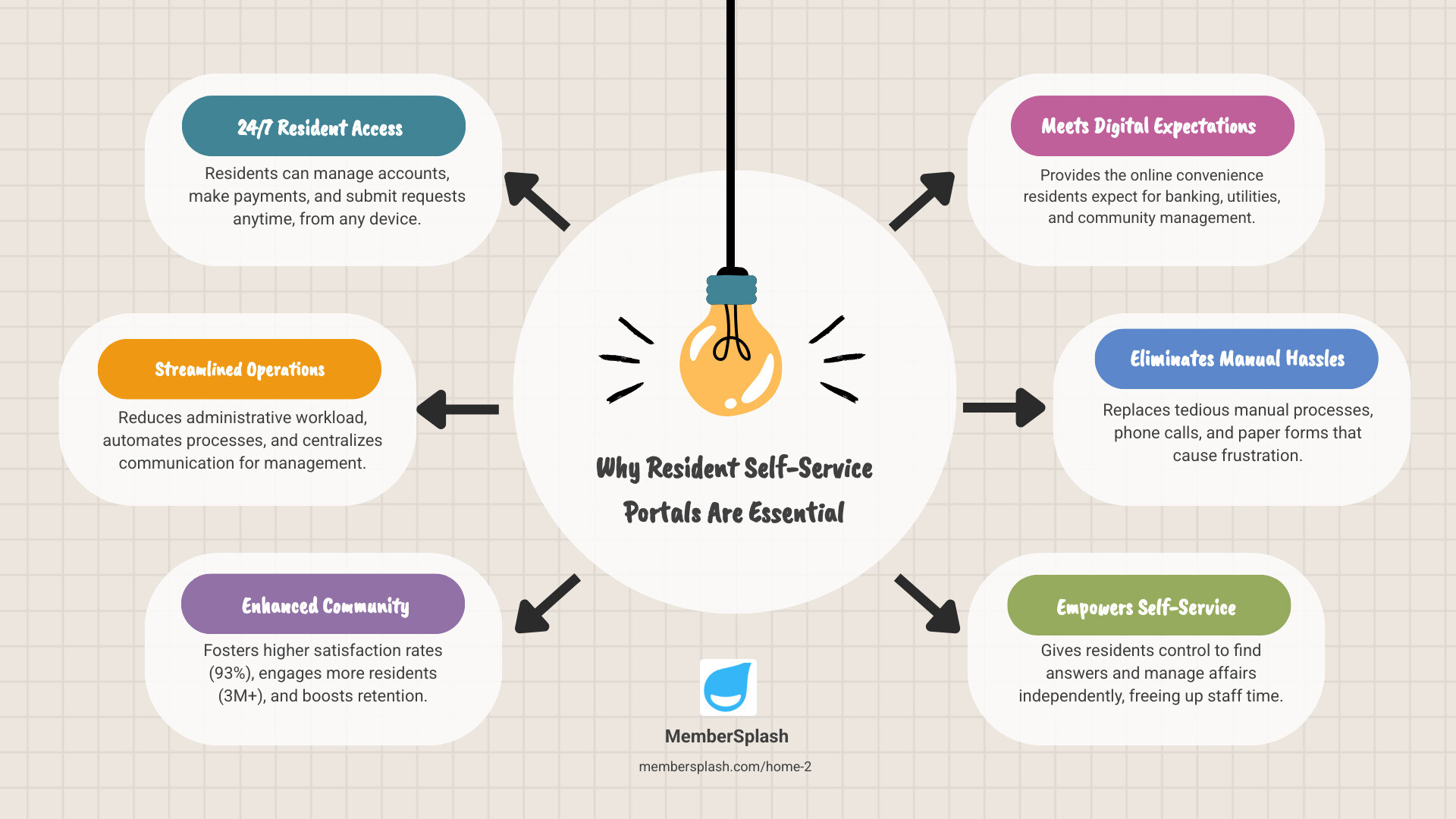
A Resident self-service portal is a centralized online platform that allows residents to manage their accounts, make payments, submit requests, and communicate with property management 24/7 without staff intervention. Here’s what makes them essential:

Core Benefits:

  • For Residents: 24/7 access to account information, online payments, maintenance requests, and community updates from any device
  • For Management: Reduced administrative workload, automated processes, faster payment collection, and centralized communication
  • For Communities: Higher satisfaction rates (93% average), improved retention, and stronger engagement across 3M+ residents

Today’s residents do everything online. They expect the same convenience for managing their community membership that they get from their bank, their utility company, or their favorite retailer.

Yet many HOAs, clubs, and pool management companies still rely on manual processes. Board members field phone calls about account balances. Managers chase down paper forms. Residents wait days for simple answers about their membership status or guest policies.

This disconnect creates frustration on both sides. Residents feel ignored when they can’t get quick answers. Management teams drown in repetitive tasks that pull them away from more important work.

The solution isn’t just about going digital. It’s about giving residents the power to help themselves while freeing up your team to focus on what matters most: building a thriving community.

As one resident noted after their community implemented a self-service portal: “It was the best experience in 17 years at their property” – citing the professionalism, punctuality, and ease of interaction.
Infographic showing three connected circles: Circle 1 labeled 'Resident Benefits' containing '24/7 Access, Self-Service Control, Payment Tracking, Request Status Updates'; Circle 2 labeled 'Management Benefits' containing 'Reduced Admin Work, Automated Payments, Centralized Data, Time Savings'; Circle 3 labeled 'Community Impact' containing '93% Satisfaction Rate, 3M+ Engaged Residents, Higher Retention, Stronger Connection' - Resident self-service portal infographic brainstorm-6-items

What is a Resident Self-Service Portal and Why is it Essential?

At its heart, a Resident self-service portal is a dedicated online hub that empowers residents to manage various aspects of their community life independently. Think of it as a digital concierge, always available, always ready to assist. This isn’t just a fancy website; it’s a strategic tool designed to facilitate seamless interactions between residents and their community management.

The primary goal of a resident self-service portal is to offer 24/7 access to essential services and information. In today’s world, convenience is king, and residents expect to handle their affairs on their own terms, whether that’s late at night or early in the morning, from their computer or their phone. This constant availability significantly reduces the need for direct staff intervention for routine inquiries, leading to a dramatic streamlining of operations.

By embracing a Resident self-service portal, organizations can automate many of the repetitive administrative tasks that often bog down staff. From processing payments to managing maintenance requests, the portal handles the heavy lifting, freeing up your team to focus on more complex issues and community-building initiatives. This shift towards automation and self-service not only cuts down on manual workload but also drastically increases overall efficiency for property managers and community associations. For more insights on maximizing efficiency and savings, explore our management solutions.

Core Functionalities of a Modern Portal

A truly effective and modern Resident self-service portal offers a comprehensive suite of functionalities designed to meet the diverse needs of residents and simplify management tasks. These core features are what make a portal invaluable:

  1. Account Management: This is the bedrock of any self-service portal. Residents can access and update their personal information, view their membership status, and manage their family details. A robust Member Account Database ensures all resident data is centralized and easily accessible.
  2. Document Access: Imagine residents no longer needing to call or email for a copy of the community bylaws, pool rules, or their lease agreement. Portals allow for easy access to important documents, contracts, and community policies, ensuring transparency and reducing administrative inquiries.
  3. Profile Updates: Life happens! Residents can update their contact information, add new family members, or change their preferences directly through the portal, ensuring that management always has the most current data.
  4. Communication History: A clear record of all past communications, including submitted requests and responses, helps residents stay informed and prevents misunderstandings.
  5. Maintenance Requests: Residents can submit maintenance requests online, often with the ability to attach photos or videos. They can then track the status of their request, from submission to completion, eliminating the need for follow-up calls. This functionality is crucial for properties, ensuring residents can easily log maintenance queries and receive updates on their status.
  6. Online Payments: One of the most popular features, allowing residents to pay dues, rent, or other fees securely online. This dramatically improves payment collection rates and provides convenience for residents.
  7. Communication Tools: Beyond just requests, portals often include messaging systems that allow residents to interact with staff, participate in community forums, or receive important announcements.

These functionalities empower residents to take control of their interactions with community management, fostering a sense of ownership and convenience.

Types of Resident Self-Service Portals

While the core concept remains the same, Resident self-service portals are adaptable and can cater to a variety of residential settings. The specific features and emphasis might shift depending on the community type:

  • HOA & Community Associations: For Homeowners Associations, a portal is essential for managing dues, sharing community documents like meeting minutes and covenants, booking shared amenities (like clubhouses or tennis courts), and facilitating communication among residents and the board. Our HOA Property Management Solutions are designed with these specific needs in mind.
  • Apartment Complexes: In apartment communities, portals often focus on rent payments, maintenance requests, lease renewals, and community event notifications. They become a vital tool for both residents and property managers in large-scale residential buildings.
  • Government Services: Even local governments in areas like Annapolis, MD, and Baltimore, MD, use self-service portals to streamline citizen interactions. These portals might allow residents to pay utility bills, apply for permits, access public records, or report civic issues. The Citizen Self-Service (CSS) Instruction Library for Annapolis, MD, serves as a great example of a city services portal, demonstrating how government entities empower their constituents with self-service options. Similarly, Baltimore City offers online payment and account lookup services, as well as a self-service portal, highlighting the widespread adoption of this technology for public convenience.
  • University Housing: For college campuses, resident portals are key for room selection, managing housing applications, booking appointments for move-in/move-out, reporting concerns, and accessing campus-specific resources.
  • Swim and Tennis Clubs: These organizations leverage portals for membership management, facility reservations, guest tracking, event registration, and fee collection. Our Swim and Tennis Club Solutions provide custom features for these dynamic environments.

Regardless of the specific type of residential community, the underlying principle of a Resident self-service portal is to improve convenience for residents and efficiency for management.

The Dual Advantage: Benefits for Residents and Management

Implementing a Resident self-service portal isn’t just a nice-to-have; it’s a strategic move that creates a genuine win-win scenario for everyone involved. Residents gain unparalleled convenience and control, while property managers achieve operational excellence and improved community health.

A property manager smiling while looking at a dashboard on a tablet, showing charts and data points - Resident self-service portal

This symbiotic relationship leads to increased satisfaction across the board, higher resident retention rates, and a more smoothly running operation. It’s a testament to the power of technology when applied thoughtfully to community management.

Empowering Your Residents

For residents, a self-service portal is nothing short of empowering. It puts control directly into their hands, allowing them to manage their living experience on their own terms.

  • 24/7 Convenience: Residents can access their accounts, make payments, or submit requests at any time, day or night, from any device. This flexibility accommodates busy schedules and diverse lifestyles, eliminating the need to wait for office hours. Offering a simple online experience is no longer a convenience; it’s a necessity because today’s residents do everything online.
  • Self-Service Control: From updating personal information to viewing important documents and signing contracts, residents have the autonomy to handle their administrative tasks. This reduces friction and gives them a sense of ownership over their community interactions.
  • Transparency on Payments and Requests: Residents can view their payment history, current balances, and the status of any maintenance requests or amenity bookings. This transparency builds trust and reduces inquiries about pending items.
  • Improved Communication: Portals provide a direct, streamlined channel for residents to interact with staff, report concerns, or receive updates. This structured communication is often more efficient than phone calls or emails, and tools allow residents to interact with staff via communication tools.
  • Improved Community Connection: By offering a centralized hub for information, events, and communication, the portal helps residents feel more connected to their community. They can see upcoming events, communicate with neighbors (if features allow), and stay informed about community news. This improved engagement contributes to the impressive 93% Resident Satisfaction statistic often seen with effective portals, and contributes to the 3M+ engaged residents we aim for.

Streamlining Your Operations

While residents bask in the glow of convenience, property managers and community associations reap significant benefits on the operational front. A Resident self-service portal transforms daily tasks, making management more efficient and effective.

  • Reduced Administrative Workload: Imagine the time saved when residents handle their own account updates, payment processing, and basic inquiries. This automation frees up your team from repetitive tasks, allowing them to focus on more complex issues, community events, or personalized resident interactions. These portals automate key property management tasks and streamline operations.
  • Centralized Data: All resident information, communication logs, payment records, and service requests are consolidated in one secure location. This eliminates data silos, improves accuracy, and provides a single source of truth for your team.
  • Faster Payments: Online payment options, especially with features like auto-pay, significantly accelerate rent and fee collection. This improves cash flow and reduces the time spent chasing overdue payments.
  • Improved Efficiency: With automated workflows and 24/7 access, processes that once took days can now be completed in minutes. This leads to faster response times for residents and a more agile management team. With over 1.6M+ properties live utilizing such platforms, the impact on efficiency is undeniable.
  • Higher Retention Rates: By providing an excellent resident experience through convenience and efficient service, portals contribute directly to higher resident satisfaction and, consequently, better retention. This helps strengthen your reputation, improve satisfaction, and retain residents longer, reducing turnover costs. This is a crucial benefit, as retaining residents is often more cost-effective than acquiring new ones.

A comprehensive view of all the features that contribute to this operational streamlining can be found by exploring our feature overview.

Choosing the Right Platform: Key Features of a Top-Tier Resident Self-Service Portal

Selecting the ideal Resident self-service portal is a critical decision for any community. It’s not just about having a portal; it’s about having the right portal. A top-tier platform should be scalable, user-friendly, and mobile-responsive, ensuring it can grow with your community and serve all residents effectively. Look for a solution that offers flexibility and scalability without requiring extensive custom development, and one that is designed to be responsive and accessible across all devices.
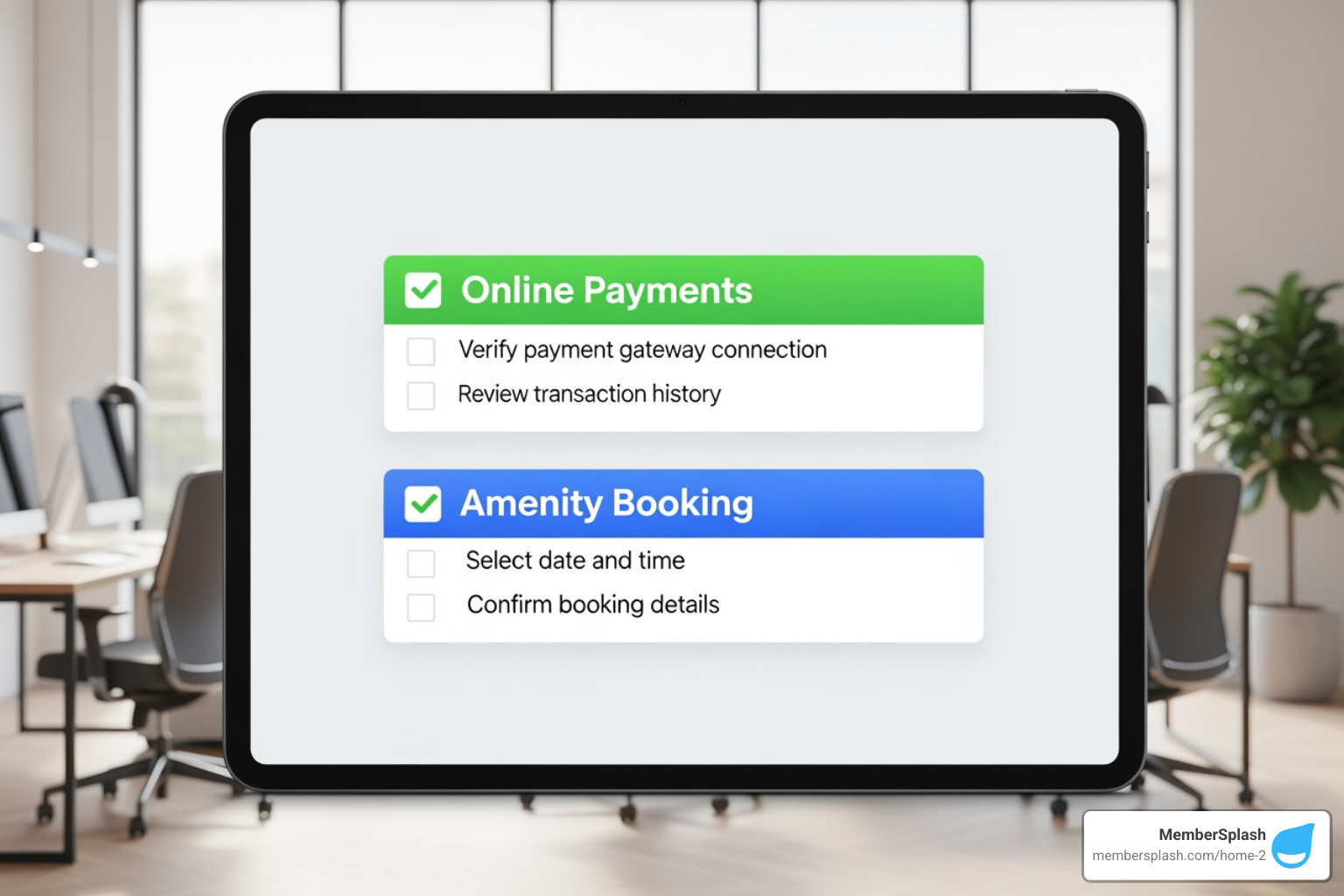
A checklist with key portal features like 'Online Payments' and 'Amenity Booking' highlighted, against a blurred background of a modern office - Resident self-service portal

Essential Financial and Payment Features

The financial aspects of community management are often the most time-consuming. A robust Resident self-service portal should simplify these processes for both residents and staff:

  • Online Payments: This is non-negotiable. Residents should be able to pay dues, rent, guest fees, or other charges securely online using various methods like credit cards, debit cards, or ACH. Our Secure Payment Processing ensures these transactions are safe and efficient. For organizations and patrons utilizing billing services, comply with the PoolPass Billing Terms and Conditions.
  • Auto-Pay Options: Offering recurring payment options significantly increases on-time payments and reduces the need for manual processing.
  • Financial Reporting: For management, the portal should provide clear, actionable reports on payment statuses, outstanding balances, and transaction histories, simplifying reconciliation.
  • Guest Fee Management: For clubs and HOAs with amenities, the ability to manage and collect fees for guests directly through the portal is invaluable. Our Guest Tracking & Payment feature streamlines this process.

Communication and Engagement Tools

Beyond transactions, a Resident self-service portal excels at fostering a connected and informed community. Effective communication is key:

  • Community Calendars: A centralized calendar keeps residents informed about upcoming events, board meetings, amenity closures, or holiday schedules. Our Events Calendar feature makes this easy.
  • Bulk Email & SMS: The ability to send mass communications directly through the portal ensures important announcements reach all residents quickly. This is perfect for emergencies, policy updates, or event reminders. Explore our Bulk Email Communication tools.
  • Digital Forms: From amenity reservation requests to feedback surveys, digital forms simplify data collection and reduce paper waste.
  • Amenity Bookings: Allowing residents to reserve common areas, sports courts, or other facilities online minimizes conflicts and streamlines resource allocation. Our Reservation System provides a seamless experience for this.

Customization and Security for Your Resident Self-Service Portal

A truly effective Resident self-service portal isn’t just functional; it’s also secure and feels like an integral part of your community’s brand.

  • Branded Portal: A portal that reflects your community’s branding – with your logo, colors, and specific messaging – creates a cohesive and professional experience for residents. This makes the portal feel like their portal, not just a generic platform.
  • Custom Forms: The ability to create custom forms custom to your specific needs, whether for new member registration, volunteer sign-ups, or specific requests, adds immense flexibility.
  • Role-Based Access: Not all users need access to the same information. Role-based access ensures that residents, board members, and staff only see the information relevant to their permissions.
  • Data Encryption: Protecting sensitive resident data is paramount. A top-tier portal employs robust data encryption and security protocols to safeguard personal and financial information. The highest level of security, with input verification at every step, is a must-have.
  • Photo Verification for Check-in: For facilities like pools or gyms, integrating photo verification adds an extra layer of security and efficiency. Our Check-in Photo Verification feature ensures only authorized individuals gain access.

From Plan to Portal: Implementation and Adoption

Starting on the journey from planning to a fully functional Resident self-service portal requires a clear roadmap. It involves careful consideration of data migration, thorough onboarding, comprehensive user training, and proactive strategies to overcome potential challenges. The goal is a smooth transition that maximizes the benefits for both your team and your residents.

Integration and Setup

The success of your Resident self-service portal often hinges on how seamlessly it integrates with your existing operations and systems.

  • Integration with Existing Software: A robust portal should be able to integrate with other property management software or accounting systems you already use. This ensures data consistency and avoids duplicate data entry, creating a unified ecosystem for your management tasks.
  • Data Migration Support: Moving existing resident data to a new platform can seem daunting. Look for providers that offer comprehensive data migration support, ensuring a smooth and accurate transfer of information.
  • Onboarding Assistance: A good vendor won’t just hand you the keys; they’ll walk you through the setup process, configure the portal to your specific needs, and provide initial training. Our Supported Implementation ensures you’re never alone in this process.
  • Customization Options: While a widget-based design allows for easy setup, the ability to customize the portal’s appearance and functionality to match your community’s unique identity is crucial for user adoption and branding.

Overcoming Challenges and Ensuring Security

While the benefits are plentiful, organizations must be aware of potential challenges and prioritize security when implementing a Resident self-service portal.

  • Potential Drawbacks: Initial resistance from residents or staff unfamiliar with new technology can be a hurdle. We address this through user-friendly design and comprehensive support.
  • Data Security Protocols: Protecting residents’ personal and financial information is paramount. The portal must use robust data encryption, firewalls, and secure servers. It’s crucial to understand the terms and conditions governing data use and protection.
  • PCI Compliance: For any portal handling payments, adhering to Payment Card Industry Data Security Standard (PCI DSS) compliance is non-negotiable. This protects cardholder data and ensures secure transactions. Organizations are responsible for their own PCI compliance.
  • User Privacy: Clear policies on how resident data is collected, used, and shared must be in place and easily accessible. For a detailed understanding of these requirements, review an Example of Portal Terms and Conditions to ensure your chosen solution aligns with strict privacy standards.
  • Staff Training: Proper training for your management team is essential to ensure they can effectively use the portal, assist residents, and troubleshoot minor issues.

Driving User Adoption for Your Resident Self-Service Portal

Building a fantastic Resident self-service portal is only half the battle; getting residents to use it is the other. User adoption is key to realizing the full return on investment.

  • Launch Campaign: Don’t just launch it and hope for the best! Create an exciting launch campaign to introduce the portal to residents. This could include emails, flyers, social media announcements, and even a launch event.
  • Clear Instructions: Provide easy-to-follow guides, FAQs, and video tutorials on how to register and use the portal’s key features. Make it as simple as possible for residents to get started. Implicit CTAs like “Need to sign up?” and “Forgot Password?” are crucial initial entry points.
  • Highlighting Benefits: Clearly communicate how the portal will make residents’ lives easier. Emphasize the 24/7 convenience, the ability to track requests, and the ease of online payments.
  • Gathering Feedback: Encourage residents to provide feedback on their experience. This not only helps identify areas for improvement but also makes residents feel heard and valued.
  • Ongoing Promotion: Regularly remind residents about the portal and its features. Highlight new functionalities, share success stories, and integrate portal usage into everyday community communications.

The Future of Resident Engagement

The landscape of resident engagement is constantly evolving, and Resident self-service portal technology is at the forefront of this change. We anticipate exciting advancements that will make community living even more connected and convenient.

Imagine a future where AI-powered support chatbots can instantly answer resident questions, freeing up staff for more complex tasks. Picture seamless smart home integration, allowing residents to manage their unit’s smart devices, submit maintenance requests, and even receive package delivery notifications all through their portal. Mobile-first design will continue to dominate, with portals becoming even more intuitive and feature-rich on smartphones and tablets.

Predictive analytics for maintenance could foresee potential issues before they become major problems, allowing for proactive repairs and minimizing resident inconvenience. Hyper-personalization will tailor the portal experience to each resident, offering relevant information, events, and services based on their preferences and history. These advancements will contribute to even stronger community-building tools, fostering deeper connections and a more harmonious living environment for everyone.

Frequently Asked Questions about Resident Portals

We understand you might have questions about how a Resident self-service portal can specifically benefit your community. Here are some common inquiries we encounter:

How much time can a portal really save our management team?

The time savings can be substantial! By automating routine tasks, a portal frees up your team from numerous manual processes. Think about:

  • Automation of Payments: Online payments and auto-pay options drastically reduce the time spent processing checks, sending reminders, and reconciling accounts. An automated and flexible billing system removes a significant manual burden on staff.
  • Digital Registration & Applications: Moving these processes online eliminates paper forms, manual data entry, and follow-up calls for incomplete information.
  • Reduced Phone Calls and Emails: Residents can find answers to common questions, check account balances, or track maintenance requests themselves, significantly cutting down on inbound inquiries.
  • Centralized Communication: Instead of scattered emails and phone calls, all communications are streamlined through one platform, making it easier to track and respond.
  • Streamlined Reporting: Automated financial and activity reports save hours of manual data compilation.

Overall, a portal can transform your team’s efficiency, allowing them to focus on resident satisfaction and community development rather than administrative drudgery.

Is it difficult for non-technical residents to use?

Not at all! Modern Resident self-service portals are designed with user-friendliness as a top priority.

  • User-Friendly Design: Intuitive interfaces, clear navigation, and straightforward language make portals accessible even for those who aren’t tech-savvy.
  • Mobile Access: Most residents interact with digital services via their smartphones. A responsive and accessible design ensures the portal works seamlessly on any device.
  • Clear Instructions: Comprehensive help sections, FAQs, and perhaps even quick video tutorials guide residents through each feature.
  • Onboarding Support: A good implementation plan includes resources to help residents get started, such as a dedicated launch campaign and direct support channels.
  • Intuitive Navigation: Features are logically organized, making it easy for residents to find what they need without extensive searching. The goal is a simple online experience that becomes a necessity.

What’s the ROI on a resident self-service portal?

The Return on Investment (ROI) for a Resident self-service portal is multifaceted, extending beyond just cost savings:

  • Time Savings: As discussed, significant time is saved by automating tasks, allowing staff to be reallocated to more impactful work. This translates directly into labor cost efficiencies.
  • Increased Revenue Capture: Easier online payment options, including auto-pay, lead to higher on-time payment rates and better overall revenue collection. For HOAs and clubs, managing guest fees through the portal also directly impacts revenue.
  • Reduced Printing and Mailing Costs: Shifting communications, forms, and statements to digital channels drastically cuts down on material and postage expenses.
  • Improved Resident Retention: Improved convenience and satisfaction directly contribute to higher resident retention rates. Reducing turnover costs is a significant financial benefit, as acquiring new residents is always more expensive than retaining existing ones.
  • Improved Reputation: A modern, efficient community management system boosts your reputation, making your property more attractive to prospective residents.

While the exact numbers will vary by community, the combination of operational efficiencies, improved financial performance, and increased resident satisfaction makes the investment in a Resident self-service portal a smart financial decision. For a detailed breakdown and comparison of pricing plans, you can visit our Pricing Comparison page.

Conclusion: Build a Stronger, More Connected Community

A Resident self-service portal is no longer a luxury; it’s a fundamental necessity for any forward-thinking community, HOA, or club. We’ve seen how these powerful platforms bridge the gap between resident expectations and management capabilities, fostering a harmonious and efficient living environment.

From empowering residents with 24/7 access and control over their accounts to drastically streamlining operations for property managers, the benefits are clear. Increased resident satisfaction, higher retention rates, and unparalleled operational efficiency are not just aspirations but achievable realities with the right portal in place.

At MemberSplash, we understand the unique needs of communities in areas like Annapolis, MD, and Baltimore, MD. Our solutions are designed to help you harness the power of resident self-service, changing how your community operates and thrives. If you’re ready to open up these benefits and build a stronger, more connected community, we invite you to see our platform in action. Watch a Demo of MemberSplash today and find your portal to paradise.

Your HOA’s Hero: Finding the Right Management Partner

Why Every HOA Needs a Better Management Approach

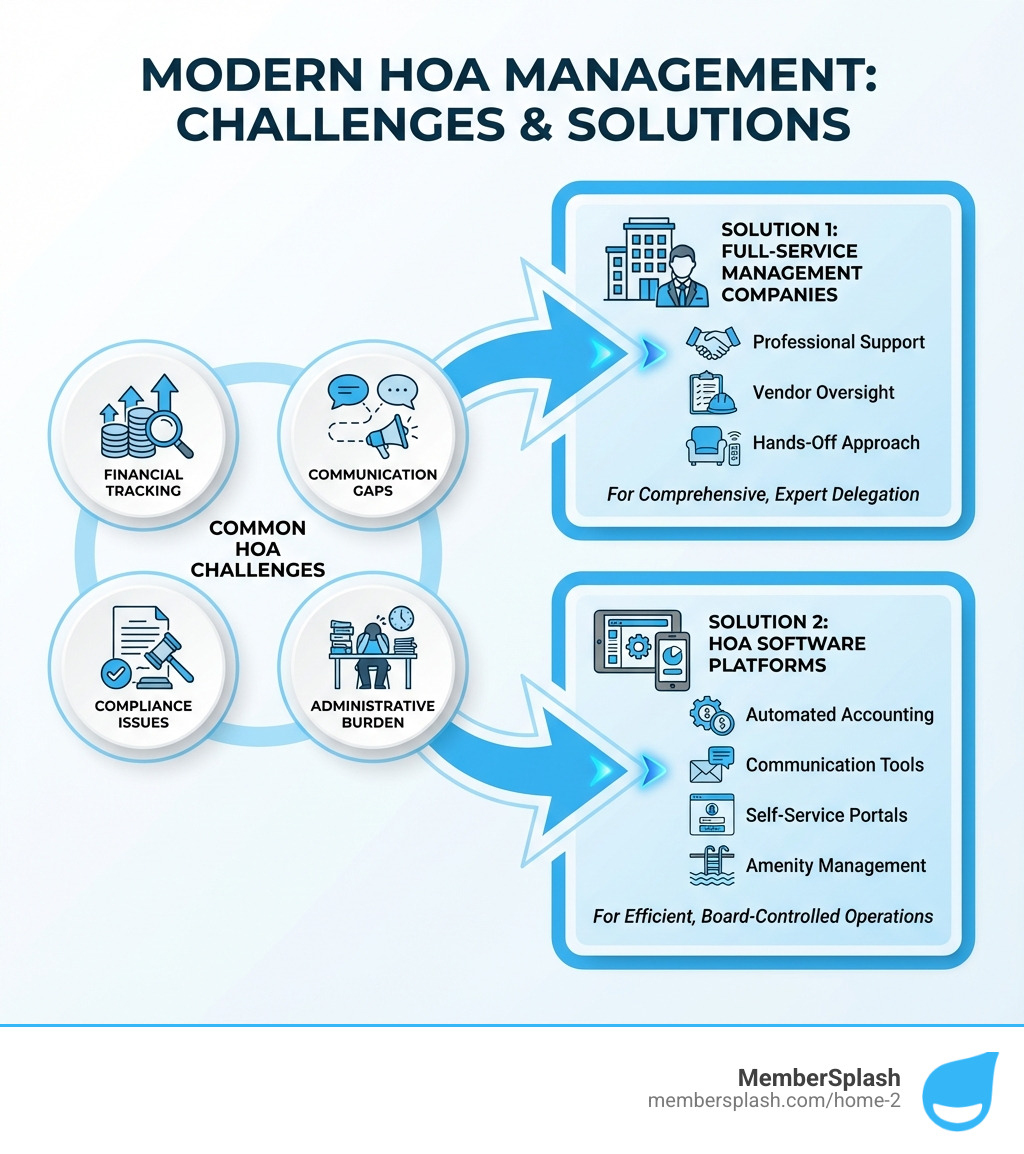
HOA management solutions come in two main forms: full-service management companies that handle operations for you, or software platforms that empower your board to manage the community more efficiently. Full-service options provide hands-off professional support but cost more, while software solutions offer greater control and cost savings but require board involvement.

Managing a homeowners association is hard work. Really hard. As many community managers will tell you, managing a community can feel like a difficult, thankless job.

If you’re a volunteer board member or manager, you know this reality all too well. You’re juggling accounting spreadsheets, chasing down late payments, fielding resident complaints, enforcing rules, and somehow trying to keep everyone happy. And you’re probably doing most of this in your spare time.

The stakes are high. Poor management doesn’t just create headaches. It can hurt property values and drive residents away. But effective management keeps your community thriving, your finances healthy, and your residents satisfied.

The good news: you don’t have to do it alone. Modern HOA management solutions can handle the grunt work, giving you back your time while improving your community’s operations. Whether you need a full-service partner to take everything off your plate or a powerful software platform to make your board more efficient, the right solution exists for your community.

The challenge is finding it.

infographic showing common HOA management challenges (financial tracking, communication gaps, compliance issues, administrative burden) with arrows pointing to two solution types: Full-Service Management Companies (professional support, vendor oversight, hands-off approach) and HOA Software Platforms (automated accounting, communication tools, self-service portals, amenity management) - HOA management solutions infographic

The Core Challenges of Modern HOA Management

We understand that running an HOA, whether you’re a dedicated board member or a professional manager, can often feel like an uphill battle. The sheer volume of tasks, coupled with the need to maintain community harmony and property values, presents a unique set of challenges. From the intricacies of financial management to the delicate art of resident communication and the steadfast enforcement of community rules, it’s a demanding role. Let’s dig into the primary problems we frequently encounter.

Financial Frustrations

Ask any HOA board, and they’ll likely tell you that financial management is one of their biggest headaches. The cycle of dues collection, budgeting, and reporting can quickly become overwhelming, especially for volunteer boards.

We often see communities struggling with:

  • Inaccurate Accounting: Manual spreadsheets or outdated systems lead to errors, obscuring the association’s financial health and undermining trust.
  • Chasing Payments: Manually invoicing, tracking, and reminding homeowners about late dues is a time-consuming struggle that can strain community relationships.
  • Lack of Transparency: Inaccessible or confusing financial records can make homeowners suspicious. Boards need to provide clear reports to foster trust.
  • Budget Variances: Without tools to compare financials against the budget, it’s hard to spot variances early, leading to unexpected shortfalls or overspending.
  • Manual Invoicing: Automating invoices for dues, fees, and fines saves immense time and eliminates a never-ending paper trail.

Modern HOA management solutions aim to simplify these processes, offering tools for online payment processing that can significantly reduce the burden. You can find more info about online payment processing services here.

Communication Breakdowns

Effective communication is the lifeblood of a thriving community, yet it’s often where HOAs struggle the most. Communication gaps can lead to frustrated residents, overwhelmed board members, and unresolved issues.

Common communication challenges include:

  • Disconnected Residents: Keeping every homeowner informed about community news, events, and important updates can be a logistical nightmare without a centralized system.
  • Board Member Burnout: Fielding endless emails, calls, and complaints from residents contributes significantly to board member fatigue.
  • Inefficient Messaging: Sending out mass communications manually is time-consuming and often lacks the immediacy needed for urgent announcements.
  • Dispute Resolution: Without clear channels for submitting and tracking requests or complaints, disputes can escalate and break down community spirit.
  • Lack of a Central Hub: Important documents, calendars, and contact information are often in disparate locations, making it hard for anyone to find what they need.

While personal interaction is invaluable, technology can vastly improve the efficiency and reach of communication, freeing up time for those vital face-to-face moments. Tools that offer bulk email capabilities are a game-changer. Find more info about bulk email communication services here.

Compliance and Operational Problems

Beyond finances and communication, the day-to-day operations and rule enforcement present their own set of challenges. HOAs are responsible for maintaining common areas, enforcing governing documents, and addressing resident requests, all while ensuring fairness and consistency.

Key operational and compliance issues we encounter include:

  • Enforcing Rules: Objectively enforcing community governing documents, rules, and regulations is crucial but can be a delicate task, requiring consistency and clear policies.
  • Tracking Violations: Identifying, documenting, and addressing violations efficiently is essential. Without a streamlined process, this can become inconsistent.
  • Managing Maintenance Requests: Maintenance requests need to be submitted, tracked, assigned, and resolved promptly, keeping homeowners informed throughout the process.
  • Architectural Reviews: Processing architectural modification requests involves multiple steps, approvals, and communication with homeowners.
  • Document Management: Storing and organizing all essential community documents—bylaws, CC&Rs, meeting minutes—in an accessible yet secure manner is vital for transparency.

As one source notes, a third-party manager can be the board’s best source for objective enforcement. However, whether managed internally or externally, robust systems are needed. These challenges highlight the need for HOA management solutions that can streamline operations and maximize efficiency. Learn more info about maximizing efficiency services here.

Comparing HOA Management Approaches: Full-Service vs. Software Solutions

When it comes to tackling the complexities of HOA management, communities generally have two main paths: engaging a full-service management company or implementing a dedicated HOA management software solution. Both offer distinct advantages and disadvantages, and the best choice ultimately depends on your community’s specific needs, budget, and the board’s desired level of involvement.

split screen showing a person working with a management partner vs a person using a laptop - HOA management solutions

Full-Service HOA Management Approach

A full-service HOA management company essentially takes the reins, handling most, if not all, of the day-to-day administrative, financial, and operational tasks on behalf of the board. These firms pride themselves on leadership and comprehensive support.

What it is: This approach means outsourcing your HOA’s management to a team of professionals. They act as the primary contact for homeowners, manage vendors, oversee finances, and ensure compliance with governing documents. For example, a company might handle all bookkeeping, including accounts, reporting, and banking, with precision and compliance. They might also serve as the primary contact person with contractors, routinely visiting the property to oversee maintenance.

Pros:

  • Hands-off Approach: Ideal for volunteer boards with limited time, as it significantly reduces the administrative burden.
  • Expert Guidance: Professional managers offer experience in legal compliance, vendor management, and crafting effective rules.
  • Vendor Management: They typically handle the negotiation and oversight of service providers, ensuring quality work at competitive prices.
  • Objective Enforcement: A third-party manager can provide objective enforcement of community rules, which can be difficult for volunteer board members who are also neighbors.

Cons:

  • Higher Investment: This option comes at a significant cost that may not be feasible for smaller communities.
  • Less Direct Control: The board relinquishes some daily operational control to the management company.
  • May Not Be Fully Custom: Their services might be standardized, potentially lacking the specific customization some unique communities desire.

If you’re considering this path, exploring how professional support can benefit your community is a great first step. You can learn more about HOA management support here.

HOA Management Software Solutions

The alternative is to empower your board and community with a dedicated software platform. This approach puts the tools and control directly into the hands of your association, enabling efficient self-management.

What they are: These are integrated digital platforms designed to streamline various aspects of HOA operations, from accounting and communication to amenity management and compliance. Many are “all-in-one” solutions designed to manage your community 100% online, often earning high ratings on software review platforms for their comprehensive features.

Pros:

  • Cost-Effective: Software subscriptions are typically more affordable than full-service management, especially for communities with engaged volunteer boards.
  • Greater Control: The board retains full control over all decisions and operations, with the software acting as an enabling tool.
  • Empowers Volunteers: It equips volunteer board members with professional-grade tools, making their tasks easier and more efficient. Features like automated invoicing and request workflows can save hours every week.
  • Customizable: Many platforms offer flexibility to tailor features and settings to your community’s unique needs.
  • Transparency: Centralized digital records and reporting features increase financial transparency for both the board and homeowners.

Cons:

  • Requires Board Involvement: While the software automates many tasks, the board still needs to actively manage the platform and make decisions.
  • Learning Curve: There might be an initial adjustment period as board members and homeowners learn the new system. However, many solutions offer hands-on onboarding and support to ease this transition.

For communities looking to leverage technology for more efficient self-management, exploring HOA property management software is a smart move. Find more info about HOA property management software here.

Must-Have Features in an HOA Management Solution

Choosing the right HOA management solution means looking beyond the basic offerings and identifying features that genuinely solve your community’s pain points. Whether you opt for a full-service provider or a software platform, certain capabilities are non-negotiable for efficient, transparent, and harmonious community living.

software dashboard showcasing multiple features - HOA management solutions

Streamlined Financial & Accounting Tools

At the heart of any well-run HOA is robust financial management. We can’t stress enough how crucial comprehensive accounting tools are for the health and stability of your community.

Look for solutions that offer:

  • Online Payments: Offering online payments and autopay for dues and fees improves cash flow and reduces collection efforts. Look for solutions that integrate securely with FDIC-insured banks, allowing direct deposits.
  • Automated Invoicing: Automatically generate and log invoices for all charges, saving countless hours and ensuring seamless ledger entries.
  • Dues Tracking: A system that clearly tracks who has paid what, and when, eliminating guesswork and simplifying follow-up for outstanding balances.
  • Financial Reporting: Real-time, accurate accounting that supports both cash and accrual reporting is essential. Solutions should generate audit-ready monthly financial statements and bank reconciliations.
  • Budgeting Tools: Features that assist in preparing annual budgets and monitoring expenditures against those budgets.
  • Vendor Payments: Automated accounts payable and smart bill entry ensure community services go uninterrupted by facilitating timely vendor payments.

Having a robust member account database is the foundation for these financial tools. Get more info about member account database services here.

Centralized Communication Hub

A connected community is a happy community. The right HOA management solution acts as the central nervous system for all communication, ensuring everyone is on the same page.

Essential communication features include:

  • Mass Emails & Texts: Send broadcast messages via text, email, or phone for timely announcements, reminders, and emergencies.
  • Resident Portal: A secure online portal where homeowners can access their accounts, view community documents, submit requests, and stay updated on community news.
  • Community Calendar: An interactive calendar for events, meetings, and amenity reservations keeps everyone informed and engaged.
  • Document Storage: A secure, centralized digital repository for all important documents—bylaws, CC&Rs, meeting minutes, policies—ensures easy access for authorized users.
  • Request Tracking: Homeowners should be able to submit maintenance requests, architectural review applications, or general inquiries online, with built-in workflows to track status.

A well-organized events calendar can transform how your community communicates and engages. Explore more info about events calendar services here.

Efficient Operations & Amenity Management

Beyond financials and communication, the daily operational aspects of an HOA, particularly those related to shared amenities, demand efficient management.

Key operational features to look for:

  • Violation Tracking: Mobile tools for tracking violations, documenting them with photos, and generating violation letters streamline compliance efforts.
  • Architectural Reviews: Online architectural review processes with in-app messaging simplify what can often be a complex approval process.
  • Work Order Management: A system to manage maintenance requests, from submission to completion, ensuring timely resolution and keeping all parties informed.
  • Amenity Reservations: For communities with pools, clubhouses, or other shared facilities, an amenity reservation system is crucial for managing capacity and enforcing rules.
  • Guest Tracking: Especially for amenities like pools, a system to track guests and manage guest passes can be vital for security and can even generate revenue from guest fees.

Effective reservation systems can dramatically improve the management of your community’s most valued assets. Find more info about reservation system services here.

The Long-Term Payoff: How the Right Solution Boosts Community Value

Implementing the right HOA management solution is a strategic investment that yields significant long-term benefits for the entire community. From bolstering financial health to fostering a vibrant living environment, the ripple effects are profound.

Achieving Financial Health and Transparency

A robust management solution is the cornerstone of an HOA’s financial stability. Transparency builds trust, and efficiency safeguards assets.

Here’s how the right solution contributes:

  • Real-time Reporting: Instant access to financial data means boards can make informed decisions quickly, eliminating the lag time of manual processes.
  • Audit-Ready Financials: Solutions that automatically log transactions and generate comprehensive reports make annual audits a breeze, demonstrating sound financial governance.
  • Improved Budget Adherence: By allowing easy comparison of financial statements against the annual budget, boards can identify variances early, preventing overruns and maintaining financial discipline.
  • Increased Revenue Capture: Automated dues collection, online payments, and efficient tracking of fees can significantly improve an HOA’s revenue. Some communities have seen guest revenues more than double due to better tracking, proving that smart management pays for itself.

The ability to generate custom reports further improves this transparency. Check out more info about custom reports services here.

The Role of Technology and Automation in Modern HOA Management Solutions

Technology is a necessity for efficient HOA operations. Automation and AI are changing the landscape of community management.

  • AI-powered Insights: Emerging AI can do the “grunt work,” analyzing data to identify trends or predict maintenance needs, freeing up human resources for strategic tasks.
  • Automated Workflows: The power of automation to save hours every week is undeniable. This includes automated invoicing, payment reminders, and routing of maintenance requests, which reduces manual errors and ensures consistency.
  • Mobile Access: Mobile apps empower board members, managers, and homeowners to access information and perform tasks on the go, even with offline access in areas with poor connectivity.
  • Data Security: Leading HOA management solutions employ bank-level encryption and adhere to industry-standard compliance to ensure data stays safe, private, and accessible.

By embracing these technological advancements, HOAs can maximize efficiency and achieve significant savings. Find more info about maximizing efficiency services here.

Boosting Resident Satisfaction and Property Values

The goal of effective HOA management is to create a desirable place to live. The right solution contributes directly to resident satisfaction and, consequently, to property values.

  • Better Communication: When residents feel informed and heard, their satisfaction soars. Centralized communication hubs reduce misunderstandings and foster a stronger sense of community.
  • Faster Issue Resolution: Streamlined request tracking and work order management mean maintenance issues are addressed promptly, leading to well-maintained common areas.
  • Well-Maintained Amenities: Efficient amenity management, including reservation systems, ensures that shared facilities are accessible, well-managed, and enjoyable for everyone.
  • Stronger Community Engagement: Easy-to-use platforms encourage resident participation in events and discussions, fostering a vibrant and cohesive community.
  • Increased Desirability: A well-managed, financially transparent, and engaged community is more attractive to potential buyers, boosting community pride and property values.

How to Choose the Best Solution for Your Community

The journey to finding your HOA’s hero—the perfect management solution—can feel daunting, but a structured approach can help you identify a partner that truly meets your community’s needs.

Step 1: Assess Your Community’s Unique Needs

Before looking at options, take an honest look at your community’s specific characteristics and challenges.

  • Community Size: Are you a small community or a larger association? Some solutions are designed for smaller HOAs, while others are built to grow with your community.
  • Amenities: Do you have a pool, clubhouse, or other facilities that require booking, access control, or guest management? This will influence the features you need.
  • Existing Challenges: What are your biggest pain points right now? Is it financial transparency, communication, or violation enforcement? Prioritize these to guide your search.
  • Board’s Technical Skill: How comfortable is your volunteer board with technology? Some solutions are incredibly intuitive, while others might have a steeper learning curve.
  • Volunteer Time Commitment: How much time can your board realistically dedicate to management? This will help determine if a software-only approach is viable.

Step 2: Understanding Pricing Models for HOA Management Solutions

Cost is always a significant factor. HOA management solutions come with various pricing structures, and understanding them is key to avoiding surprises.

  • Per-Unit Pricing: Many software solutions charge a monthly or annual fee per household, which scales with your community size.
  • Tiered Subscriptions: Some platforms offer different plans (e.g., Basic, Premium) with varying features and support levels at different price points.
  • Flat Fees: Full-service management companies might offer flat monthly fees or charge based on the scope of services.
  • Hidden Costs: Always ask about potential extra fees for payment processing, data migration, or advanced support. Look for solutions that are transparent about all costs.

Many providers offer discounts for annual plans. Importantly, look for solutions that offer flexibility, with no long-term contracts or cancellation fees, so you’re not locked in if it’s not the right fit. For a detailed breakdown, check out more info about pricing comparison services here.

Step 3: Evaluate and Select Your Partner

Once you have a clear understanding of your needs and budget, it’s time to evaluate potential solutions.

  • Request Demos: Don’t just read about features; see them in action. Request personalized demos to understand how the solution would work for your community.
  • Check Reviews: Look at independent review platforms for ratings and testimonials. Pay attention to feedback on ease of use, customer support, and overall satisfaction.
  • Ask About Support: What kind of support is offered? Is it chat, email, or phone? High-quality support can make all the difference during implementation and ongoing use.
  • Onboarding Process: How easy is it to switch from your current system? A dedicated onboarding specialist who handles data migration, setup, and training can make the transition seamless. Some companies can get organizations fully up and running in just a few days.

A supported implementation process is vital for a smooth transition and long-term success. Find more info about supported implementation services here.

Conclusion: Empower Your Board and Lift Your Community

We’ve explored the myriad challenges facing HOA boards and managers today—from the relentless pursuit of financial transparency to the delicate dance of resident communication and the systematic enforcement of community standards. We’ve also seen how modern HOA management solutions, whether in the form of full-service partnerships or powerful software platforms, offer a guide of hope, promising to transform these burdens into manageable tasks.

By embracing the right solution, your community can open up a wealth of benefits: achieving financial health and unwavering transparency, leveraging technology and automation to reclaim countless hours, and ultimately boosting resident satisfaction that translates into higher property values and a more desirable place to call home. Empowering your volunteer board members with intuitive tools means they can focus on the bigger picture, fostering community spirit rather than getting bogged down in administrative minutiae.

The future of HOA management is smart, connected, and efficient. It’s about giving your community the tools it needs to thrive. For a solution that champions these values, we invite you to explore how MemberSplash can be your HOA’s hero, providing the customizable platform and dedicated support to streamline your operations and lift your community experience.

To learn more about how we can help your community, get more info about HOA property management services here.

From Communication to Portals: Your Guide to HOA Software

Why HOA Community Software Matters for Your Association

HOA community software is an all-in-one management platform that helps homeowners associations automate administrative tasks, manage finances, facilitate communication, and improve resident engagement. These systems eliminate manual paperwork and save managers significant time—in some cases, over 15 hours per week.

Top HOA community software solutions provide a range of powerful tools designed for different community needs. Key features often include robust accounting and payment processing, unlimited messaging capabilities, resident portals for self-service, and scalable pricing models that can accommodate both small and large associations.

If you’re a board member or HOA manager drowning in spreadsheets, email chains, and manual payment tracking, you’re not alone. One HOA manager described their experience: “I know one woman who runs her entire 1,500-member homeowner association by herself as a part-time staff member. That’s because she leaves most of the work up to her Homeowner Association Software—it essentially runs the organization for her.”

The challenges are real: collecting dues, processing maintenance requests, tracking violations, scheduling amenity reservations, and keeping residents informed all consume valuable time. Most HOA managers agree that the biggest issue with their association is the significant amount of time it requires.

That’s where specialized software comes in. The HOA software market is projected to grow to $1.5 billion by 2027, driven by associations finding they can automate nearly all administrative work. Modern platforms centralize everything—from accounting and online payments to communication tools and member portals—into one system that actually saves you time and money.

The goal isn’t just efficiency. It’s about creating a thriving community where residents feel connected, finances are transparent, and you’re not buried under paperwork. Whether you manage a small self-governed neighborhood or oversee multiple large communities, the right software transforms how your HOA operates.

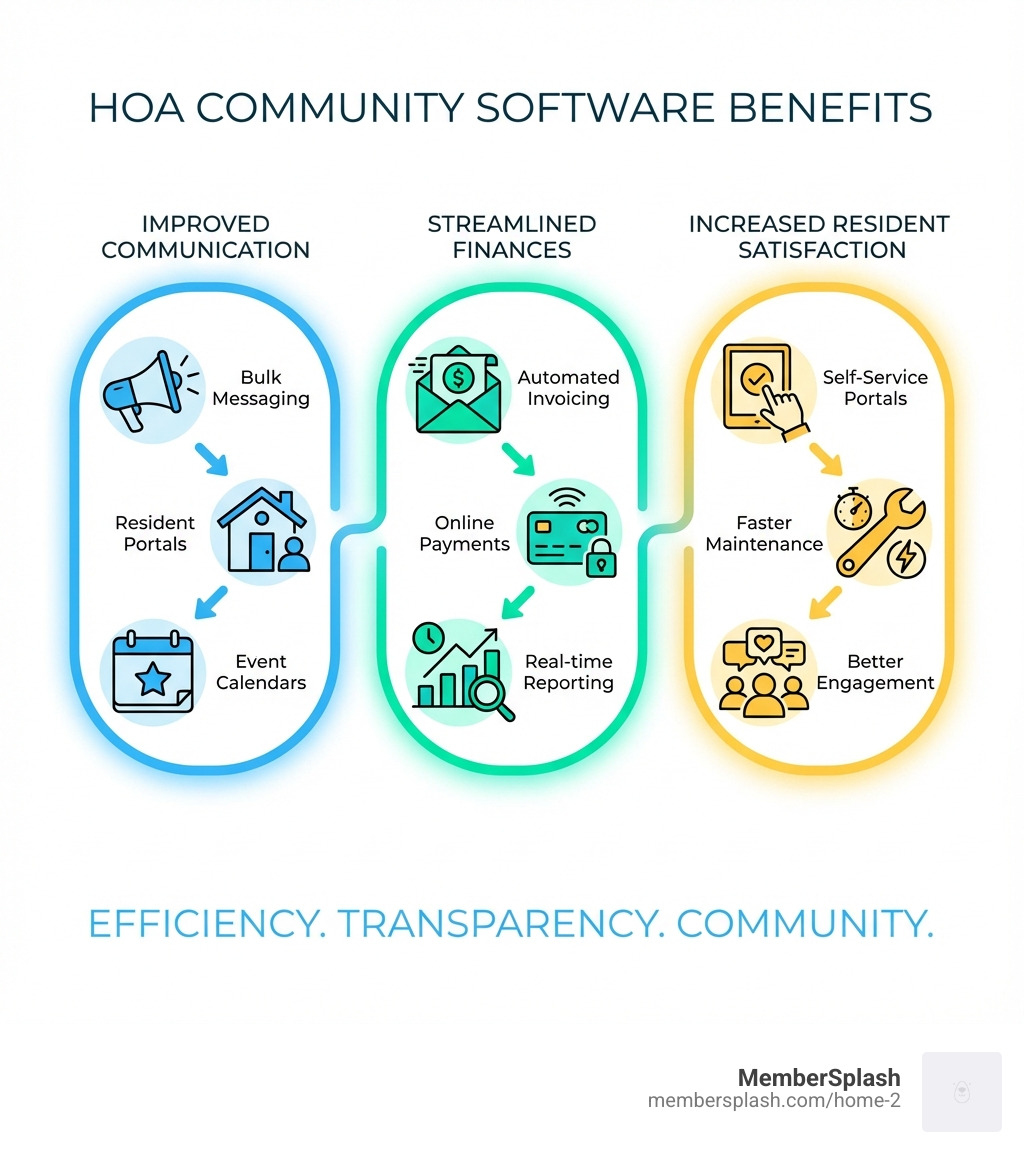
Infographic showing the three main benefits of HOA community software: 1) Improved Communication through bulk messaging, resident portals, and event calendars, 2) Streamlined Finances via automated invoicing, online payments, and real-time reporting, and 3) Increased Resident Satisfaction through self-service portals, faster maintenance responses, and better community engagement - HOA community software infographic

Core Features to Look for in HOA Community Software

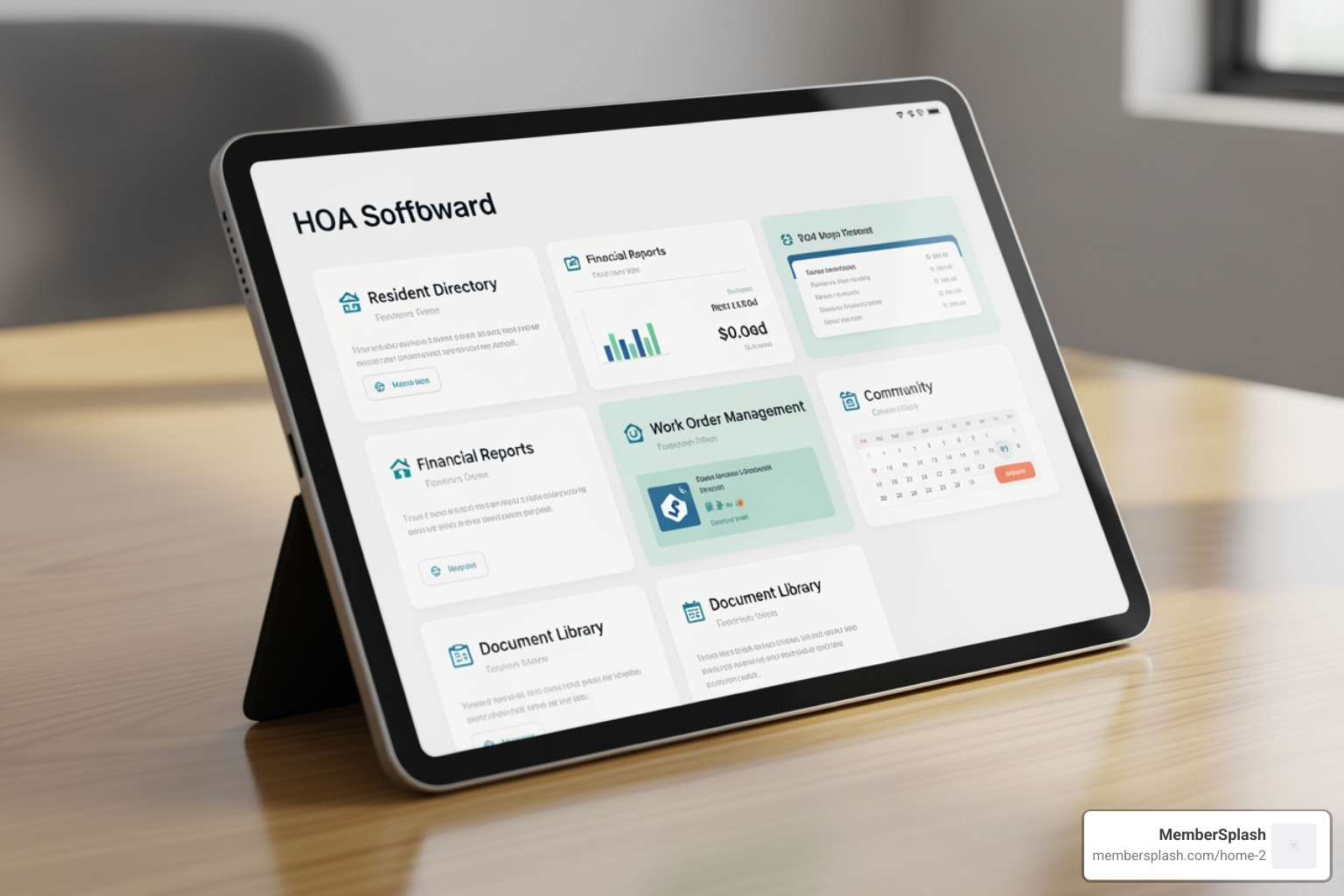
A clean, modern HOA software dashboard displayed on a tablet, showcasing various management modules. - HOA community software

When we talk about HOA community software, we’re discussing comprehensive, all-in-one platforms designed to bring every facet of your association’s operations into one central hub. The aim is not just to digitize processes but to genuinely improve efficiency and improve the member experience. Imagine a single system that handles everything from collecting dues to coordinating community events – that’s the power we’re looking for.

Financial Management and Online Payments

One of the most time-consuming aspects of HOA management is undoubtedly financial oversight. This is where robust accounting tools within HOA community software become invaluable. We need software that can manage accounts, automate invoicing for dues, fees, and fines (including late fees), and handle online payment processing. Homeowners will love the convenience of paying online and setting up autopay, which also significantly improves collection rates for the HOA.

Our ideal software will offer real-time, accurate accounting specifically custom for community associations, supporting both cash and accrual reporting. It should provide powerful reporting tools to give board members the visibility they need into the financial health of the association. Look for features like bank integrations, automated accounts payable, smart bill entry, customized reports, corporate accounting, multiple fund accounting, and vendor eCheck capabilities. These tools streamline financial management, making budgeting and financial transparency a breeze. More info about online payment processing can be found by exploring solutions that simplify these critical tasks.

Centralized Member Portal and Database

A cornerstone of effective HOA community software is a centralized member portal and database. This isn’t just a digital rolodex; it’s a dynamic hub for resident self-service and communication. A comprehensive member database allows us to easily search, filter, and update contact information, ensuring we always have accurate records.

The member portal empowers residents by giving them secure access to their accounts. Here, they can update their contact information, view their payment history, access important documents like bylaws and community rules, and even participate in opinion polling. This self-service capability reduces administrative inquiries and provides a convenient, 24/7 resource for residents. It also acts as a critical communication hub, fostering a more connected and informed community. More info about member account database reveals how these systems centralize and secure member information.

Communication and Engagement Tools

Effective communication is the lifeblood of any thriving community. HOA community software provides a suite of tools that make keeping residents informed and engaged easier than ever. We’re talking about more than just email; modern systems offer bulk email and text messaging capabilities, ensuring important announcements reach everyone quickly. Imagine sending out an urgent community alert or a friendly reminder about an upcoming event with just a few clicks. More info about bulk email communication highlights how these features simplify outreach.

Beyond one-way communication, look for features that foster engagement, such as community forums where residents can discuss local issues, share recommendations, and build connections. An integrated event calendar is crucial for managing and promoting community activities, from board meetings to holiday parties. Residents can view upcoming events, register, and even receive reminders. More info about events calendar details how these tools can boost participation. Surveys and polls are also excellent for gathering feedback and ensuring resident voices are heard on important community decisions.

Operations and Maintenance Management

The day-to-day operations of an HOA often involve managing a myriad of requests and ensuring community standards are upheld. HOA community software is a game-changer here, automating workflows that traditionally consume significant time and effort.

Key features include robust maintenance request tracking, allowing residents to submit issues online, often with photos, and then enabling our team to track the request’s progress from submission to completion. This transparency keeps residents informed and streamlines the entire process. Similarly, violation tracking and enforcement tools help us manage compliance efficiently, from issuing violation letters to tracking resolution.

Architectural review workflows are essential for maintaining community aesthetics, allowing residents to submit plans for approval and facilitating board member reviews. Work order management integrates seamlessly with maintenance requests, assigning tasks to vendors and tracking their completion. Finally, amenity reservations, like booking the clubhouse or a tennis court, can be managed effortlessly online, preventing double-bookings and maximizing usage. More info about reservation system can guide you through optimizing shared space management.

How to Choose the Right Software for Your Community

An HOA board member reviews software options on a laptop, comparing features and pricing. - HOA community software

Selecting the perfect HOA community software is a significant decision that can profoundly impact your association’s efficiency and resident satisfaction. It’s not a one-size-fits-all scenario, and a thorough evaluation process is essential. We need to consider our community’s unique characteristics, assess the software’s capabilities, and understand the different types of solutions available.

Assessing Your Community’s Unique Needs

The first step in choosing HOA community software is to look inward. What are the specific demands of your community?

  • Community Size: A small, self-managed neighborhood might have different needs than a large, multi-unit association. Some software is designed for small HOAs with pricing models that scale from just a few households, while other platforms are built to handle the complexities of larger or professionally managed communities.
  • Self-Managed vs. Professionally Managed: Self-managed HOAs often need more comprehensive, all-in-one solutions to handle tasks typically outsourced by managed communities. The research notes that HOA software can essentially run the organization for a part-time staff member in a 1,500-member HOA, highlighting its importance for self-managed groups.
  • Specific Amenity Needs: Do you have a community pool, tennis courts, or a clubhouse? If so, you’ll need software with strong amenity management features, including reservation systems, check-in capabilities, and guest tracking. This is particularly relevant for communities in Annapolis and Baltimore, Maryland, where community pools and recreational facilities are common.
  • Required Features: Make a list of your non-negotiables. Is online payment processing critical? Do you need robust financial reporting? Is a resident portal a must-have for communication? Don’t pay for features you won’t use, but also don’t compromise on essential functionalities. More info about solutions for HOAs can help you identify key functionalities.

Evaluating Key Software Characteristics

Once you understand your needs, it’s time to scrutinize the software itself.

  • Ease of Use: An intuitive interface is crucial. If the software is complicated, adoption rates will be low, and the benefits will diminish. Look for simple and intuitive dashboards.
  • Mobile App Availability: In today’s mobile-first world, a user-friendly mobile app for both managers and residents is a huge plus. This allows managers to conduct inspections and track violations on the go, and residents to access information and submit requests from their smartphones.
  • Data Security: This is non-negotiable. We need to ensure our community’s sensitive financial and personal data is protected. Look for bank-level encryption, adherence to industry-standard compliance practices, and PCI DSS compliance for payment processing.
  • Customer Support: What kind of support is available? Is it chat, email, phone, or 1-on-1 screenshare meetings? Timely and helpful support is critical for troubleshooting and maximizing the software’s potential.
  • Onboarding Process: How easy is it to switch? Look for providers that offer dedicated onboarding specialists who handle data migration, setup, and training to ensure a smooth transition.
  • Scalability: Can the software grow with your community? Ensure it can handle an increasing number of homeowners, messages, and data without performance issues.

Understanding Different Types of HOA Community Software

The market for HOA community software offers a variety of solutions, each with its strengths:

  • Comprehensive Platforms: These are all-in-one solutions that aim to cover every aspect of HOA management, from accounting and communication to maintenance and amenity booking. They centralize operations and offer a unified experience.
  • Feature-Rich Solutions: Some software excels in specific areas, such as financial management or resident engagement. If your HOA has a particular pain point, you might prioritize a solution known for its strength in that area.
  • Cloud-Based Options: The majority of modern HOA software is cloud-based, offering accessibility from anywhere with an internet connection and automatic updates. Some, like PoolPass, even offer an “internet optional” standalone mode for specific on-site needs.
  • Customizable Modules: Look for platforms that offer flexibility and customization, allowing you to tailor features to your community’s unique rules and preferences. This ensures the software truly fits your operational model.

The right software acts as a digital partner, empowering us to manage our communities more effectively and efficiently. Learn more about MemberSplash’s HOA software solutions to see how we can assist your specific needs.

The Impact of Software on Amenity and Access Management

For many HOAs, particularly those in areas like Annapolis and Baltimore with shared recreational facilities, managing amenities is a significant part of community life. HOA community software revolutionizes this aspect, bringing a new level of convenience, security, and efficiency to amenity and access management. We’re moving beyond clipboards and paper sign-up sheets to a seamless, contactless experience that benefits both residents and management.

Streamlining Access to Pools and Facilities

One of the most immediate impacts of HOA community software is how it streamlines access to shared facilities like pools, gyms, and clubhouses. Digital passes are becoming the norm, allowing residents to use their smartphones or RFID tags for quick and secure entry. This not only improves convenience but also provides a robust layer of security, ensuring only authorized members can access facilities.

Dedicated check-in software, like PoolPass, allows staff to quickly verify membership, track attendance, and manage guest access. It can even operate in an “internet optional” mode for facilities with limited connectivity. Photo ID verification adds an extra layer of security, ensuring the person checking in matches the member record. More info about check-in photo verification explains how this works.

Guest pass management is also simplified. Residents can obtain guest passes online, and the system tracks guest usage, ensuring compliance with community rules. This eliminates manual logs and reduces potential disputes. More info about guest tracking highlights the benefits of digital guest management. The ability to integrate with existing RFID tags or cards further streamlines the process, making entry swift and hassle-free.

Managing Reservations for Shared Spaces

Beyond simple access, HOA community software empowers us to efficiently manage reservations for shared spaces. Whether it’s the community clubhouse for a party, a tennis court, or a meeting room, online booking systems make the process transparent and fair. Residents can view availability, book slots, and receive confirmations instantly, all from their member portal.

Automated waitlists are a fantastic feature, especially for popular amenities. If a desired slot is taken, residents can join a waitlist and be automatically notified if it becomes available. More info about auto-waitlist management details how this maximizes amenity usage and resident satisfaction. This system prevents frustrating double-bookings and ensures equitable access for all members. By optimizing the use of shared resources, we can improve the overall value of living in our community.

Frequently Asked Questions about HOA Software

We understand that adopting new HOA community software can raise several questions, especially regarding implementation, security, and scalability. Let’s address some of the most common concerns we hear from HOAs like yours in Annapolis and Baltimore.

How difficult is it to switch to a new HOA software?

Switching to new software might seem daunting, but modern HOA community software providers have made the transition remarkably smooth. Most offer dedicated onboarding specialists who handle the heavy lifting for you. This includes basic data migration (importing units, owners, starting balances, and custom fields), system setup, and comprehensive onboarding training.

The goal is to minimize disruption to your community’s operations. Many organizations report being fully up and running on new software in just a few days. Look for providers that offer supported implementation to guide you through every step, ensuring a quick and efficient transition. The ease of switching is a testament to the user-centric design of today’s solutions.

Is my community’s data secure with this type of software?

Data security is paramount, especially when dealing with sensitive homeowner information and financial transactions. Reputable HOA community software employs robust security measures to protect your data. Key security features to look for include:

  • Bank-level encryption: This is a standard for protecting financial data, ensuring that all information transmitted and stored is highly secure.
  • Industry compliance standards: Providers should adhere to recognized industry standards and best practices for data protection.
  • PCI compliance for payments: If the software handles online payments, it must be PCI DSS compliant to securely process credit card information.
  • Data privacy: Strong privacy policies and measures are essential to safeguard personal information.
  • High system uptime: Reliable software ensures your data is always accessible when you need it, backed by secure infrastructure.

Thousands of communities trust their most important information to these systems, which are built with security at their core.

Are there limits on users, storage, or messaging?

Many modern HOA community software solutions are designed for scalability, meaning they can grow with your community without imposing restrictive limits. This is a crucial consideration for any HOA looking for a long-term solution.

Look for platforms that offer unlimited storage and messaging capabilities, ensuring you never have to worry about hitting a cap on the number of documents you upload or communications you send. Furthermore, the best solutions typically have no cap on the number of homeowners you can manage. As your community evolves and expands, the software should scale seamlessly alongside you, providing consistent performance and functionality regardless of size. This scalability ensures that your investment in HOA community software remains valuable for years to come.

Conclusion: Build a Better, More Connected Community

The journey from managing your HOA with manual processes to embracing HOA community software is a transformative one. As we’ve explored, these all-in-one platforms are not just about digitizing tasks; they’re about revolutionizing how your community operates, fostering engagement, and bringing peace of mind to board members and residents alike.

By centralizing financial management, streamlining communication, empowering residents with self-service portals, and simplifying amenity access, HOA community software delivers tangible benefits. We see increased efficiency, which can save managers over 15 hours a week, allowing more time for community-building initiatives rather than administrative burdens. Financial health improves through automated collections and transparent reporting. Most importantly, resident satisfaction grows as communication becomes clearer, requests are handled faster, and community amenities are more accessible and enjoyable.

Choosing the right software is about finding a digital partner that understands the unique needs of your HOA. It’s an investment in a more organized, efficient, and ultimately, a more connected community. We believe in the power of technology to simplify complex tasks and improve community living.

Are you ready to transform your HOA operations and empower your residents? Explore HOA management solutions to find the perfect fit for your community.

Sync and Succeed: Integrating Your Email Marketing Efforts

Why Email Marketing Integration Matters for Your Club or Association

Email marketing integration is the process of connecting your email platform with other business software—like your member database, payment system, or event registration tools—so data flows automatically between them.

Quick Answer: What Email Marketing Integration Does

  • Eliminates manual data entry by automatically syncing member information across systems
  • Triggers timely emails based on member actions (new sign-up, event registration, payment received)
  • Personalizes messages using data from your CRM and other tools
  • Tracks performance by connecting email results to revenue and member engagement
  • Saves time by automating repetitive communication tasks

Running a membership organization means juggling multiple systems. Your member database lives in one place. Your email tool sits in another. Payment records are somewhere else. This creates what experts call “data silos”—isolated pockets of information that don’t talk to each other.

The result? You’re copying and pasting member lists. Manually triggering welcome emails. Wondering which campaign actually drove renewals. It’s time-consuming, error-prone, and frustrating.

The good news: email marketing delivers an impressive ROI of $36 for every dollar spent. But you only capture that value when your systems work together. When your email platform syncs with your member database, point-of-sale system, and analytics tools, you create what the research calls “personalized, efficient communication with customers” and a “seamless experience.”

For clubs, HOAs, and pool management companies, this means new members get welcome emails automatically. Payment reminders go out without manual tracking. Event promotions target the right people based on past attendance. And you see exactly which emails drive revenue.

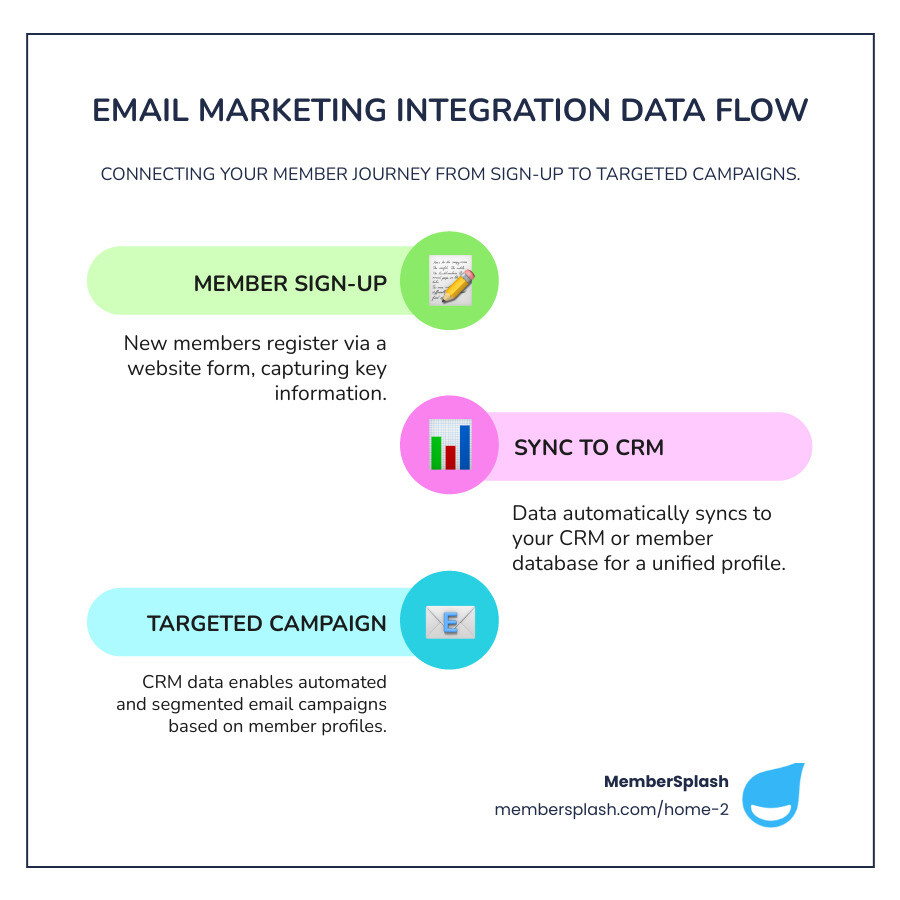
Infographic explaining the data flow from a member sign-up form, to a CRM, to a segmented email campaign. - email marketing integration infographic infographic-line-3-steps-colors

What are email marketing integrations?

At its heart, email marketing integration is all about getting your various digital tools to play nicely together. Think of it like a well-orchestrated team where every player knows their role and communicates seamlessly. Instead of siloed systems, where your member database holds one set of information and your email platform another, integration ties these systems, tools, and software together for seamless processes around email marketing.

This means unifying your data. When your marketing department can seamlessly tie systems and processes together, it allows us to unify our email marketing with our CRM, point-of-sale, and analytic tools. This eliminates the need for tedious manual data entry and ensures that the information used for your email campaigns is always up-to-date and accurate. Essentially, we’re breaking down those pesky data silos to create a single, comprehensive view of every member.

Why is email marketing integration crucial for modern businesses?

In today’s digital world, efficiency and personalization are not just buzzwords—they’re necessities. Email marketing integration is crucial for modern businesses, especially membership organizations like ours, because it directly impacts our ability to connect with members, streamline operations, and ultimately, grow.

Firstly, it’s about streamlining workflows and improving efficiency. Imagine the time saved when a new member’s details are automatically added to your email list the moment they sign up, rather than having to manually export and import lists. This automation means less manual effort, allowing our team to focus on strategy and creative content rather than repetitive administrative tasks.

Secondly, it enables hyper-personalization. With integrated data, we can send highly relevant messages to every member at the right moment. This leads to higher engagement and improved conversions, turning casual interest into lasting loyalty.

Thirdly, it improves analytics. By connecting email performance data with other business metrics, we gain a clearer picture of what’s working and why. This informed approach helps us optimize our campaigns, ensuring we’re always improving.

Finally, these benefits collectively lead to increased sales and engagement. Whether it’s driving registrations for an upcoming event, promoting club merchandise, or encouraging membership renewals, integrated email marketing helps us achieve our business goals more effectively, delivering on that impressive ROI.

How Integrations Streamline Workflows and Boost Efficiency

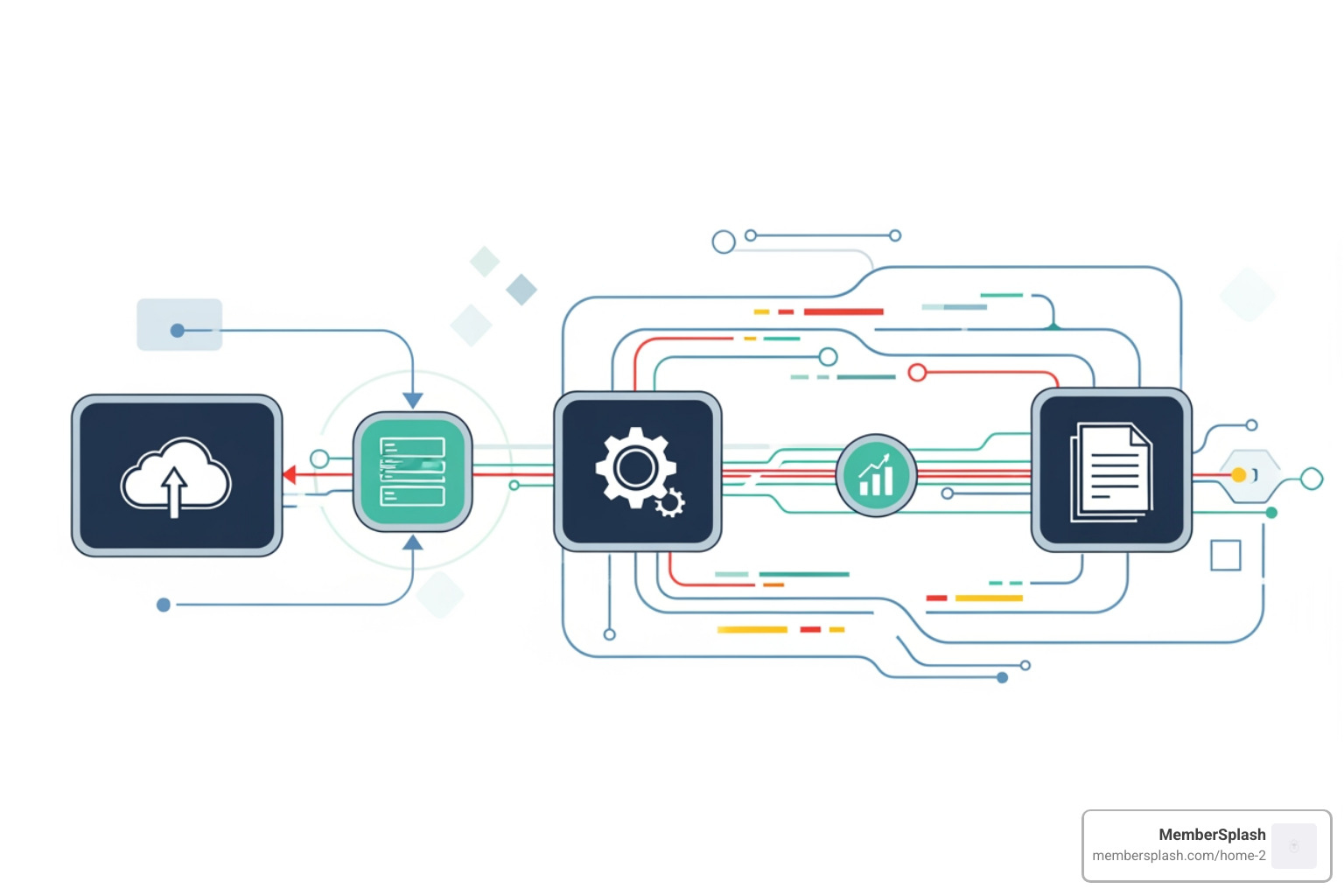
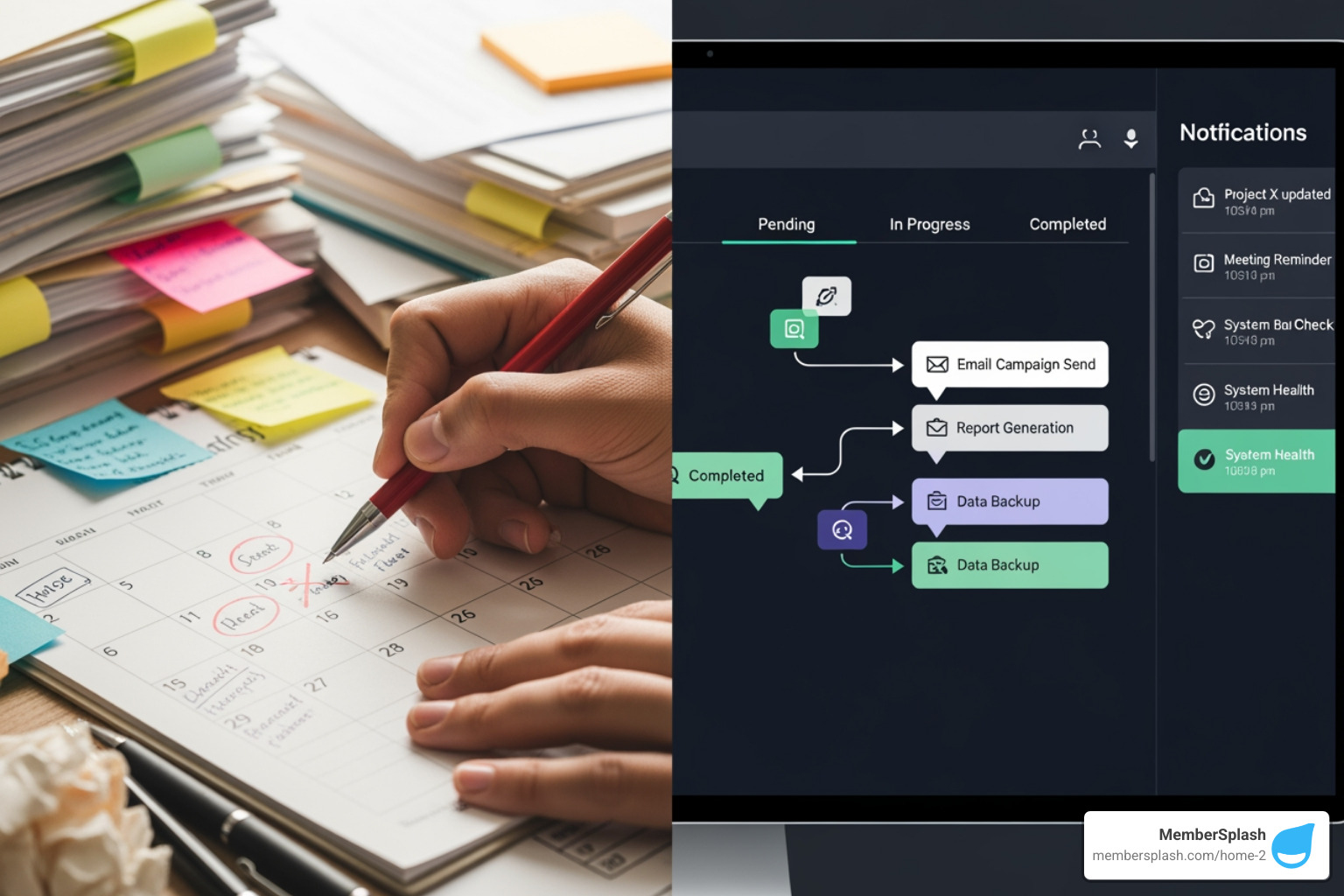
automated workflow diagram - email marketing integration

One of the most immediate and impactful benefits of email marketing integration is its ability to streamline workflows and dramatically boost efficiency. We’ve all experienced the frustration of manual tasks: copying data, sending individual reminders, or trying to piece together information from different platforms. Integrations put an end to this, freeing up valuable time and resources for our team.

By connecting your email platform with other software, we can reduce manual data entry and automate many routine communications. This means less time spent on administrative chores and more time focused on delivering exceptional experiences for our members. For example, Zapier highlights that email marketing automation allows us to automatically segment contacts, personalize messages, and schedule campaigns without manual effort, resulting in higher engagement, improved conversions, and significant time savings.

This seamless data flow also ensures consistent messaging across all member touchpoints. Whether it’s a welcome email or an event reminder, the information is always accurate and aligned with our club’s overall communication strategy. You can find more information about how we streamline member communications with our bulk email communication services.

Automating the Member Journey

For membership organizations, the member journey is a series of interactions, from initial interest to long-term engagement. Email marketing integration allows us to automate key touchpoints in this journey, making it smoother for members and simpler for our staff.

  • New Member Onboarding: The moment a new member signs up through our platform, integration can trigger a personalized welcome email series. This isn’t just a generic “hello”; it can be custom with specific information relevant to their membership type, club rules, and upcoming events. Klaviyo’s approach to welcome flows, for instance, involves saving email templates and triggering them based on “Added to List” actions, allowing us to deliver timely and relevant content.
  • Event Registration Confirmations: When a member registers for a club event, an automated confirmation email can be sent instantly, providing all necessary details. This can be followed by pre-event reminders, ensuring good attendance and reducing last-minute queries.
  • Dues Payment Reminders: Say goodbye to manually tracking overdue payments! Integrations can automatically send gentle reminders to members whose payments are approaching their due date or are overdue, improving collection rates and reducing administrative burden.
  • Automated Segmentation: Based on member actions or profile data, integrations can automatically segment our audience. For example, members who attend swim lessons might receive emails about advanced training, while those who frequent the tennis courts get updates on tournaments. This ensures every email is relevant.

Common Integration Workflows for Membership Clubs

Let’s look at some practical examples of how email marketing integration translates into real-world benefits for clubs, HOAs, and pool management companies:

  • New member signs up on website -> Add to CRM & “New Members” email list: When a prospective member fills out a contact form or completes registration on our website, their details are immediately captured and added to our CRM. Simultaneously, they are automatically subscribed to a “New Members” email list, triggering a welcome series that introduces them to the club’s amenities, rules, and community spirit. This is akin to a new lead from a social advert being added to a marketing app and triggering a sales campaign, but custom for our membership onboarding.
  • Member registers for an event -> Send confirmation & pre-event reminder emails: A member signs up for our annual pool party or a community BBQ. Our event management system, integrated with our email platform, instantly sends a confirmation email with event details. As the event draws near, automated reminders are dispatched, potentially with directions or last-minute tips, ensuring maximum attendance and engagement. This leverages the power of event-driven transactional emails and SMS, as highlighted by Mailchimp’s developer tools.
  • Member’s payment is overdue -> Trigger automated reminder sequence: Our payment processing system detects an overdue membership fee. This triggers an automated sequence of polite, yet firm, email reminders. These can be spaced out over several days or weeks, improving collection rates without requiring manual intervention from our staff.
  • Member’s birthday -> Send personalized greeting and offer: Imagine wishing every member a happy birthday with a personalized email, perhaps even including a special offer for a discounted guest pass or a free snack bar item. By integrating our member database, which contains birth dates, with our email system, we can easily set up automated birthday campaigns. This is a classic example of using CRM data to trigger personalized campaigns with a discount code, fostering member loyalty and a sense of belonging.

Opening up a 360-Degree Member View with CRM Integration

unified customer profile dashboard - email marketing integration

For any membership organization, truly understanding your members is the cornerstone of success. Email marketing integration with your CRM (Customer Relationship Management) system is the key to open uping a powerful 360-degree view of every individual. This holistic perspective means we’re not just seeing an email address; we’re seeing a complete member profile, including their membership type, payment history, event attendance, interests, and communication preferences.

Klaviyo emphasizes the power of a “CDP (Customer Data Platform) that gives you the full data story” and a “360-degree view of each customer.” This unified data empowers us to create highly personalized experiences, drive data-driven segmentation, and ultimately, increase member satisfaction and retention. When all member data resides in one accessible location, our ability to connect, engage, and serve our community is dramatically improved.

Benefits of Integrating Email Marketing with Your Member Database

Integrating our email marketing efforts with our member database (often our CRM) offers a multitude of benefits that directly impact our operational efficiency and member engagement:

  • Single Source of Truth: This is perhaps the most significant benefit. All member information—contact details, membership status, payment records, past event attendance, preferences, and communication history—resides in one central location. This eliminates data inconsistencies, reduces errors, and ensures that everyone on our team is working with the most current information. For more details on managing member data, explore our member account database services.
  • Hyper-Personalization: With a comprehensive member profile, we can move beyond basic personalization (like using a member’s first name). We can segment our audience based on specific behaviors, interests, or demographics. Imagine sending an email about upcoming swim team tryouts only to members with children in a certain age group, or promoting adult fitness classes to members who’ve attended similar events in the past. This ensures “every subscriber receives relevant content at the right moment,” leading to significantly higher open and click-through rates.
  • Targeted Campaigns: Instead of broadcasting generic messages, integration allows us to create highly targeted campaigns. We can segment our audience based on their membership tier, how long they’ve been a member, which facilities they use most, or even their past interactions. This means we can “segment our audience to stay relevant,” as Zapier suggests, sending messages that truly resonate.
  • Improved Member Engagement: When members receive emails that are relevant and timely, they feel understood and valued. This leads to increased interaction with our communications, higher attendance at events, and a stronger sense of community. This translates to “higher engagement, improved conversions,” which is the goal of any effective email strategy.

Leveraging Data for Increased Revenue

A 360-degree view of our members isn’t just about better communication; it’s a powerful tool for driving revenue and fostering loyalty. By leveraging the rich data housed in our integrated systems, we can identify opportunities for growth and tailor our offerings to maximize impact.

  • Targeted Promotions for Club Merchandise Sales: Let’s say our member database shows that a group of members frequently purchases items from our pro shop. We can send them an exclusive email promoting new merchandise arrivals or offering a special discount. This targeted approach is far more effective than a blanket promotion.
  • Upselling Membership Tiers: If a basic member frequently brings guests or expresses interest in additional amenities, our integrated system can identify this. We can then send them a personalized email highlighting the benefits and cost savings of upgrading to a higher membership tier.
  • Promoting Paid Events Based on Past Attendance: Members who have attended our annual gala or special workshops in the past are prime candidates for future paid events. Our integrated data allows us to identify these individuals and send them early-bird invitations or exclusive access, significantly increasing event participation and revenue.
  • Using Guest Tracking Data for Targeted “Bring a Friend” Campaigns: Our guest tracking data can reveal which members frequently bring guests. We can leverage this insight to send these “super-connectors” a special “bring a friend” campaign, offering incentives for new member referrals. This not only drives new memberships but also rewards our most engaged community members.

Choosing Your Tools: A Practical Guide to Email Marketing Integration

Starting your email marketing integration journey requires choosing the right tools to make those connections. The landscape of options is vast, from simple connectors to complex APIs. Understanding the different mechanisms and what to look for will ensure you choose the right path for your club or association.

At a high level, integrations are facilitated by:

  • APIs (Application Programming Interfaces): These are essentially sets of rules that allow different software applications to communicate with each other. They are the backbone of most custom and sophisticated integrations.
  • Connectors: These are pre-built links designed to connect two specific applications. They often require less technical expertise to set up.
  • Native Integrations: Many email marketing platforms offer built-in connections to popular CRMs, e-commerce platforms, or other tools. These are typically the easiest to configure.
  • Third-Party Integration Tools (e.g., Zapier): Platforms like Zapier act as a bridge between thousands of different applications, allowing you to create automated workflows (called “Zaps”) without writing any code. Zapier, for instance, can connect your email platform to “dozens of data sources” and over 3000+ apps, as SendX highlights.

Security considerations are paramount. When data is flowing between systems, we must ensure that it is protected and that we comply with all relevant data privacy regulations, such as anti-spam and privacy laws.

Key Considerations for Selecting Integration Platforms

When we’re looking to improve our email marketing with integrations, choosing the right platforms and tools is critical. Here are the key factors we consider to ensure a successful and sustainable integration strategy:

  • Scalability: Will the integration solution grow with our club? As our membership expands and our needs evolve, the chosen platform should be able to handle increasing data volumes and more complex workflows without breaking the bank or requiring a complete overhaul.
  • Ease of Use: Not everyone on our team is a developer, and that’s okay! We look for platforms that offer intuitive interfaces, often with drag-and-drop or point-and-click options. Many modern platforms offer “easy to use tools” that are “equally usable for a complete novice and an expert.”
  • Available Connectors: Does the platform already integrate with the tools we currently use, like our MemberSplash membership management system, payment processors, or event schedulers? Look for an “open API and hundreds of integrations” or even “350+ apps to connect” as some platforms boast. This reduces the need for custom development.
  • Cost and ROI: What’s the upfront cost, and what are the ongoing fees? More importantly, what’s the return on investment? We consider the time saved, the revenue generated from more targeted campaigns, and the improved member satisfaction. Email marketing has a strong ROI, but the integration needs to contribute positively to that.
  • Data Security: Protecting our members’ data is non-negotiable. We ensure any integration platform adheres to the highest security standards, encrypts data in transit and at rest, and helps us comply with relevant privacy regulations.
  • Customer Support: Should we run into an issue or need assistance, responsive and knowledgeable customer support is invaluable. We look for vendors that offer robust support channels.
  • For comprehensive support throughout your integration process, consider our supported implementation services.

The Technology Behind the Connection: APIs and Connectors

Understanding the technology behind email marketing integration, like APIs and connectors, helps explain how our systems communicate.

  • APIs (Application Programming Interfaces) Explained Simply: Think of an API as a digital waiter. You tell the API (the waiter) what data you want from another system (the kitchen), and it retrieves and delivers it. APIs define the rules for how software applications request and exchange information. Powerful Email APIs, like those highlighted by SendX, enable systems to talk directly. Mailchimp’s developer tools also emphasize how their APIs provide everything needed to integrate data with intelligent marketing tools.
  • How Connectors Work: While APIs are the underlying language, connectors are like pre-translated phrases or specific menu items. They are pre-built integrations designed to link two specific applications, often without requiring any coding. As the Glossary Entry states, email integrations are the “tying together of systems, tools, and software.” Connectors make this tying easier for common pairings.
  • Importance of an Open Developer Portal: For more complex or custom integration needs, a developer portal is invaluable. This is where developers can find documentation, tools, and resources to build bespoke connections using APIs. An open developer portal signifies a platform’s commitment to flexibility and extensive integration possibilities.
  • Native vs. Third-Party Integrations: Native integrations are built directly into a software by its vendor (e.g., your email platform has a built-in connection to a popular CRM). Third-party integrations use external tools (like Zapier) to connect applications that don’t have a direct native link. Both have their place, depending on the specific needs and technical resources available.

Email marketing integration offers immense benefits, but it’s not without potential challenges. Being aware of these can help you plan effectively and avoid future headaches.

  • Data Mapping Issues: This is a common hurdle. Different systems might call the same piece of information by different names (e.g., “Customer ID” in one system, “Member Code” in another). Ensuring that the data fields “map” correctly between systems is crucial to avoid errors and ensure accurate data transfer.
  • Maintenance Overhead: Integrations aren’t always a “set it and forget it” solution. Software updates, API changes, or even changes in our internal processes can sometimes break integrations. We need to be prepared for ongoing monitoring and occasional maintenance. Mailchimp’s best practices for developers recommend “logging and monitoring errors” to adjust code if issues persist.
  • Hidden Costs: Beyond the initial setup or subscription fees for integration tools, there might be hidden costs. These could include developer time for custom configurations, unexpected fees for high data volumes, or the cost of training staff on new integrated workflows.
  • Ensuring Data Privacy: As we consolidate and transfer member data across systems, maintaining privacy and security is paramount. We must ensure all integrated systems are compliant with regulations like GDPR or CCPA, and that we have proper consent for data usage.
  • Complying with Anti-Spam and Privacy Laws: This is a critical legal consideration, especially when automatically adding contacts to email lists. We must always ensure that our subscribers have explicitly consented to receive marketing communications from us. Failing to do so can lead to legal penalties and damage our club’s reputation.

Frequently Asked Questions about Email Marketing Integration

What’s the difference between email marketing automation and integration?

It’s a common point of confusion, but the distinction is quite simple. Think of it this way:

  • Email marketing automation is the action—it’s the process of setting up predefined rules and workflows to send messages automatically based on specific triggers (e.g., sending a welcome email when someone signs up, or a birthday greeting). It’s the “what happens.”
  • Email marketing integration is the connection that enables that action by allowing data to flow between different systems (e.g., connecting your member database to your email platform so the email platform knows when someone signs up). It’s the “how it happens.”
    As Zapier explains, email marketing automation is a subset of marketing automation, focused specifically on automating email campaigns, while integration is the essential link that enables these automated processes by sharing data between systems.

Can I connect my existing member database to an email platform?

Absolutely, and this is one of the primary and most beneficial use cases for email marketing integration! Connecting your existing member database to your email platform is fundamental for personalizing communications, automating workflows, and gaining a 360-degree view of your members. This can typically be achieved in a few ways:

  • Pre-built Connector (Native Integration): Many popular email marketing platforms offer direct integrations with common CRM or membership management systems.
  • Third-Party Integration Tool: Tools like Zapier specialize in connecting thousands of applications, often without requiring any coding. You can set up “Zaps” to transfer member data between your database and email platform.
  • Custom API Integration: For unique or highly specific needs, a custom integration can be built using APIs (Application Programming Interfaces) to establish a direct, custom connection between your systems.

How much technical skill is needed to set up an integration?

The amount of technical skill required for email marketing integration varies greatly depending on the complexity of the integration and the tools you choose:

  • No-Code/Low-Code Solutions: Many modern email marketing platforms and third-party integration tools (like Zapier) offer user-friendly interfaces that allow you to set up basic integrations with point-and-click or drag-and-drop functionality. For these, minimal technical skill is needed—mostly just a good understanding of your business processes and data. SendX, for example, highlights how easy their APIs and detailed documentation make integration.
  • Intermediate Skill: If you’re dealing with slightly more complex data mapping or custom workflows using a third-party tool, a general understanding of how data flows and logical thinking will be beneficial, but advanced coding is usually not required.
  • Advanced/Developer Skill: For highly customized integrations, working directly with APIs, or when connecting very specialized or proprietary systems, you will likely need the assistance of a developer or someone with strong technical expertise. Platforms often provide developer portals and documentation for this purpose.

Conclusion: Unify Your Systems, Amplify Your Success

In the dynamic world of membership organizations, from swim clubs to HOAs and pool management companies, effective communication is paramount. As we’ve explored, email marketing integration isn’t just a technical improvement; it’s a strategic imperative that transforms how we connect with our members and manage our operations.

By embracing integration, we open up a multitude of benefits:

  • Unprecedented Efficiency: Automating mundane tasks frees up our team’s time, reduces errors, and allows us to focus on what truly matters—our members.
  • Hyper-Personalized Engagement: Leveraging a 360-degree view of our members allows us to send highly relevant, timely messages that resonate, fostering stronger connections and loyalty.
  • Data-Driven Decisions: Integrated analytics provide clear insights into campaign performance, enabling us to optimize our strategies and maximize our ROI.

Email marketing integration changes email from a mere communication channel into a powerful, connected business tool. It’s about ensuring every dollar spent on email marketing works harder, delivering that impressive $36 for every dollar invested.

Our MemberSplash platform is designed to be the central nervous system for your club or association, making it easier than ever to integrate your email marketing efforts. We help you unify your data, streamline your workflows, and create a seamless experience for every member.

Take the Next Step

Imagine a world where new members are welcomed automatically, event promotions are perfectly targeted, and payment reminders go out without a second thought. This isn’t a dream; it’s the reality that email marketing integration offers. Unifying your club’s operations saves time, captures revenue, and improves the member experience. A connected system is key to growth and sustained success.

Ready to transform your club’s communication and management?

More info about how to maximize efficiency and savings.

Collecting HOA Dues: Strategies for Success

Why HOA Dues Collection Matters for Your Community’s Financial Health

HOA dues collection is the process of gathering assessments from homeowners to fund community operations, maintenance, and amenities. Here’s what you need to know:

Essential HOA Dues Collection Strategies:

  • Establish a clear written policy with defined due dates, late fees, and collection timelines
  • Communicate proactively with homeowners before accounts become delinquent
  • Offer flexible payment options including online payments and payment plans
  • Escalate systematically from reminder notices to liens and legal action when necessary
  • Stay compliant with state laws and the Fair Debt Collection Practices Act

HOA fees typically range from $200-$300 per month in most states. These funds are essential to keeping your community clean, safe, and livable, covering everything from landscaping and pool maintenance to insurance and reserve funds for major repairs.

When homeowners fall behind on payments, the impact ripples through the community: operating funds dry up, maintenance gets deferred, and the homeowners who do pay on time may face special assessments or increased fees.

The good news? Most owners pay their dues on time. The challenge is managing the few who don’t—and doing it in a way that’s firm but fair. Whether you’re dealing with a handful of late payments or chronic delinquencies, having the right strategies in place makes all the difference.

This guide walks you through everything from establishing a solid collection policy to leveraging modern payment technology, so you can keep your community’s finances healthy without the administrative headache.

Infographic showing the lifecycle of delinquent HOA dues: 1) Payment due date passes, 2) Grace period expires, 3) Late fee applied and reminder notice sent, 4) First warning letter with consequences outlined, 5) Second warning letter mentioning potential lien or legal action, 6) Payment plan offered if applicable, 7) Lien filed on property, 8) Collection agency or legal action initiated, 9) Potential foreclosure proceedings, 10) Resolution through payment, sale, or foreclosure completion - HOA dues collection infographic pillar-5-steps

Understanding HOA Dues and the Cost of Delinquency

Community budget chart - HOA dues collection

An HOA operates like a mini-government for your community, and it needs funds to function. These regular payments, known as HOA dues or assessments, are the lifeblood of your community, funding everything that makes your neighborhood a desirable place to live. Paid monthly, quarterly, or annually, the amount is determined by the HOA’s annual budget, which projects the costs of maintaining common areas and amenities.

What Our HOA Dues Cover:
Our HOA dues cover a wide array of essential services and amenities, including:

  • Maintenance and Repairs: Landscaping, routine upkeep of common areas (lobbies, pools, roads), and repairs to shared structures.
  • Utilities: Common area utilities like lighting, water for irrigation, and sometimes trash and snow removal.
  • Insurance: General liability insurance for common areas, property insurance for shared buildings, and Directors & Officers (D&O) insurance to protect our volunteer board members.
  • Reserve Funds: A portion of dues is set aside for major, infrequent expenses like replacing a clubhouse roof or repaving roads. This proactive saving helps avoid sudden, large special assessments.
  • Administrative Costs: Day-to-day operational costs, including management fees, legal fees, and accounting services.

The average HOA fee in most states ranges from $200 to $300 per month. These funds are vital for maintaining property values and ensuring our shared spaces are well-kept.

What Are Delinquent HOA Fees and Why Are They Crucial?

When homeowners fail to pay their HOA dues on time, those unpaid amounts become “delinquent HOA fees.” This creates significant financial challenges for the entire association.

The consequences of delinquent payments are severe:

  • Budget Shortfalls: Unpaid dues directly deplete the HOA’s operating budget, leaving less money for routine maintenance and planned improvements.
  • Deferred Maintenance: When funds are scarce, the HOA may be forced to delay essential maintenance, leading to larger, more expensive problems later and making the community less attractive.
  • Special Assessments: To cover shortfalls, the HOA might have to levy special assessments, unfairly burdening homeowners who pay on time.
  • Decreased Property Values: A community with neglected common areas and an unstable financial footing often sees a decline in property values.
  • Strain on Paying Members: Delinquency creates resentment among homeowners who pay on time but see their neighbors benefiting from shared amenities without contributing their fair share.

Effectively managing HOA dues collection is not just about balancing books; it’s about preserving the quality of life and financial health of our entire community.

Developing a Proactive and Compliant Collection Policy

A well-defined collection policy is the cornerstone of effective HOA dues collection. It provides a consistent framework, protects the HOA, and ensures all homeowners understand their obligations and the consequences of non-payment. A written policy ensures fairness and transparency, treating all homeowners equally and providing a clear roadmap for the board.

Key Components of Our Collection Policy:
Our comprehensive collection policy should clearly outline:

  • Due Dates: The exact date assessments are due.
  • Grace Periods: A period after the due date during which payments can be made without penalty.
  • Late Fees: The specific amount charged for late payments, which must be reasonable and in line with governing documents and state law.
  • Interest Rates: Any interest charged on overdue balances, adhering to legal limits.
  • Collection Timeline: A step-by-step sequence of actions the HOA will take for delinquent accounts.
  • Adherence to Governing Documents (CC&Rs): The policy must strictly follow the rules outlined in our Covenants, Conditions, and Restrictions (CC&Rs) and bylaws.
  • Legal Review: It’s a best practice to have the policy reviewed by an attorney specializing in HOA law to ensure compliance with all relevant regulations.

Communication: The Key to Successful Collections

Even the best policy is ineffective without clear communication. How we communicate with homeowners about their dues can significantly impact collection success.

Best Practices for Communication:
Our communication strategy should prioritize clarity, consistency, and respect. While we must be firm, we should always treat homeowners with dignity. All communications should be formal, factual, and courteous, clearly stating the amount due and consequences of non-payment. Written communication is preferred as it creates a formal record.

It’s also important to distinguish between Dues Letters (late notices sent to homeowners) and Status Letters (legally binding documents, also called estoppel letters, requested during a property sale to certify the amount an owner owes).

We must keep meticulous records of all communications, including dates and delivery methods. This documentation is invaluable if legal action becomes necessary.

Incentivizing Payments and Showing Compassion

While a firm policy is necessary, we recognize that homeowners can face unexpected financial hardships. A compassionate approach can often lead to quicker resolutions.

Offering Payment Plans:
A payment plan is an excellent way to help struggling homeowners catch up over time. In some states, offering a payment plan may be a mandatory step before pursuing more aggressive collection actions. We should always review our governing documents and state laws to understand our obligations.

Waiving Penalties:
For homeowners who are genuinely trying to pay but are overwhelmed by late fees, offering to waive penalties if they commit to a payment plan can be a powerful incentive.

Working with Homeowners in Hardship:
We encourage homeowners experiencing financial difficulties to communicate with us as soon as possible. By understanding their situation, we can explore options together. A proactive, empathetic approach can turn a potentially adversarial situation into a collaborative solution.

A Comprehensive Guide to HOA Dues Collection Methods

Flowchart of HOA dues collection paths - HOA dues collection

When it comes to HOA dues collection, we have a range of tools at our disposal, from simple reminders to legal actions. Understanding these methods and when to apply them is crucial for our community’s financial stability.

Foundational HOA Dues Collection Methods and Unique Strategies

Our initial approach is a progressive escalation, starting with less severe measures.

Traditional Methods:

  • Reminder Notices: A polite reminder that payment is overdue, often with the initial late fee.
  • Late Fees: Applying late fees, as outlined in our collection policy, creates a financial incentive for prompt payment.
  • Revocation of Privileges: Our governing documents may allow us to restrict access to common amenities (like the pool or gym) for delinquent accounts.

While these steps are important, some homeowners may ignore them. At some point, we need more robust strategies, such as leveraging the sale of a property. When a delinquent homeowner sells, any outstanding HOA liens must typically be satisfied before the title can be cleared for the new owner.

Foundational HOA Dues Collection Methods: Liens and Foreclosure

When other efforts fail, HOAs have significant legal remedies, primarily through placing a lien on the property and, in severe cases, initiating foreclosure.

Placing a Property Lien:
This is one of the most powerful tools in our HOA dues collection arsenal. A lien is a legal claim against the property, making it collateral for the unpaid debt. This means the homeowner cannot sell or refinance their property without first satisfying the lien.

What Happens If You Don’t Pay HOA Fees?
The consequences escalate from late fees and loss of privileges to collection agency involvement, lawsuits, property liens, and ultimately, foreclosure. Foreclosure is the most severe consequence, where the HOA can force the sale of the property to satisfy the debt.

Judicial vs. Nonjudicial Foreclosure:
Depending on state law and governing documents, foreclosure can be judicial (court-supervised) or nonjudicial (without court intervention). Both have strict legal procedures. In Maryland, for example, HOAs can foreclose but must follow specific notice requirements and respect homeowner rights.

Homeowners do have potential defenses against foreclosure, such as the HOA failing to follow proper legal procedure, charging unreasonable fees, or not having the authority to foreclose in its governing documents. It’s crucial for our HOA to follow every step correctly to ensure our collection efforts are legally sound.

Advanced HOA Dues Collection: Lawsuits and Judgments

Beyond liens, HOAs can pursue civil lawsuits to obtain a money judgment against the homeowner. For smaller amounts, this can often be done in small claims court, which is a more streamlined process.

Money Judgments and Enforcement:
A money judgment is a court order declaring that the homeowner owes a specific amount. With a judgment, we can take further steps to collect the debt, such as:

  • Wage Garnishment: Petitioning the court to have a portion of the homeowner’s wages sent directly to the HOA.
  • Attachment of Bank Accounts: Seeking a court order to freeze and seize funds from the homeowner’s bank accounts.
  • Lien on Other Property: Using the judgment to place a lien on other real estate the homeowner owns.

Homeowner’s Obligation to Pay Is Independent of HOA Duties:
A critical legal principle is that a homeowner’s obligation to pay assessments is independent of the association’s duties. A homeowner generally cannot withhold dues as a defense because they believe the HOA has failed to perform its duties (e.g., maintain common areas). Their proper recourse is to file a separate legal action to compel the HOA to act, not to engage in “self-help” by withholding payments.

Leveraging Technology and Professional Support for Better Collections

Relying solely on paper notices and checks for HOA dues collection is inefficient and outdated. Modern technology offers powerful solutions that can revolutionize how we collect dues, benefiting both the HOA and our homeowners.

Advantages of Electronic Payments

Embracing electronic payment options is a strategic move that improves financial health and operational efficiency.

  • Convenience for Homeowners: Offering online payment options (credit/debit cards, ACH/eChecks) allows homeowners to pay anytime, anywhere, meeting modern expectations.
  • Increased On-Time Payments: The easier it is to pay, the more likely homeowners are to pay on time. Automatic recurring payments and automated reminders also reduce delinquencies.
  • Reduced Administrative Costs: Switching to electronic payments significantly reduces the costs associated with printing, postage, and manual processing of paper checks, freeing up valuable volunteer time.
  • Environmental Benefits: Reducing our paper footprint aligns with sustainable practices.
  • Automated Payment Processing: Digital platforms automate invoicing, payment application, and integration with accounting software, reducing errors and providing real-time financial visibility.

Choosing the Right Platform for Your Community

Selecting the right platform is crucial. We want a system that is robust, secure, and user-friendly.

Types of Platforms:

  • Bank Portals: Many banks offer basic online payment services but may lack HOA-specific features like comprehensive reporting.
  • Specialized Payment Platforms: Some services focus solely on payment processing, offering features like lockbox services or mobile check scanning.
  • All-in-One HOA Management Software: This is often the most comprehensive solution. Platforms like MemberSplash provide a customizable system that integrates online payments with membership management, facility reservations, communication, and reporting. This holistic approach streamlines operations and saves time and money.

Key Features to Look For:
When evaluating platforms, prioritize security, comprehensive reporting, seamless member database integration, ease of use, and automation features like recurring payments and late fee application.

Even with the best technology, HOA dues collection can be complex. Sometimes, bringing in outside expertise is beneficial.

Role of HOA Management Support:
Professional HOA management companies often provide comprehensive dues collection services. They have established processes and expertise to handle everything from sending reminders to managing payment plans, freeing up the volunteer board.

When to Seek Legal Counsel:
Legal guidance is indispensable for complex collection scenarios. An HOA attorney can review collection policies, advise on liens and foreclosures, and represent the HOA in court. They can also ensure compliance with the federal Fair Debt Collection Practices Act (FDCPA), which protects consumers from unfair collection practices. While HOAs collecting their own debt are often exempt, using a third party (like a lawyer or collection agency) can bring these rules into play.

Hiring a Third-Party HOA Collection Agency:
Turning over delinquent accounts to a specialized collection agency can be an effective step. Homeowners often take the debt more seriously when contacted by a professional agency. However, these agencies charge a fee and must be carefully vetted to ensure they treat residents with dignity and comply with all laws.

Frequently Asked Questions about HOA Dues Collection

We understand that HOA dues collection can raise many questions. Here are answers to some of the most common inquiries.

Can an HOA really foreclose on my home for unpaid dues?

Yes, in most states, including Maryland, an HOA can initiate foreclosure for unpaid dues. This is a severe but legal right granted to HOAs to ensure financial stability. The process typically involves placing a lien on the property first. If the lien remains unpaid, the HOA can pursue foreclosure. While this is a powerful tool, there are strict notice requirements and homeowner protections under Maryland law. The best way to avoid this is proactive communication with the HOA if you’re facing financial difficulty.

What should I do if I can’t afford to pay my HOA dues?

If you can’t afford your HOA dues, the most important step is to communicate with the board proactively. Don’t wait until you’re deeply delinquent.

  1. Contact the Board/Management: Reach out to our HOA board or management company as soon as possible.
  2. Request a Payment Plan: Explain your situation and ask to enter into a payment plan. Many HOAs are willing to work with homeowners to establish a manageable repayment schedule.
  3. Explore Options: Discuss any available resources with us. The goal is to find a solution that prevents further penalties and legal action.

Ignoring the problem will only make it worse. Open communication is key.

Can I withhold dues if the HOA isn’t maintaining the property?

Generally, no. In most states, including Maryland, a homeowner’s obligation to pay HOA assessments is considered independent of the HOA’s duties. This means you cannot legally withhold your dues as a form of protest, even if you believe the HOA is failing in its responsibilities.

Courts consistently uphold this principle to prevent the breakdown of HOA finances. If you believe the HOA is not fulfilling its obligations, the proper recourse is to express your concerns to the board in writing, attend meetings, and, if necessary, file a separate lawsuit to compel the HOA to perform its duties. However, you must continue to pay your dues while pursuing this action.

Conclusion: Streamlining Your Collection Process for a Healthier Community

Effective HOA dues collection is more than just a financial task; it’s a vital function that underpins the health, vibrancy, and property values of our entire community. By adopting a balanced approach that combines clear policies, proactive communication, and modern technology, we can steer the challenges of delinquency with greater success and maintain a harmonious living environment.

We’ve explored the importance of understanding HOA dues, the significant costs of delinquency, and the necessity of a robust, legally compliant collection policy. From traditional methods like notices and liens to advanced legal actions and the strategic use of payment plans, a comprehensive strategy is key. Furthermore, leveraging electronic payment options not only streamlines our operations and reduces administrative burdens but also improves convenience for our homeowners, leading to increased on-time payments.

For HOAs in Annapolis, Baltimore, and across the United States, managing HOA dues collection efficiently and fairly is paramount. By investing in the right tools and professional support, we can ensure consistent cash flow, protect our community’s assets, and foster a positive relationship with our residents.

To simplify and optimize your HOA’s management and collection processes, including seamless online payments and comprehensive member management, we invite you to learn more about MemberSplash’s management solutions.

Learn more about MemberSplash’s management solutions

Streamline Success: How to Automate Membership Renewals and Billing Cycles

Why Manual Membership Renewals Are Costing You Time and Money

Automated membership renewals are systems that handle the entire renewal process—from sending reminders to processing payments—without manual intervention. Here’s what you need to know:

  • They eliminate manual paperwork by digitizing renewal notices, invoices, and payment processing
  • They reduce administrative burden by automatically tracking expiration dates and sending timely reminders
  • They improve cash flow through recurring payments and predictable revenue streams
  • They boost retention by ensuring members never miss a renewal due to forgetfulness
  • They save significant time and cost—renewing 500 members manually costs over $1,000 and takes 172 hours, while automation requires virtually no time or cost

If you’re a club manager, HOA board member, or pool facility administrator, you know the drill. Spreadsheets. Manual invoices. Chasing down late payments. The renewal season brings a mountain of paperwork and countless hours tracking who’s paid, who’s overdue, and who quietly let their membership lapse.

Managing membership renewals manually is like trying to hold water in your hands—no matter how hard you try, something always slips through. Missed payments. Expired memberships. Members who wanted to renew but simply forgot. All while your staff drowns in administrative tasks that pull them away from actually serving your members.

The subscription economy has grown 4.6x faster than the S&P 500, and there’s a reason why. Organizations that automate their renewals see dramatic improvements in efficiency, revenue predictability, and member satisfaction. Your members are already accustomed to auto-renewal from their streaming services and software subscriptions. They expect the same convenience from you.

The good news? You don’t need to keep struggling with the manual grind. Modern membership management systems can automate your entire renewal process, from sending personalized reminders to processing payments to updating member status—all while you focus on creating value for your community.

infographic showing the automated membership renewal timeline from initial onboarding through renewal reminders at 90, 60, and 30 days before expiration, renewal period, grace period notifications, and lapsed member re-engagement campaigns, with automated actions at each stage - Automated membership renewals infographic

The Manual Grind vs. The Automated Advantage

For years, many organizations, especially our beloved swim clubs, HOAs, and pool management companies, have relied on manual processes for membership renewals. This often involves physical mail, phone calls, and countless hours of data entry. While it might feel familiar, this traditional approach comes with a hefty price tag in terms of time, money, and missed opportunities.

Imagine the scene: a dedicated staff member, perhaps even a volunteer, carefully cross-referencing spreadsheets, printing invoices, stuffing envelopes, and then waiting for checks to arrive. This painstaking process is not only prone to human error but also incredibly time-consuming. Research suggests that renewing the memberships of just 500 members using traditional methods could cost over a thousand dollars and take an estimated 172 hours to complete. That’s nearly a full month of work for one person, just for renewals! This administrative burden distracts from more valuable tasks, like planning engaging events or improving member services.

Inconsistent revenue is another major headache. With manual renewals, payments trickle in, making it difficult to forecast income or plan for future club improvements. Members, too, can get frustrated by clunky, outdated systems. If renewing is a hassle, they might simply let their membership lapse, not because they don’t value your community, but because the process was too cumbersome.

Now, let’s pivot to the automated advantage. Automated membership renewals streamline the entire process, making it efficient, cost-effective, and far more pleasant for everyone involved. Instead of manual data entry, a smart system handles everything. Reminders are sent automatically, payments are processed securely online, and membership statuses are updated instantly. This dramatically reduces administrative hours and minimizes the risk of errors. Think of the peace of mind knowing your membership roster is always accurate and up-to-date.

The financial benefits are equally compelling. With automated systems, renewals can be processed at virtually no additional cost or time. This translates to significant cost savings, which can then be reinvested into your club or community. More importantly, automated renewals lead to greater revenue predictability. When payments are recurring and renewals are timely, you have a clearer picture of your financial health, enabling better budgeting and strategic planning. We’ve seen how this shift can transform an organization’s operations and financial stability.

calendar with manual reminders vs. automated workflow diagram - Automated membership renewals

Why Members and Staff Both Prefer Automation

The preference for automation isn’t just about organizational efficiency; it’s deeply rooted in the desire for convenience for both members and staff.

For members, automation means uninterrupted access to the benefits they love. No more scrambling to remember renewal dates or worrying about their access being cut off. With automated systems, they can opt for recurring payments, ensuring their membership continues seamlessly, much like their favorite streaming services. Self-service portals allow them to update their payment information, view their membership status, and manage their details at their convenience, 24/7. This level of convenience significantly improves their overall experience, fostering satisfaction and loyalty. 83% of B2B buyers prefer rep-free transactions, highlighting a clear preference for self-service options. Your members are no different. They want to renew on their terms, quickly and easily.

For your dedicated staff and volunteers, automation is a game-changer. It dramatically reduces the workload associated with manual renewals—no more chasing payments, printing invoices, or endless data entry. This frees them up to focus on what truly matters: engaging with members, organizing fantastic events, and building a vibrant community. By offloading repetitive administrative tasks, your team can dedicate their energy to value-add activities, making their roles more fulfilling and impactful. We believe that maximizing staff efficiency is key to a thriving organization, and automation is the cornerstone of that strategy. More on maximizing staff efficiency

Boosting Retention and Engagement

One of the most critical aspects of any membership-based organization is member retention. After all, it’s easier and more cost-effective to keep an existing member happy than to acquire a new one. Automated renewals play a pivotal role in boosting retention and engagement.

The harsh truth is that one of the primary reasons members fail to renew their memberships is simply because they forget. Life gets busy, and renewal notices can get lost in the shuffle. Automated systems combat this forgetfulness head-on with timely, proactive communications. By sending out a series of reminders leading up to and even slightly past the renewal date, we significantly increase the chances of a timely renewal.

Beyond just reminding them, automated communications can be custom to be personalized and engaging. We can highlight the specific benefits a member might be enjoying, or even gently remind them of upcoming events they might miss. This proactive approach makes members feel valued and connected, reinforcing their decision to be part of your community. It reduces churn by removing a common barrier to renewal—simple oversight—and fosters a sense of continued engagement and loyalty. A smooth, automated renewal process signals that your organization is modern, efficient, and cares about its members’ experience.

Key Components of an Automated Renewal System

To truly harness the power of automated membership renewals, you need a robust system built on several interconnected core components. These elements work together seamlessly to manage the entire membership lifecycle, from initial signup to ongoing renewals. Think of it as the engine driving your membership success.

interconnected parts of a membership management system - Automated membership renewals

At the heart of any effective automated renewal system are:

  • A Centralized Member Database: This is your single source of truth for all member information.
  • Automated Reminders and Communications: The system’s ability to proactively reach out to members.
  • Recurring Payments and Online Portals: The mechanisms for easy, secure transactions and member self-service.

Let’s dive deeper into each of these essential components.

Automated Reminders and Communications

Effective communication is the backbone of successful membership retention, and automation lifts it to an art form. An automated system allows us to set up sophisticated sequences of reminders and messages that go out at predetermined intervals.

These can include:

  • Pre-renewal notices: Gentle nudges sent well in advance (e.g., 90, 60, 30 days out) to inform members their renewal is approaching and to highlight the value of their membership.
  • Renewal notices: Clear calls to action sent as the renewal date arrives, with easy links to renew.
  • Grace period reminders: Messages sent during a specified period after expiration, offering a final chance to renew before membership benefits are fully suspended.
  • Lapsed member campaigns: Targeted communications aimed at re-engaging members who have not renewed, perhaps with special offers or a reminder of what they’re missing.

These communications aren’t just generic blasts; they can be personalized with the member’s name, membership type, and direct links to their renewal portal. This level of customization makes members feel seen and valued, increasing the likelihood of renewal. We can easily configure these email sequences, ensuring the right message reaches the right member at the right time. Learn about bulk email features

Recurring Payments and Online Portals

The convenience of modern life often revolves around recurring payments, and membership renewals are no exception. A core component of an automated system is the ability to offer secure, recurring payment options. Members can simply set it and forget it, knowing their membership will automatically renew without interruption. This provides a frictionless experience for them and a steady, predictable revenue stream for your organization.

Alongside recurring payments, online portals are indispensable. These self-service hubs empower members to:

  • Update payment information: Easily change credit card details if they expire or are updated.
  • View invoices and payment history: Access their financial records at any time.
  • Manage their membership: Review their membership type, expiration date, and other relevant details.

These portals reduce administrative calls and emails, as members can find answers and manage their accounts independently. They provide a secure payment processing environment, giving members confidence in their transactions. Explore online payment processing

Here’s a quick comparison of manual vs. automated payment workflows:

Feature Manual Invoice Workflow Automated Recurring Payment Workflow
Member Action Required Receive invoice, remember to pay, send check/go online Opt-in once, payment automatically processed
Payment Method Checks, manual online payments, cash Credit card, digital wallet (auto-charge)
Reminders Manual calls/emails, paper notices Automated email/SMS sequences
Staff Effort High (printing, mailing, data entry, chasing) Low (initial setup, monitoring)
Error Rate Higher (typos, missed payments) Lower (system-driven)
Revenue Predictability Low High
Member Experience Potentially clunky, forgettable Seamless, convenient, uninterrupted

A Centralized Member Database

The foundation of any successful automated membership system is a robust, centralized member database. This isn’t just a fancy spreadsheet; it’s a dynamic repository that holds all critical information about your members in one secure location.

A centralized database ensures a “single source of truth,” meaning everyone on your team accesses the same, up-to-date information. This eliminates discrepancies and errors that often plague fragmented data across multiple systems or spreadsheets.

Key data points managed in such a database include:

  • Contact information: Names, addresses, phone numbers, email addresses.
  • Membership history: Join date, renewal dates, membership type, payment history.
  • Membership status: Active, pending, lapsed, grace period.
  • Engagement tracking: Records of event attendance, volunteer activities, communications received.

Having all this information consolidated allows for powerful segmentation and personalization, which we’ll discuss further. It provides the essential data needed for targeted communications, effective reporting, and a holistic view of each member’s journey with your organization. This is crucial for understanding your community and tailoring your offerings to their needs. Benefits of a central member database

Your Step-by-Step Guide to Implementing Automated Membership Renewals

Implementing automated membership renewals might seem like a big undertaking, but with a clear strategy and the right tools, it’s a manageable and incredibly rewarding process. We’re here to guide you through it.

Step 1: Map Your Current Renewal Process and Set Goals

Before you can automate, you need to understand what you’re currently doing.

  • Identify pain points: Where are the bottlenecks in your manual process? Is it chasing payments, updating spreadsheets, or dealing with forgotten renewals? Pinpointing these will highlight where automation will have the biggest impact.
  • Define success metrics: What do you hope to achieve? Higher renewal rates? Reduced administrative hours? Improved cash flow? Quantify these goals so you can measure your success. For example, aim to increase your renewal rate by a specific percentage or reduce staff time spent on renewals by a defined number of hours.
  • Choose a timeline: Set realistic expectations for when you want to research, implement, and launch your new system.

Step 2: Choose the Right Membership Management Software

This is perhaps the most critical step. Selecting the right software is like choosing the right foundation for your club’s future. For organizations like swim clubs, HOAs, and pool management companies in our area, a system that understands your unique needs is essential. We recommend looking for the following features:

  • Comprehensive Member Management: Tracks memberships, payments, and renewals efficiently.
  • Online Payment Processing: Securely handles credit card transactions and recurring payments.
  • Automated Communication Tools: Enables scheduled email and SMS reminders.
  • Self-Service Member Portal: Allows members to manage their own profiles and payments.
  • Access Control Integration: If applicable for your facility, integrates with check-in and access systems.
  • Event Management: Streamlines event registration and communication.
  • Reporting and Analytics: Provides insights into membership trends and financial data.
  • Customization and Scalability: The ability to tailor the platform to your specific rules and grow with your organization.
  • Security: Robust measures to protect member data and financial information.
  • User-Friendly Interface: Easy for both staff and members to steer.
  • Dedicated Support: Access to assistance when you need it.

When evaluating options, consider how well the software can handle complex pricing structures, seasonal memberships, and guest tracking—features particularly important for local clubs and HOAs in communities around Annapolis and Baltimore.

Step 3: Configure Your Automation Workflows

Once you’ve chosen your software, it’s time to set up the automation. This involves customizing the system to fit your organization’s specific renewal policies.

  • Set reminder intervals: Decide when and how often members will receive renewal reminders. A common strategy is to send notices at 90, 60, 30, and 7 days before expiration, followed by reminders during a grace period.
  • Customize email templates: Craft clear, compelling, and personalized messages. Include direct links to the renewal portal and highlight the benefits of continued membership. Remember to test these emails thoroughly to ensure they look good on all devices and that links are working correctly.
  • Configure payment options: Set up recurring payment options, define pricing for different membership tiers, and ensure your payment gateway is integrated and secure.
  • Define grace periods: Determine how long members have to renew after their official expiration date before their benefits are suspended. Configure automated reminders for this period as well.

Step 4: Communicate the Change and Go Live

The final stage is rolling out your new automated system. This requires clear communication to your members to ensure a smooth transition.

  • Inform members of the new process: Send out an announcement explaining the benefits of the new system (e.g., easier renewal, uninterrupted service).
  • Provide clear instructions: Offer a simple guide on how to use the new member portal, update payment information, or opt into auto-renewal.
  • Offer support: Designate a point person or team to answer questions and assist members during the transition.
  • Monitor the initial launch: Keep a close eye on renewal rates, payment processing, and member feedback immediately after launch. Be prepared to address any unexpected issues quickly.
  • Send test emails: Before fully launching automated reminders, send test emails to yourself and a few trusted colleagues to confirm everything is working as intended.

Optimizing Your Strategy and Overcoming Challenges

Even with a fully automated system, the work isn’t entirely done. To truly maximize the benefits of automated membership renewals, we need to continuously optimize our strategy and be prepared to address potential challenges. This involves leveraging data, personalizing communications, and understanding the legal landscape.

Using Data to Refine Your Approach

Data is your secret weapon for fine-tuning your renewal strategy. A good membership management system will provide robust reporting tools that give us invaluable insights.

  • Track renewal rates: Monitor overall renewal percentages and segment them by membership type, tenure, or other demographics to identify trends.
  • Analyze member behavior: Look at who is renewing, when they’re renewing, and which communications are most effective. Are members engaging with your emails? Are they clicking the renewal links?
  • A/B test communications: Experiment with different subject lines, email content, and call-to-actions to see what resonates best with your members. Small tweaks can lead to significant improvements in renewal rates.
  • Identify at-risk members: Data can help us spot members who might be disengaging or are less likely to renew. Perhaps they haven’t attended an event recently, or their login activity has decreased. This allows for proactive, targeted outreach to re-engage them before they lapse.

Regularly reviewing these reports and using the insights to fine-tune your automation strategy ensures your system is always performing at its best. We can gain a clearer understanding of what works and what doesn’t, allowing us to allocate resources more effectively for retention efforts. Learn about custom reporting tools

Personalization and Flexible Options

While automation handles the mechanics, personalization ensures the human touch. Generic communications can feel cold; custom messages foster connection.

  • Segmented messaging: Divide your members into groups based on their interests, membership history, or engagement levels. Send different messages to long-term members versus new members, or to members who prefer certain activities.
  • Tiered membership offers: Use automation to present options for different membership levels during renewal. Some members might be ready to upgrade, while others might appreciate a more affordable downgrade path if their circumstances change. Providing downgrade paths can ensure that these members still find value in staying connected with your organization, albeit at a lower tier, preventing complete churn.
  • Celebrate milestones: Automated systems can trigger personalized messages for membership anniversaries or other milestones, making members feel appreciated and strengthening their bond with your community.

By customizing automated renewal communications, we improve their effectiveness and demonstrate our commitment to each member’s unique experience.

Addressing Common Challenges

Even the best automated systems can encounter bumps in the road. Being prepared for common challenges is key to maintaining a smooth renewal process.

  • Failed payments: Credit cards expire, get lost, or are replaced. A robust system should have dunning management features that automatically retry failed payments and notify members immediately.
  • Expired credit cards: Automated reminders can prompt members to update their payment information before their card expires, preventing a lapse in membership.
  • Legal compliance with auto-renewal laws: It’s crucial to understand state-specific laws regarding auto-renewal. In the US, some states have specific requirements for clear disclosure, consent, and cancellation procedures for automatically renewing subscriptions. Ensure your terms of service and communications clearly outline your auto-renewal policies and provide easy ways for members to manage or cancel their subscriptions. This is particularly important for organizations operating in Annapolis, Baltimore, and other parts of Maryland. We must ensure our processes are transparent and compliant.

By proactively addressing these potential issues, we can maintain high renewal rates and a positive member experience.

Frequently Asked Questions about Automated Renewals

How far in advance should we send renewal reminders?

Best practice suggests a sequence starting 60-90 days before expiration, with increasing frequency as the date approaches, including reminders during a grace period. This catches both early planners and last-minute renewers.

What happens if an automated payment fails?

A good system includes a dunning management process. It should automatically retry the payment, notify the member of the failure via email, and provide a direct link for them to update their payment information in a secure portal.

Can we still accept manual payments like checks?

Yes. A flexible membership management platform should allow you to manually record offline payments (check, cash) for a member, which then updates their status and stops any further automated “overdue” reminders for that cycle.

Conclusion: Make Every Renewal a Success

We’ve explored the profound difference automated membership renewals can make for your organization. From escaping the manual grind and its associated costs to significantly boosting member retention and engagement, automation is not just a convenience—it’s a strategic imperative for modern club and community management.

By implementing a system with core components like automated communications, recurring payments, online portals, and a centralized database, you empower your staff, delight your members, and secure your financial future. We can transform administrative burdens into opportunities for growth and deeper member connection.

The future of club management is efficient, member-centric, and automated. By embracing these changes, we ensure every renewal is a success, contributing to a vibrant, thriving community for years to come. MemberSplash is dedicated to providing solutions that simplify your operations and improve your members’ experience.

Discover management solutions for your club

Beyond the Buzz: Choosing the Right SMS Platform for Your Business

Why Every Business Needs an SMS Communication Platform

An SMS communication platform is a software tool that enables businesses to send, receive, and manage text messages at scale with customers and members. These platforms provide features like mass texting, two-way messaging, automation, and analytics to streamline communication and boost engagement.

Key capabilities of SMS communication platforms:

  • Two-way messaging – Have real conversations with customers, not just broadcast messages
  • Mass texting – Send bulk SMS to large contact lists efficiently
  • Automation – Schedule campaigns, set up drip sequences, and trigger messages based on actions
  • Segmentation – Target specific groups based on demographics, behavior, or purchase history
  • Analytics – Track open rates, click-through rates, and campaign performance
  • Compliance tools – Manage opt-ins, opt-outs, and regulatory requirements like TCPA and GDPR

If you’re managing a club, HOA, or pool facility, you know the pain of chasing down members about renewals, sending reminders, and trying to get important updates actually read. Email often fails you – buried in inboxes, filtered to spam, or simply ignored.

SMS changes that equation dramatically. Text messages boast a 98% open rate compared to just 20% for emails. Even better, 9 out of 10 people read texts, and 45% reply – often within minutes. When you need members to see a facility closure alert, a payment reminder, or a registration deadline, SMS gets the job done.

The challenge isn’t whether SMS works. It’s choosing the right platform that fits your needs without drowning you in complexity or hidden costs. Some platforms are built for enterprise marketing teams with massive budgets. Others are developer tools that require technical expertise. And many promise simplicity but nickel-and-dime you with confusing pricing.

This guide cuts through the noise to help you understand what matters when evaluating SMS platforms – especially if you’re trying to reduce administrative burden while ensuring you never miss capturing revenue.

Infographic comparing SMS vs Email communication showing 98% open rate for SMS messages versus 20% for email, 45% response rate for SMS versus 6% for email, and average read time within 3 minutes for SMS versus several hours for email - SMS communication platform infographic

Key Features of a Modern SMS Communication Platform

When we look for an effective SMS communication platform, we’re seeking more than just a way to send texts. We’re looking for a comprehensive tool that acts as a central hub for our member and customer interactions. The best platforms streamline processes, improve engagement, and ultimately help us achieve our operational and revenue goals.

Here are the key features that truly make a difference:

  • Two-Way Messaging: This isn’t just about sending announcements; it’s about fostering conversations. A robust platform allows members to reply to your messages, whether it’s to ask a question about an event or confirm an appointment. This immediate feedback loop is invaluable.
  • Mass Texting: The ability to send bulk SMS to large lists of recipients efficiently is foundational. Whether it’s an urgent facility closure or a special holiday promotion, reaching everyone at once is critical.
  • Automation Workflows: Imagine sending a welcome message to a new member, a reminder about an upcoming payment, or a notification about an expiring membership – all automatically. Automation saves immense time and ensures consistency.
  • Personalization: Generic messages often get ignored. A good platform lets us personalize texts with member names, specific reservation details, or custom offers, making each message feel more relevant and valued.
  • Audience Segmentation: Not all messages are for everyone. Segmenting our audience based on interests, membership type, or past interactions ensures that our messages are targeted and effective.
  • Analytics and Reporting: We need to know what’s working. Tracking open rates, click-through rates, and overall campaign performance allows us to refine our strategies and improve over time.
  • MMS Support: Sometimes, a picture truly is worth a thousand words. The ability to send multimedia messages (MMS) allows for richer communication, whether it’s a photo of a newly renovated pool area or a visual for an upcoming event.

A clean SMS platform dashboard showing a unified inbox for messages and various analytics widgets - SMS communication platform

Facilitating Two-Way Conversations and Support

One of the most powerful aspects of a modern SMS communication platform is its ability to facilitate true two-way communication. Unlike traditional one-way alerts, these platforms enable genuine conversations, making members feel heard and valued.

  • Shared Inbox: For clubs and HOAs, this means a centralized place where our team can manage all incoming and outgoing messages. No more scattered texts across personal phones! Everyone on the team can see conversation history, ensuring seamless support and preventing duplicate responses.
  • Real-time Chat: When a member has a quick question about pool hours or a tennis court booking, a real-time text chat is often far more convenient for them than a phone call or email. We can provide immediate answers, improving member satisfaction.
  • Customer Feedback: SMS can be an excellent channel for gathering quick feedback. A simple text survey after an event or a facility visit can provide valuable insights.
  • Automated Replies: While encouraging conversations, we can also set up automated replies for common queries or after-hours messages. This ensures members always get a response, even when staff aren’t immediately available.
  • Templates: To ensure consistency and efficiency, platforms offer message templates. These can be pre-approved responses for FAQs or standard messages for various scenarios, saving our team time.
  • Member Database Integration: For organizations like ours, integrating SMS with a robust member database is crucial. This allows us to link conversations directly to member profiles, access their information, and ensure all communications are personalized and context-aware. Learn more about how a comprehensive member account database can transform your communication.

Automation and Scalability

Automation is the secret sauce for efficiency, especially when managing memberships, events, and facilities. A strong SMS communication platform allows us to set up intelligent workflows that handle routine tasks, freeing our team to focus on more complex member needs.

  • Scheduled Campaigns: We can plan and schedule messages in advance for things like event announcements, payment reminders, or seasonal promotions. This ensures timely delivery without last-minute scrambling.
  • Drip Campaigns: For new members, a series of automated welcome messages can introduce them to facilities, rules, and upcoming events. This helps onboard them smoothly and keeps them engaged from day one.
  • Keyword-Based Autoresponders: Imagine a member texting “HOURS” to our dedicated number and instantly receiving our operating hours. Or “EVENTS” for a list of upcoming activities. These autoresponders provide instant information and reduce inbound calls.
  • API Access: For more advanced needs, API access allows us to integrate SMS functionality directly into our existing systems or custom applications, providing ultimate flexibility.
  • Triggered Messages: These are powerful. A message can be triggered by a specific action, such as a payment confirmation after a successful transaction, or a notification when a spot opens up on a waitlist. This is particularly useful for managing popular amenities. Find how automated waitlist management can keep your operations smooth and fair.

The ability to scale these automations means that whether we have 100 members or 10,000, our communication remains efficient and personalized without increasing our administrative burden.

How Businesses Leverage SMS for Growth

SMS isn’t just for quick alerts; it’s a powerful engine for business growth. By leveraging a robust SMS communication platform, we can significantly improve customer engagement, drive sales, improve our return on investment (ROI), and boost overall operational efficiency. SMS marketing boasts an impressive average ROI of $42 for every $1 spent, making it a highly cost-effective channel.

A graphic illustrating an automated SMS workflow for an appointment reminder, showing a calendar event triggering an SMS send, which is then delivered to the customer's phone - SMS communication platform

Marketing and Promotions

For clubs, HOAs, and pool facilities, SMS opens up a direct, high-impact channel for marketing and promotions that members actually see.

  • Promotional Offers & Flash Sales: Want to fill a last-minute tennis clinic or offer a discount on guest passes? A quick SMS can reach members instantly, often resulting in immediate uptake.
  • Loyalty Programs: We can use SMS to announce new loyalty rewards, track points, or send exclusive offers to our most engaged members, encouraging continued participation and spending.
  • Text-to-Win Contests: Running a contest via text is simple and drives engagement. “Text ‘SWIM’ to 555888 to enter our summer raffle!” This is a fun way to interact with members and grow our contact list.
  • Abandoned Cart Recovery: For businesses with online stores (e.g., club merchandise), if a member adds items to their cart but doesn’t complete the purchase, an automated SMS reminder can gently nudge them to return and complete their order.
  • Bulk Communication: Beyond individual messages, the ability to send bulk email and SMS communication allows us to quickly disseminate newsletters, important updates, or event invitations to segmented groups of members, ensuring high visibility for our most critical messages.

Operations and Customer Service

Beyond marketing, SMS is an indispensable tool for daily operations and improving customer service, especially for membership-based organizations.

  • Appointment Reminders: Reduce no-shows for tennis court bookings, personal training sessions, or facility reservations with automated SMS reminders. This saves time and ensures optimal resource utilization.
  • Order Confirmations: Whether it’s a new membership purchase or an event registration, an instant SMS confirmation provides peace of mind and reduces inquiries.
  • Payment Notifications: Alert members about upcoming payment due dates, successful transactions, or overdue balances. This can significantly improve cash flow and reduce administrative follow-ups.
  • Customer Support: For urgent issues or quick questions, SMS provides a fast and convenient support channel. Our team can respond efficiently, leading to higher member satisfaction.
  • Reservation Systems: Integrating SMS with our reservation systems allows for automated confirmations, reminders, and even waitlist notifications, ensuring members are always informed about their bookings.
  • Shipping Updates: If we operate a club shop that ships merchandise, automated SMS updates can keep members informed about their order status, from dispatch to delivery.

By integrating SMS into these operational workflows, we not only improve member experience but also significantly reduce the manual effort required from our staff.

While the benefits of an SMS communication platform are clear, it’s crucial to steer the regulatory landscape and adhere to best practices. Ignoring compliance can lead to hefty fines and damage to our reputation. For businesses operating in the United States, like those in Annapolis, MD or Baltimore, MD, understanding regulations like the TCPA and the new A2P 10DLC requirements is non-negotiable.

Compliance is paramount in SMS marketing. We must ensure our communication practices protect member privacy and adhere to legal standards.

  • Explicit Consent: We must always obtain explicit consent from our members before sending them any text messages. This means they must actively opt-in, typically by filling out a form or texting a keyword. Simply having their phone number isn’t enough.
  • Clear Opt-Out Instructions: Every marketing or promotional SMS must include clear instructions on how to opt-out, usually by replying “STOP.” Our platform must automatically manage these opt-out requests promptly.
  • TCPA (Telephone Consumer Protection Act): This US federal law governs telemarketing calls and texts. It requires prior express written consent for marketing messages and provides strict rules for automated dialing systems.
  • GDPR (General Data Protection Regulation): While primarily a European regulation, if we have any members who are EU citizens, we need to be mindful of its stringent data protection and privacy rules, particularly regarding consent and data handling.
  • A2P 10DLC Registration: As of August 2023, businesses sending texts to customers in the US need to register with The Campaign Registry. This system is for Application-to-Person (A2P) messaging over 10-Digit Long Codes (10DLC). Unregistered phone numbers are likely to be blocked by carriers, meaning our messages won’t reach our members. Our chosen SMS communication platform should guide us through this essential registration process to ensure our messages are legitimate and delivered.

Best Practices for Successful Campaigns

Beyond legal compliance, following best practices ensures our SMS campaigns are not just delivered, but also effective and well-received by our members.

  • Message Timing: Consider when our members are most likely to read and respond. Urgent alerts might be immediate, but promotional offers might be better received during business hours or evenings.
  • Clear Call-to-Action (CTA): Every message should have a purpose. Do we want them to click a link, reply with a keyword, or visit our facility? Make it crystal clear.
  • Message Personalization: Using a member’s name or referencing their specific membership status can significantly increase engagement. Our platform should easily integrate with our member database for this.
  • Conciseness: SMS is about brevity. Get straight to the point. While longer messages are possible, they can incur additional charges and might lose the reader’s attention. A standard SMS is 160 characters.
  • Using a Dedicated Business Number: A dedicated business SMS number (like a local 10-digit number, a toll-free number, or a short code) improves professionalism and allows for two-way communication. Using a personal mobile number for business is unprofessional, lacks scalability, and complicates compliance.
  • Analytics and Reporting: Regularly reviewing custom reports on message delivery rates, open rates, and conversion rates helps us understand what works best for our audience and continuously optimize our campaigns.

Selecting the ideal SMS communication platform can feel like a daunting task given the myriad of options available. However, by focusing on key criteria like integration capabilities, pricing models, and how the platform aligns with future trends, we can make an informed decision that truly benefits our business.

Pricing Model Description Best For
Pay-as-you-go You pay a set price for each message sent or received. There are no monthly fees, offering maximum flexibility. Businesses with infrequent or unpredictable messaging needs, or those just starting with SMS and wanting to test the waters without commitment.
Monthly Subscription You purchase a bundle of message credits or a plan with a set number of messages for a fixed monthly fee. This often provides a lower per-message cost than pay-as-you-go. Businesses with consistent, predictable monthly messaging volume. This model simplifies budgeting and rewards regular usage.
Tiered Plans Multiple subscription levels are offered, with each tier providing more messages and/or advanced features for a higher price. Growing businesses that need scalability. You can start on a lower tier and easily upgrade as your contact list and messaging needs expand.

Navigating the Club Waitlist: What to Expect When You’re Expecting a Membership

The Unprecedented Rise of Country Club Waitlists

Country club waitlist times have exploded in the post-pandemic era, with nearly half of all private clubs now maintaining waitlists compared to just a quarter before COVID-19. For club managers and board members, this surge represents both an opportunity and a significant operational challenge.

Key Facts About Country Club Waitlists:

  • 49% of golf country clubs now have waitlists, up from 25% in 2019
  • Median initiation fees doubled from $25,000 to $56,000 since the pandemic
  • Wait times range from a few months to over 7 years depending on club exclusivity
  • 70% of prospects say they won’t join a club with a 12+ month waitlist
  • Attrition rates dropped from 5-6% pre-pandemic to 3-4% currently, slowing membership turnover

The waitlist phenomenon isn’t just about increased demand. It reflects a fundamental shift in how Americans view private club membership. Remote work flexibility freed people to spend more time at clubs. Families sought safe, outdoor recreation during lockdowns. And perhaps most significantly, members simply stopped leaving—creating a bottleneck that transformed club operations overnight.

For clubs that have never managed a waitlist before, the challenge is substantial. How do you balance member satisfaction with revenue opportunities? What amenities should waitlisted applicants access? How do you prevent your waitlist from becoming a liability rather than an asset?

The answers require careful strategy, clear communication, and often, better technology to manage the complexity. This guide will walk you through everything you need to know about country club waitlists—from the forces driving demand to the practical systems that keep operations running smoothly.

Infographic showing country club waitlist statistics: 25% of clubs had waitlists in 2019 vs 49% now, median initiation fees increased from $29,000 to $50,000 for golf clubs, attrition rates dropped from 5-6% to 3-4%, and 70% of prospects won't join clubs with 12+ month waits - Country club waitlist infographic checklist-notebook

The “Why” Behind the Wait: Factors Fueling the Surge

The current boom in country club waitlists isn’t a fluke; it’s the culmination of several powerful trends that have reshaped the private club landscape. What was once a niche pursuit for some has become a highly sought-after lifestyle for many, leading to unprecedented demand and longer waiting periods.

The Pandemic Effect on Membership

The COVID-19 pandemic acted as a powerful catalyst, fundamentally altering how we live, work, and seek recreation. With remote work becoming the norm for many, individuals and families gained newfound flexibility. This led to a search for safe, accessible, and enjoyable local amenities. Country clubs, with their expansive grounds, outdoor activities, and controlled environments, became attractive havens.

Crucially, the pandemic also led to a significant drop in member attrition rates. Before 2020, clubs typically saw 5-6% of their members resign each year. Today, that figure has fallen to 3-4%. This means members are staying put longer, creating fewer openings for new applicants. A club that once replaced its entire membership every 20 years now takes 33 years at the lower attrition rate. This slower replacement cycle directly translates into longer waitlists, as fewer spots open up each year. The increased interest in golf, in particular, played a huge role, driving up demand for private golf club memberships and tee times.

Economic and Supply Dynamics

Beyond the pandemic’s immediate impact, broader economic and supply dynamics have contributed to the waitlist surge.

First, the overall supply of country clubs in the U.S. has been contracting. In 2008, there were approximately 12,059 country clubs. By 2023, this number had fallen to 10,016, with a further slight decrease projected for 2024. While golf course closures are slowing and some new courses are in planning, the net effect is fewer private clubs to accommodate growing demand. This reduced supply, coupled with surging interest, naturally creates a bottleneck.

Second, clubs are engaged in an “amenities arms race.” To attract and retain members, many are investing millions in facility upgrades, renovations, and new programming. This investment, while enhancing the member experience, also drives up operational costs and justifies higher initiation fees. The median initiation fee for golf clubs, for instance, jumped from $29,000 in 2019 to around $50,000 by late 2022. Non-golf clubs saw their median initiation fees rise from $13,000 to $22,000 in the same period.

This combination of pandemic-fueled demand, lower attrition, reduced club supply, and increased investment has created a “good problem” for many clubs—but a challenging one for those aspiring to join. As one industry expert noted, it’s taking longer to get into clubs these days. You can learn more about this trend and its implications for golf clubs: Why it’s taking so long to get into golf clubs these days.

The Anatomy of a Country Club Waitlist

of a diverse group of people at a club social event - Country club waitlist

For prospective members, understanding the intricacies of a country club waitlist is crucial. It’s not just about getting your name on a list; it’s about navigating varying wait times, financial commitments, and managing expectations regarding access to amenities.

Typical Wait Times and Regional Differences

The length of a country club waitlist can vary dramatically, from a few months to several years, depending on the club’s exclusivity, location, and the type of membership desired. While some clubs in our region, like those in Annapolis and Baltimore, might have more manageable wait times, highly exclusive clubs across the country have seen waitlists extend upwards of seven years.

For example, a survey of prospective members revealed that 62% would be “not likely” or “not at all likely” to join a club with a golf membership waitlist longer than nine months. However, 38% were willing to wait one to four months, and 42% were willing to wait five months to one year. This suggests a sweet spot for clubs in managing expectations.

Wait times also differ significantly between social and golf memberships. Social memberships typically grant access to dining, social events, fitness centers, and sometimes pools and tennis courts, but exclude golf privileges. Golf memberships, of course, include everything. Because golf courses have limited capacity, golf memberships almost universally have longer and more competitive waitlists.

Understanding the Financials of a Country Club Waitlist

Joining a waitlist often comes with its own set of financial considerations, even before full membership is granted.

  • Initiation Fees: These are the one-time, upfront costs to join a club. As we’ve seen, median initiation fees for golf clubs have doubled since 2019, reaching around $50,000. For clubs without golf, they’ve risen to about $22,000. These fees are often used by clubs to fund capital improvements and facility upgrades.
  • Non-refundable Deposits: Many clubs now require a non-refundable deposit to secure a spot on the waitlist. This is a strategy to ensure applicants are serious and committed. While 82% of prospects surveyed said they wouldn’t invest 50% of the initiation fee to hold a spot, a smaller, nominal application fee can still generate significant revenue for clubs and filter out uncommitted individuals. In our region, some clubs have reported averaging over $6,000 annually from waitlist application fees alone.
  • Monthly Dues While Waiting: Some clubs might offer a “waitlist membership” tier that allows limited access to amenities for a reduced monthly due while you await full membership.
  • Food and Beverage Minimums: Once a full member, most clubs require members to spend a minimum amount on food and beverages each month or quarter.
  • Capital Assessments: Clubs may occasionally levy special assessments on members to fund major renovations or improvements.

Modern club management platforms can greatly simplify the process of handling these financial transactions, from application fees to monthly dues. Learn more about how these systems can help with seamless payment processing: More info about online payment processing.

Privileges and Expectations While You Wait

For those patiently waiting, the question of what access they can expect is paramount. Our research shows a clear hierarchy of desires among prospective members:

  • Golf Access: This is overwhelmingly the most important amenity for waitlisted members, with 94% of those surveyed stating its importance. Even limited access, such as off-peak tee times or practice facility use (83% found this important), can significantly improve the waitlist experience.
  • Dining Privileges: While not as critical as golf, 43% of prospective members found access to dining important or very important, especially during peak season (78%).
  • Social Event Invitations: About 26% found member events important. These can be a great way to integrate waitlisted individuals into the club community.
  • Pool and Tennis Access: For clubs offering these amenities, limited access can also be a valuable perk for those on the waitlist, particularly for families.

Clubs that offer some level of access to waitlisted members often find it helps keep them engaged and reduces the likelihood of them seeking alternatives.

From the Club’s Perspective: Effective Waitlist Management

For country clubs, a robust country club waitlist is a double-edged sword. While it signifies high demand and perceived exclusivity, managing it effectively is crucial to maintain member satisfaction, generate revenue, and ensure long-term stability.

Strategies for Managing a Full Roster

As clubs in Annapolis, Baltimore, and across the U.S. steer unprecedented demand, implementing smart waitlist management strategies is more important than ever.

  1. Define Maximum Capacity: The fundamental reason for a waitlist is to preserve the experience for current members. Clubs must determine an optimal member capacity to prevent overcrowding and ensure access to amenities.
  2. Non-Refundable Deposits: To filter out uncommitted applicants, many clubs are making deposits non-refundable or partially non-refundable. This ensures that those on the list are truly serious about joining. Charging a nominal application fee, even just $100, can generate significant revenue and act as a filter.
  3. Tiered Access Levels: Consider offering waitlisted members limited access to certain amenities. For instance, allowing access to dining, social events, or even the practice facility can keep prospects engaged without overwhelming the main golf course or other premium facilities.
  4. Clear Communication: Regular and transparent communication is vital. Inform applicants about their position, estimated wait times, and any available perks. MemberSplash’s bulk email communication tools can help clubs send targeted updates to waitlist applicants efficiently. Explore our features for seamless communication: More info about bulk email communication.
  5. Prioritization Systems: While many clubs operate on a first-come, first-served basis, some implement more sophisticated prioritization systems. This could involve awarding points based on answers to follow-up questions (e.g., interest in specific amenities, willingness to serve on committees) or giving preference to referrals from existing members.
  6. Technology for Automation: Manually managing a long waitlist can be a nightmare. Automated waitlist management systems can track applicants, send automated invoices, manage communication, and even allow applicants to check their own status, significantly reducing administrative burden. Learn how MemberSplash can help automate your waitlist: More info about auto waitlist management.

For clubs experiencing waitlists for the first time, establishing a clear blueprint for management and sticking to it is crucial. This prevents confusion and dissatisfaction among both current and prospective members.

The Role of Renovations and New Amenities

The “amenities arms race” is a real phenomenon, with clubs constantly investing in improvements to attract and retain members. From updating clubhouses and dining facilities to adding pickleball courts or enhancing golf courses, these renovations play a significant role in waitlist dynamics.

  • Attracting New Applicants: High-quality amenities are a major draw. A club that consistently reinvests in its facilities is perceived as more valuable and exclusive, fueling demand and justifying higher initiation fees.
  • Justifying Fee Increases: When a club undergoes significant renovations, it often needs to raise initiation fees or levy capital assessments. A healthy waitlist demonstrates strong demand and member commitment, making these financial adjustments more palatable and proving to banks that the club has a stable financial future when applying for loans.
  • Impact on Waitlist Length: Paradoxically, renovations can temporarily impact waitlist movement. While they attract new interest, major projects might disrupt existing amenities, potentially causing some current members to pause their membership or even resign. However, a robust waitlist ensures there are enough applicants ready to fill these freed-up spots once the improvements are complete.

These investments are not just about luxury; they are strategic moves to ensure the club’s long-term vibrancy and financial health.

The Applicant’s Dilemma: Navigating Your Options

For individuals hoping to join a country club, the current landscape presents a unique dilemma. The allure of exclusivity and top-tier amenities is stronger than ever, but the path to membership is often paved with long waits and significant financial commitments.

Facing a country club waitlist requires a strategic approach. Here are some considerations for prospective members:

  1. Age Considerations: Your age plays a significant role in your willingness to wait. A younger prospective member might be comfortable with a five-year wait, understanding they have many years ahead to enjoy the club. However, someone older, looking to enjoy golf or social activities sooner, might find such a wait prohibitive.
  2. Patience vs. Alternatives: Our research indicates that 70% of prospective members are unwilling to join a club with a waitlist longer than 12 months, and 50% would actively seek alternative clubs to avoid a waitlist altogether. This means you must weigh your patience against the desire for immediate access.
  3. Researching Club Policies: Before committing, thoroughly research each club’s waitlist policies. What is the average wait time? Is the deposit refundable? What, if any, amenities can waitlisted applicants access? Understanding these details upfront can prevent future frustration.
  4. Networking with Members: For many exclusive clubs, membership is by invitation or sponsorship. Building relationships with existing members can be crucial for getting your name recognized and potentially moving up a waitlist, as these lists are not always strictly chronological.
  5. Exploring New Communities: In some high-demand areas, new luxury communities are emerging that integrate club memberships with property purchases. While this often involves a substantial real estate investment, it can offer a faster track to club access. However, such options may not be available in all regions, including our Annapolis and Baltimore areas, where established clubs are more prevalent.

The decision to join a waitlist involves a careful assessment of your priorities, patience, and financial capacity.

Potential Downsides for Clubs and Applicants

While waitlists are generally a positive sign of a club’s health, they come with potential downsides for both parties.

For Clubs:

  • Waitlist Attrition: If waitlists become excessively long, prospective members may lose interest and drop off, leading to “waitlist dilution” where the actual number of committed applicants is lower than it appears. This can be a costly mistake if clubs completely close off new applications based on inflated waitlist numbers.
  • Overcrowding Concerns: Even with a waitlist, managing capacity can be challenging. If a club doesn’t accurately project attrition, it could inadvertently admit too many members, leading to overcrowding and a diminished experience for existing members, which was the original problem the waitlist was meant to solve.
  • Financial Risk: Overly aggressive initiation fees can backfire. In some regions, clubs that pushed fees too high saw a decline in demand and an increase in available memberships. This can impact a club’s revenue stability.

For Applicants:

  • Frustration: Waiting for years for a membership, especially with limited access, can be incredibly frustrating. The “indignity of restricted golf privileges” upon finally getting in can also dampen the excitement.
  • Financial Commitment Risk: Placing a significant non-refundable deposit on a waitlist ties up capital. If your circumstances change, or you find a more suitable club elsewhere, that money may be lost.
  • Missed Opportunities: While on a waitlist, you might miss out on years of enjoyment at a club that could have been a good fit, especially if you’re an older applicant.

The challenge for clubs is to balance the exclusivity and revenue generation of a waitlist with the need to keep prospective members engaged and avoid alienating them.

Frequently Asked Questions about Country Club Waitlists

How long are country club waitlists?

Wait times vary dramatically from a few months to over seven years, depending on the club’s exclusivity, location, and the type of membership. Post-pandemic, the average wait has increased significantly. For golf memberships in particular, the median wait time has stretched due to increased demand and lower member attrition.

What happens to my deposit if I leave the waitlist?

This depends on the club’s policy. Many clubs are moving to non-refundable or partially non-refundable deposits to ensure applicants are serious. Always clarify this policy in writing before paying. Our research shows that while a large percentage of an initiation fee as a deposit might deter applicants, a smaller, non-refundable application fee is a common and accepted practice.

Can I use club amenities while on the waitlist?

Some clubs offer limited “preview” or “waitlist” memberships that grant access to certain amenities like dining, social events, or the pool. Access to the golf course is the most sought-after but often the most restricted privilege, though some clubs offer limited off-peak or practice facility access. It’s important to inquire about these options when joining a waitlist.

Conclusion: The New Normal of Club Membership

The landscape of private club membership has undeniably shifted. The country club waitlist, once a rarity for many, is now a prominent feature of the membership journey. This phenomenon, largely spurred by post-pandemic lifestyle changes and a sustained interest in golf and community, reflects a positive outlook for the financial health and vibrancy of clubs in our region, including those in Annapolis and Baltimore.

For clubs, a healthy waitlist is a strong indicator of demand and perceived value. It allows for strategic financial planning, supporting investments in new amenities and ensuring a top-tier experience for existing members. However, managing these waitlists effectively is paramount. This includes establishing clear policies, leveraging technology for communication and administration, and offering thoughtful engagement opportunities for those patiently waiting.

For prospective members, navigating this new normal requires both strategic patience and proactive research. Understanding the financial commitments, expected access, and potential alternatives is key to making an informed decision. While the wait can be long, many believe the reward of belonging to a thriving club community is well worth it.

At MemberSplash, we understand the complexities clubs face in this new environment. Our customizable platform offers robust solutions for managing memberships, processing payments, streamlining communications, and, critically, automating waitlist management. We help clubs maximize efficiency and savings, ensuring that the journey from waitlist to full membership is as smooth as possible for everyone involved. Find how our management solutions can help your club thrive: More info about management solutions to maximize efficiency and savings.

Software for Membership and Dues: Your Financial Lifeline

The End of Manual Dues Collection

Dues collection software automates the entire billing cycle for membership organizations—from generating invoices to processing payments and tracking balances. Here’s what you need to know:

Core capabilities of dues collection software:

  • Automated invoicing – Generates bills automatically based on your schedule (monthly, annual, or custom)
  • Online payment processing – Accepts credit cards, ACH, and recurring payments 24/7
  • Member self-service – Lets members view balances, update payment methods, and access history
  • Real-time tracking – Monitors who’s paid, who’s overdue, and total revenue instantly
  • Automated reminders – Sends payment notifications without manual follow-up
  • Financial reporting – Provides audit trails and integrates with accounting software

If you’re a club manager, HOA board member, or association treasurer, you already know the pain. Spreadsheets scattered across multiple computers. Members asking “Did you get my check?” Paper invoices that cost money to print and mail. Hours spent reconciling payments at month-end.

One pool management company using specialized software reported sending 700 texts to members in the first month alone—all automated, all tracked, all without lifting a finger.

The reality is simple: manual dues collection doesn’t scale. As your membership grows, the administrative burden multiplies. Volunteers burn out. Errors increase. Revenue slips through the cracks.

Modern dues collection software solves these problems by automating the entire billing lifecycle. It handles complex pricing structures, processes payments securely, and gives you real-time visibility into your organization’s financial health—all while reducing your workload by hours each week.

Infographic comparing manual dues collection workflow (spreadsheets, paper checks, manual reminders, reconciliation headaches) versus automated workflow (automatic invoicing, online payments, system-sent reminders, instant reconciliation) - Dues collection software infographic

Why Automation is a Game-Changer for Your Organization

Manual dues collection eats up time and energy. Creating invoices one by one, tracking who has paid, and fixing spreadsheet errors makes it hard to focus on running your organization. Automation turns these repetitive tasks into a streamlined process.

When you use dues collection software, you are not just making things a bit easier. You are changing how your organization operates day to day.

Achieve Financial Clarity and Control

Clear, up-to-date financial information is essential. Manual systems often rely on outdated spreadsheets and delayed bank statements, which makes it difficult to see your true financial position.

With automated dues collection software, every transaction is recorded in real time. You always know who has paid, who is overdue, and how much revenue has been collected. There is no need to wait for month-end to understand your numbers.

Reconciliation also becomes much simpler. Payments are automatically matched to invoices, which reduces bookkeeping work and cuts down on mistakes. The system builds a complete audit trail, logging each charge, payment, refund, and adjustment. This level of detail is extremely helpful for treasurers, accountants, and auditors.

Accurate reporting is another major advantage. Instead of sorting and filtering spreadsheets, you can generate precise reports whenever you need them. These reports can show unpaid dues, aging balances, and revenue trends, giving you the information you need for budgeting and planning.

Integrated billing and accounting approaches ensure that your membership accounting and dues billing work seamlessly together, creating a unified financial management system for your organization.

Improve the Member Experience

Automation does more than help your staff and volunteers. It also improves the experience for your members.

Dues collection software supports convenient online payments, including credit cards and ACH. Members can pay from their phone or computer at any time, without writing checks or mailing forms. Many systems also support recurring billing and autopay, so members can set their preferences once and let the system handle renewals.

Self-service portals give members direct access to their information. They can log in to see their payment history, check current balances, update contact details, and manage payment methods. This transparency builds trust and cuts down on support requests.

Automated reminders replace manual follow-up and reduce awkward conversations about overdue balances. The software can send scheduled email or text reminders before and after due dates. Members receive clear, consistent communication, and your organization sees better on-time payment rates without extra effort.

Key Features to Look for in Dues Collection Software

Choosing the right dues collection software means understanding the features that will truly benefit your organization. We believe a robust solution should offer comprehensive tools to automate and streamline every aspect of your financial management and member interactions.

A core component is automated invoicing. This allows us to generate bills automatically based on our chosen schedule – whether it’s monthly, annually, or a custom cadence. Features like bulk invoicing and reusable billing profiles simplify the creation process, letting us create all invoices at once with minimal effort. We can also customize invoices with our organization’s branding and unique payment terms.

Of course, seamless online payment processing is essential. The software should accept various payment methods, including credit cards and ACH, and support recurring billing to ensure consistent revenue. This convenience encourages members to pay on time and reduces administrative follow-up.

Effective member database management is crucial for keeping track of all our members electronically, replacing cumbersome spreadsheets. A good system provides a member account database that gives us a 360-degree view of each member, including their payment history, membership status, and custom data fields.

Finally, strong communication tools are vital. This includes the ability for bulk email communication to send announcements, newsletters, and, critically, automated payment reminders. Some systems even offer unlimited text and phone calls, ensuring we can reach members effectively.

A clean, modern software dashboard highlighting automated invoicing, online payment processing, and member management features - Dues collection software

How Dues Collection Software Handles Complex Payment Models

Many organizations, especially those in Annapolis, MD, and Baltimore, MD, have unique and sometimes complex dues structures. A versatile dues collection software isn’t a one-size-fits-all solution; it must adapt to our specific needs.

Here’s how robust software can handle various payment models:

  • Tiered Memberships: If your organization offers different membership levels (e.g., basic, premium, family), the software can automatically apply different rates and benefits based on each tier.
  • Flat Fees: For straightforward, recurring charges, the system can be configured to automatically bill a set amount at regular intervals.
  • Per Capita Dues: Some organizations, like certain unions or HOAs, might base dues on factors like active headcount, hours worked, or property size. Advanced software can handle these per capita rules.
  • Pro-rated Billing: When new members join mid-period, the software can automatically calculate and apply pro-rated dues, ensuring fairness and accuracy without manual calculations.
  • Hybrid Models: For organizations that combine several of these approaches, the software provides the flexibility to create custom rules and formulas. This means we can configure models that perfectly match our bylaws and operational requirements.
  • Automatic Adjustments: Life happens, and member statuses change. Whether a member moves from an applicant to a full member, or qualifies for an exemption due to leave or disability, the software can dynamically recalculate their dues obligations, ensuring perfect accuracy and audit trails.

The goal is to eliminate spreadsheets and manual calculations, reducing errors and ensuring that every member is billed correctly, every time.

Crucial Reporting Capabilities in Dues Collection Software

Financial oversight and informed decision-making hinge on access to accurate and timely data. A leading dues collection software provides powerful reporting and analytics capabilities that are indispensable for any organization. These reports offer a clear picture of our financial health and membership trends.

Key reports we should look for include:

  • Unpaid Dues Reports: These reports instantly show us who has outstanding balances, allowing for targeted follow-up and improved collection rates.
  • Aging Reports: Beyond just identifying unpaid dues, aging reports categorize outstanding balances by how long they’ve been overdue (e.g., 30, 60, 90+ days). This helps us prioritize collection efforts.
  • Revenue Forecasting: By analyzing historical payment data and current membership status, the software can help us forecast future revenue, aiding in budget planning and strategic decision-making.
  • Membership Trends: Reports can highlight patterns in membership growth, retention rates, and payment habits, providing valuable insights into member engagement and overall organizational health.
  • Transaction History: A detailed log of all payments, refunds, and adjustments provides a complete audit trail for transparency and accountability.

Many solutions also offer custom reports, allowing us to tailor data views to our specific needs. This capability ensures that we can always pull the exact information we require, whether it’s for a board meeting, an annual audit, or simply to track internal KPIs.

How to Choose the Right Platform for Your Organization

Selecting the ideal dues collection software is a pivotal decision that can profoundly impact your organization’s efficiency and financial stability. It’s not just about finding a tool; it’s about finding a partner that understands and supports your unique operational needs.

Our first step in this journey is assessing our specific needs. What are our current pain points with dues collection? Do we have complex pricing models? How many members do we serve? What are our communication priorities? These questions will help us narrow down the options.

Scalability is another critical factor. Your organization in Baltimore, MD, or Annapolis, MD, may grow, and your software should be able to grow with you. A good platform offers unlimited storage and messaging capabilities, with no cap on the number of members you can manage. This ensures that the system remains effective whether you have 50 members or 5,000.

Security is non-negotiable when dealing with sensitive financial data. We must ensure the software adheres to strict security measures, including bank-level encryption and industry-standard compliance practices like PCI compliance for handling credit card payments. This protects both our organization and our members from data breaches.

Finally, consider integration capabilities. Can the software seamlessly connect with our existing accounting software, such as QuickBooks Online or Desktop? This integration can streamline financial reporting and reconciliation, avoiding duplicate data entry and ensuring consistency across our financial systems.

Image depicting an HOA board, a swim club committee, and a union representative, all looking confident and organized, implying the software benefits various organization types - Dues collection software

Finding a Solution for Your Organization Type

The beauty of modern dues collection software is its adaptability to various types of organizations, each with their own unique challenges and requirements.

For HOA management, software can become the heartbeat of the community. It streamlines everything from managing pool access and amenities to processing member applications and tracking payments. Solutions are available that help HOAs oversee recreational facilities, manage digital passes, and ensure secure, contactless entry. They can also simplify fee collection, handle recurring payments, and offer robust reporting tools to monitor trends and assess resident engagement.

Swim & tennis clubs in the United States often deal with seasonal memberships, facility reservations, and concession sales. Specialized software can manage memberships, automate billing for annual dues and assessments, and even track attendance for staffing decisions. Imagine automatically invoicing for negative concession balances or allowing members to pre-load accounts. These platforms can also manage reservations for courts or cabanas, and provide communication tools for important club announcements.

While we focus on HOAs and clubs, other organizations like unions and fraternities also benefit immensely from automated dues collection. Unions, for instance, often have complex dues structures based on flat fees, per capita models, or hybrid approaches, sometimes tied to hours worked or wage rates. Robust software can configure these models to match specific bylaws, handle advanced rules like tiers and exemptions, and manage employer remittances or member self-pay options. Similarly, fraternities and sororities can leverage such tools for all-in-one financial management, simplifying chapter finances and ensuring smooth operations for student leaders.

The key is to seek a solution that is flexible enough to adapt to your specific operational nuances and member base.

Understanding Pricing and Implementation

When considering a dues collection software, understanding the pricing models and the implementation process is crucial for making an informed decision. We want a solution that fits our budget and provides a smooth transition.

Pricing models for dues collection software typically vary. Some providers offer flat monthly or annual fees, while others might base pricing on the number of members or features included. Many offer scalable plans, meaning the cost adjusts as your organization grows or your needs change. It’s common to find discounts for annual plans, sometimes as much as 10% compared to month-to-month billing. Be sure to inquire about any setup fees, transaction processing fees (and if those can be passed on to members), or additional costs for integrations. Many providers offer a free demo, allowing us to explore the software’s capabilities before committing.

The implementation process involves getting the software up and running. A good provider will offer comprehensive onboarding support. This often includes a dedicated onboarding specialist who handles the heavy lifting, such as basic data migration (importing existing units, members, starting balances, and custom fields). The goal is to make the switch without disrupting your organization’s operations, with many organizations becoming fully operational in just a few days. We also look for providers who offer ongoing support through various channels—chat, email, phone, and even 1-on-1 screenshare meetings—along with a robust knowledge base of helpful guides and tutorials. This ensures that we’re never left in the dark and can maximize the software’s potential.

Frequently Asked Questions about Dues Management Platforms

We know you likely have questions about transitioning to or optimizing your dues collection software. Here are some common inquiries we encounter:

How difficult is it to switch from our current system?

Many organizations worry about the complexity of migrating from manual methods or an outdated system. The good news is that modern dues collection software is designed to make this process as smooth as possible. Providers often offer dedicated onboarding specialists who handle the heavy lifting of data migration. This includes importing existing member lists, contact information, starting balances, and any custom fields you use.

Our goal is to ensure a seamless transition without disrupting your community’s operations. Most organizations find they are fully up and running on a new system in just a few days, thanks to this expert support. It’s much easier than you might think!

Is our members’ financial data secure with online payments?

Absolutely. The security of sensitive financial data is a top priority for reputable dues collection software providers. We understand the importance of protecting our members’ information.

Leading platforms use bank-level encryption and adhere to stringent industry-standard compliance practices, including PCI compliance for all credit card transactions. This means that sensitive credit card information is never stored directly in the software’s database, significantly reducing risk. Additionally, robust systems implement theft prevention protocols and maintain high system uptime to ensure your data remains safe, private, and accessible only to authorized personnel. You can rest assured that your members’ financial data is handled with the utmost care and security.

Can the software handle our organization’s unique, complex dues structure?

Yes, this is one of the primary advantages of investing in specialized dues collection software. We recognize that organizations in Baltimore, MD, Annapolis, MD, and across the US often have intricate dues structures that go beyond simple flat fees.

Modern software is built with powerful rules engines that can accommodate a wide array of payment models. This includes tiered memberships (different rates for different levels), pro-rated billing for new members joining mid-cycle, and even hybrid models that combine various criteria. The system can automate advanced rules like applying exemptions, dynamically recalculating dues based on member status changes, and incorporating additional contributions (like foundation or PAC funds) into billing. If your organization has a truly unique scenario, many providers also offer customization options to ensure the software perfectly aligns with your specific bylaws and operational needs.

Conclusion: Empower Your Organization with Smarter Dues Management

The journey from manual, labor-intensive dues collection to an automated, streamlined process is a transformative one. Embracing dues collection software empowers our organizations to thrive by delivering immense benefits, including significant time and cost savings, improved cash flow, reduced errors, and unparalleled financial clarity.

This transition isn’t just about efficiency; it’s about empowering our volunteers and staff. By alleviating the burden of administrative tasks, we free up valuable resources that can be redirected towards our core mission and member engagement. This future-proofs our finances, providing stable revenue streams and data-driven insights that allow us to make informed decisions and adapt to changing needs.

Adopting smarter dues management allows us to focus on what truly matters: serving our members and achieving our organizational goals. We encourage you to explore how modern software can become your financial lifeline.

Watch a demo of our software to see how we can help your organization streamline operations, improve member satisfaction, and secure its financial future.

Member Splash and SquadLocker’s Heart for Fundraising: Recognizing its Pivotal Role in the Success of Clubs and Organizations

Dive into Efficiency: SquadLocker and Member Splash Revolutionize Swim Club Fundraising


Swimming clubs are the heartbeat of the swimming community – nurturing talent, instilling a passion for the sport, and shaping future athletes. However, running a swimming club can sometimes feel like navigating treacherous waters. From managing memberships to sourcing custom apparel, the list of responsibilities can seem endless. But fear not! Enter the dynamic duo of SquadLocker and Member Splash, here to simplify club operations and let clubs focus on what truly matters – their members.

Picture this: A user-friendly interface that effortlessly handles membership management, saving precious time and money. That’s where Member Splash shines. Tailored specifically for swim clubs, this powerhouse platform understands the unique pricing structures, account types, and club rules that clubs deal with. Say goodbye to administrative headaches and hello to streamlined efficiency.

SquadLocker Merchandise Now, let’s talk about SquadLocker, the unrivaled champion of custom apparel and e-commerce solutions. Their mission? To revolutionize how organizations personalize and distribute custom goods. With their cutting-edge online tools, SquadLocker empowers swimming clubs to effortlessly create, manage, and distribute custom apparel. From sleek uniforms to spirited team gear, SquadLocker offers a staggering selection of over 16,000 products from top brands like Wilson, Under Armour, Adidas, and Nike. In other words, the possibilities are endless, allowing clubs to showcase their unique brand identity. And here’s an exciting tidbit: SquadLocker’s SquadStudio design tool will soon unveil sublimated swim uniforms, taking style to new depths.

But that’s not all. SquadLocker’s true strength lies in their lightning-fast service. No more waiting for ordering windows or dealing with minimum order quantities. With SquadLocker, club members can enjoy the convenience of round-the-clock online stores, where they can order anytime, anywhere. And thanks to SquadLocker’s seamless payment and fulfillment process, the journey from selection to delivery is as smooth as a perfectly executed butterfly stroke.

SquadLocker Fundraising But wait, there’s more! SquadLocker goes above and beyond custom apparel. They have a heart for fundraising, recognizing its pivotal role in the success of clubs and organizations. Thanks to SquadLocker’s fundraising feature, clubs can display a SquadLocker Store Banner on their Club Website and effortlessly earn funds with every purchase. It’s as simple as flicking a switch, allowing clubs to raise funds to cover expenses such as new equipment, maintenance, upgrades, and those unexpected repairs. Talk about a win-win situation!

To wrap it all up, the partnership between SquadLocker and Member Splash presents swimming clubs with an all-encompassing solution for their membership management and custom club apparel needs. With SquadLocker’s unrivaled expertise in custom apparel and e-commerce and Member Splash’s unwavering focus on streamlining swim club operations, clubs can sail smoothly through their daily tasks, saving valuable time and resources. Together, SquadLocker and Member Splash are redefining the game and empowering swimming clubs to make waves. It’s time to make a splash!