From Communication to Portals: Your Guide to HOA Software
Why HOA Community Software Matters for Your Association
HOA community software is an all-in-one management platform that helps homeowners associations automate administrative tasks, manage finances, facilitate communication, and improve resident engagement. These systems eliminate manual paperwork and save managers significant time—in some cases, over 15 hours per week.
Top HOA community software solutions provide a range of powerful tools designed for different community needs. Key features often include robust accounting and payment processing, unlimited messaging capabilities, resident portals for self-service, and scalable pricing models that can accommodate both small and large associations.
If you’re a board member or HOA manager drowning in spreadsheets, email chains, and manual payment tracking, you’re not alone. One HOA manager described their experience: “I know one woman who runs her entire 1,500-member homeowner association by herself as a part-time staff member. That’s because she leaves most of the work up to her Homeowner Association Software—it essentially runs the organization for her.”
The challenges are real: collecting dues, processing maintenance requests, tracking violations, scheduling amenity reservations, and keeping residents informed all consume valuable time. Most HOA managers agree that the biggest issue with their association is the significant amount of time it requires.
That’s where specialized software comes in. The HOA software market is projected to grow to $1.5 billion by 2027, driven by associations finding they can automate nearly all administrative work. Modern platforms centralize everything—from accounting and online payments to communication tools and member portals—into one system that actually saves you time and money.
The goal isn’t just efficiency. It’s about creating a thriving community where residents feel connected, finances are transparent, and you’re not buried under paperwork. Whether you manage a small self-governed neighborhood or oversee multiple large communities, the right software transforms how your HOA operates.
Core Features to Look for in HOA Community Software
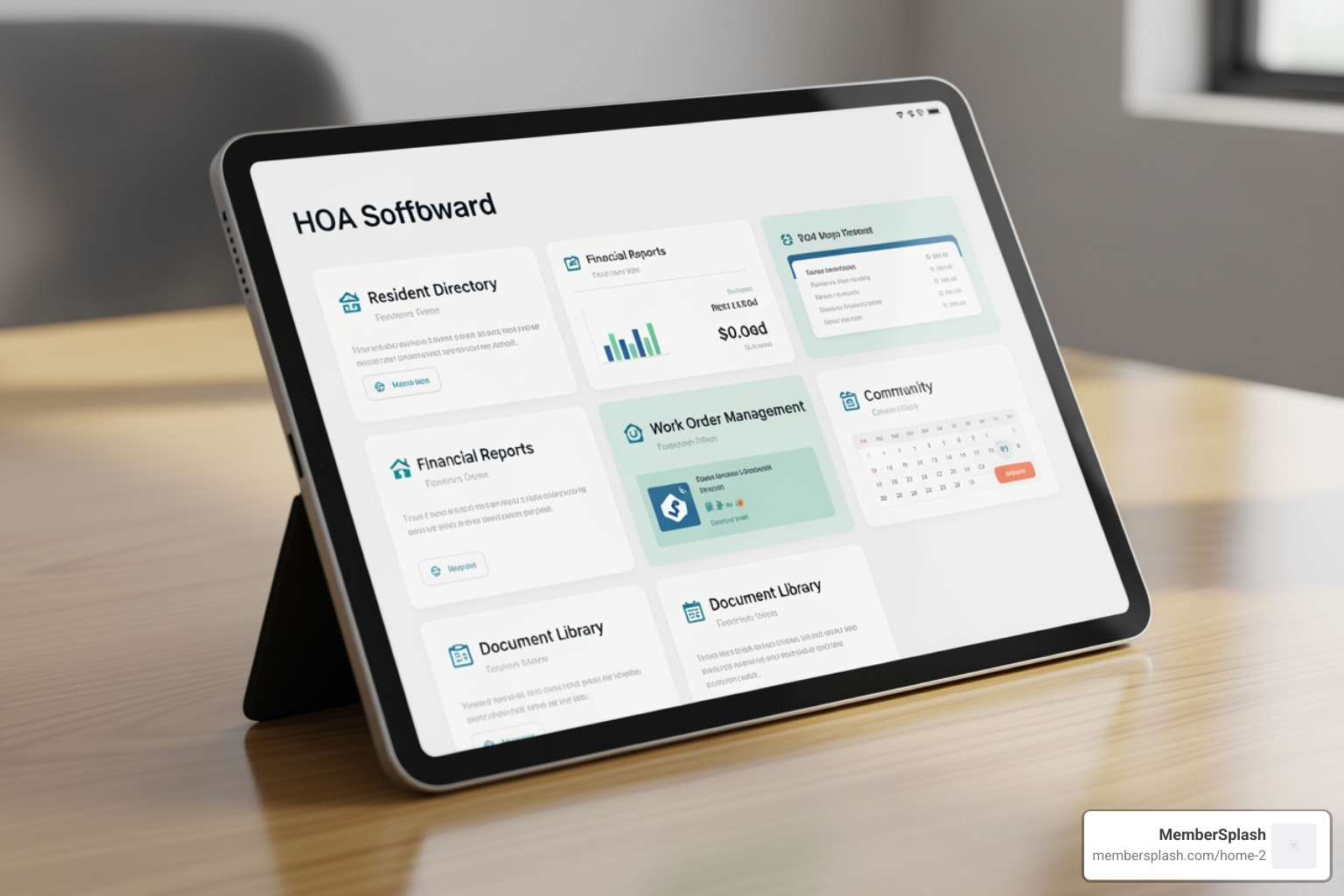
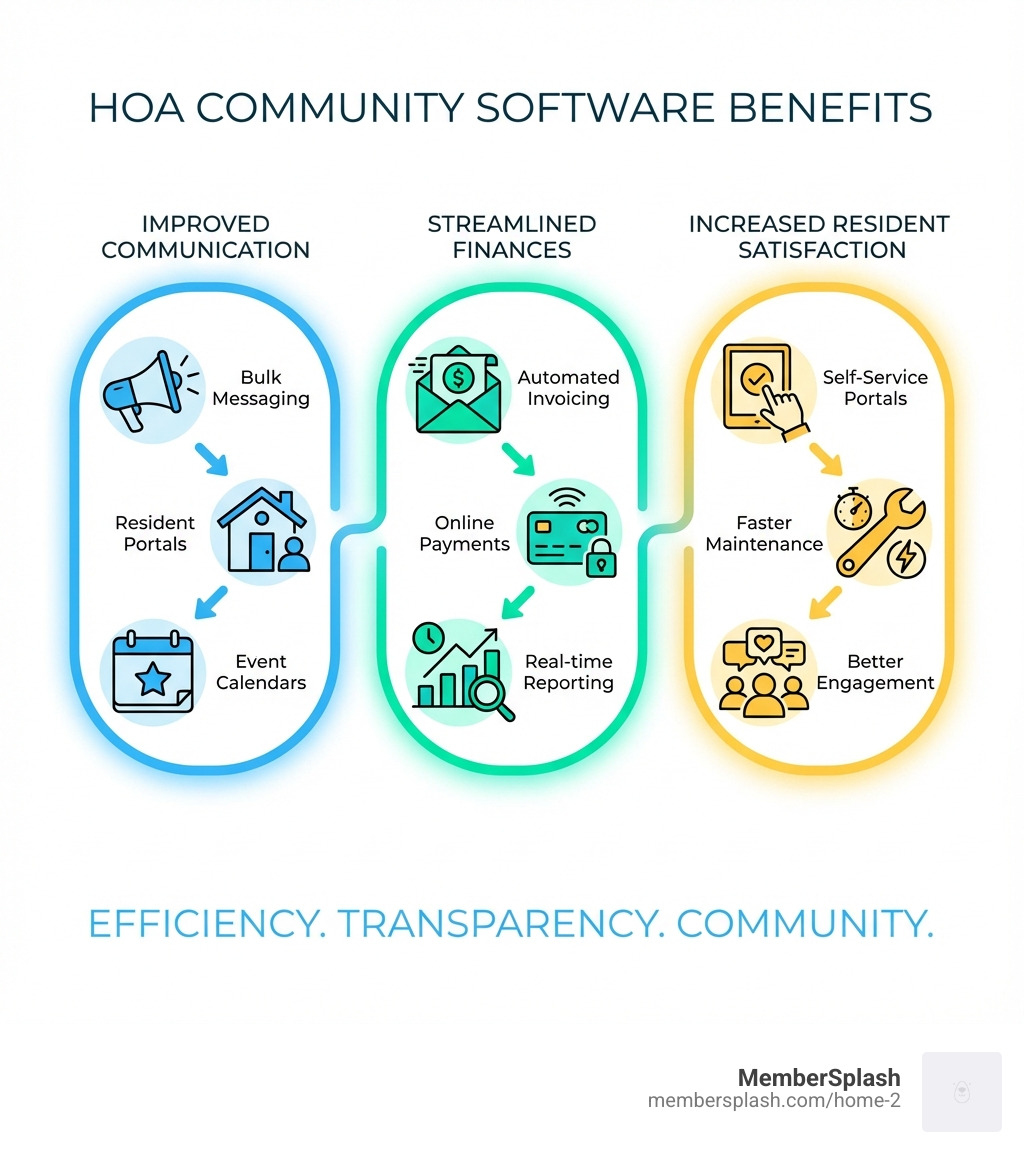
When we talk about HOA community software, we’re discussing comprehensive, all-in-one platforms designed to bring every facet of your association’s operations into one central hub. The aim is not just to digitize processes but to genuinely improve efficiency and improve the member experience. Imagine a single system that handles everything from collecting dues to coordinating community events – that’s the power we’re looking for.
Financial Management and Online Payments
One of the most time-consuming aspects of HOA management is undoubtedly financial oversight. This is where robust accounting tools within HOA community software become invaluable. We need software that can manage accounts, automate invoicing for dues, fees, and fines (including late fees), and handle online payment processing. Homeowners will love the convenience of paying online and setting up autopay, which also significantly improves collection rates for the HOA.
Our ideal software will offer real-time, accurate accounting specifically custom for community associations, supporting both cash and accrual reporting. It should provide powerful reporting tools to give board members the visibility they need into the financial health of the association. Look for features like bank integrations, automated accounts payable, smart bill entry, customized reports, corporate accounting, multiple fund accounting, and vendor eCheck capabilities. These tools streamline financial management, making budgeting and financial transparency a breeze. More info about online payment processing can be found by exploring solutions that simplify these critical tasks.
Centralized Member Portal and Database
A cornerstone of effective HOA community software is a centralized member portal and database. This isn’t just a digital rolodex; it’s a dynamic hub for resident self-service and communication. A comprehensive member database allows us to easily search, filter, and update contact information, ensuring we always have accurate records.
The member portal empowers residents by giving them secure access to their accounts. Here, they can update their contact information, view their payment history, access important documents like bylaws and community rules, and even participate in opinion polling. This self-service capability reduces administrative inquiries and provides a convenient, 24/7 resource for residents. It also acts as a critical communication hub, fostering a more connected and informed community. More info about member account database reveals how these systems centralize and secure member information.
Communication and Engagement Tools
Effective communication is the lifeblood of any thriving community. HOA community software provides a suite of tools that make keeping residents informed and engaged easier than ever. We’re talking about more than just email; modern systems offer bulk email and text messaging capabilities, ensuring important announcements reach everyone quickly. Imagine sending out an urgent community alert or a friendly reminder about an upcoming event with just a few clicks. More info about bulk email communication highlights how these features simplify outreach.
Beyond one-way communication, look for features that foster engagement, such as community forums where residents can discuss local issues, share recommendations, and build connections. An integrated event calendar is crucial for managing and promoting community activities, from board meetings to holiday parties. Residents can view upcoming events, register, and even receive reminders. More info about events calendar details how these tools can boost participation. Surveys and polls are also excellent for gathering feedback and ensuring resident voices are heard on important community decisions.
Operations and Maintenance Management
The day-to-day operations of an HOA often involve managing a myriad of requests and ensuring community standards are upheld. HOA community software is a game-changer here, automating workflows that traditionally consume significant time and effort.
Key features include robust maintenance request tracking, allowing residents to submit issues online, often with photos, and then enabling our team to track the request’s progress from submission to completion. This transparency keeps residents informed and streamlines the entire process. Similarly, violation tracking and enforcement tools help us manage compliance efficiently, from issuing violation letters to tracking resolution.
Architectural review workflows are essential for maintaining community aesthetics, allowing residents to submit plans for approval and facilitating board member reviews. Work order management integrates seamlessly with maintenance requests, assigning tasks to vendors and tracking their completion. Finally, amenity reservations, like booking the clubhouse or a tennis court, can be managed effortlessly online, preventing double-bookings and maximizing usage. More info about reservation system can guide you through optimizing shared space management.
How to Choose the Right Software for Your Community

Selecting the perfect HOA community software is a significant decision that can profoundly impact your association’s efficiency and resident satisfaction. It’s not a one-size-fits-all scenario, and a thorough evaluation process is essential. We need to consider our community’s unique characteristics, assess the software’s capabilities, and understand the different types of solutions available.
Assessing Your Community’s Unique Needs
The first step in choosing HOA community software is to look inward. What are the specific demands of your community?
- Community Size: A small, self-managed neighborhood might have different needs than a large, multi-unit association. Some software is designed for small HOAs with pricing models that scale from just a few households, while other platforms are built to handle the complexities of larger or professionally managed communities.
- Self-Managed vs. Professionally Managed: Self-managed HOAs often need more comprehensive, all-in-one solutions to handle tasks typically outsourced by managed communities. The research notes that HOA software can essentially run the organization for a part-time staff member in a 1,500-member HOA, highlighting its importance for self-managed groups.
- Specific Amenity Needs: Do you have a community pool, tennis courts, or a clubhouse? If so, you’ll need software with strong amenity management features, including reservation systems, check-in capabilities, and guest tracking. This is particularly relevant for communities in Annapolis and Baltimore, Maryland, where community pools and recreational facilities are common.
- Required Features: Make a list of your non-negotiables. Is online payment processing critical? Do you need robust financial reporting? Is a resident portal a must-have for communication? Don’t pay for features you won’t use, but also don’t compromise on essential functionalities. More info about solutions for HOAs can help you identify key functionalities.
Evaluating Key Software Characteristics
Once you understand your needs, it’s time to scrutinize the software itself.
- Ease of Use: An intuitive interface is crucial. If the software is complicated, adoption rates will be low, and the benefits will diminish. Look for simple and intuitive dashboards.
- Mobile App Availability: In today’s mobile-first world, a user-friendly mobile app for both managers and residents is a huge plus. This allows managers to conduct inspections and track violations on the go, and residents to access information and submit requests from their smartphones.
- Data Security: This is non-negotiable. We need to ensure our community’s sensitive financial and personal data is protected. Look for bank-level encryption, adherence to industry-standard compliance practices, and PCI DSS compliance for payment processing.
- Customer Support: What kind of support is available? Is it chat, email, phone, or 1-on-1 screenshare meetings? Timely and helpful support is critical for troubleshooting and maximizing the software’s potential.
- Onboarding Process: How easy is it to switch? Look for providers that offer dedicated onboarding specialists who handle data migration, setup, and training to ensure a smooth transition.
- Scalability: Can the software grow with your community? Ensure it can handle an increasing number of homeowners, messages, and data without performance issues.
Understanding Different Types of HOA Community Software
The market for HOA community software offers a variety of solutions, each with its strengths:
- Comprehensive Platforms: These are all-in-one solutions that aim to cover every aspect of HOA management, from accounting and communication to maintenance and amenity booking. They centralize operations and offer a unified experience.
- Feature-Rich Solutions: Some software excels in specific areas, such as financial management or resident engagement. If your HOA has a particular pain point, you might prioritize a solution known for its strength in that area.
- Cloud-Based Options: The majority of modern HOA software is cloud-based, offering accessibility from anywhere with an internet connection and automatic updates. Some, like PoolPass, even offer an “internet optional” standalone mode for specific on-site needs.
- Customizable Modules: Look for platforms that offer flexibility and customization, allowing you to tailor features to your community’s unique rules and preferences. This ensures the software truly fits your operational model.
The right software acts as a digital partner, empowering us to manage our communities more effectively and efficiently. Learn more about MemberSplash’s HOA software solutions to see how we can assist your specific needs.
The Impact of Software on Amenity and Access Management
For many HOAs, particularly those in areas like Annapolis and Baltimore with shared recreational facilities, managing amenities is a significant part of community life. HOA community software revolutionizes this aspect, bringing a new level of convenience, security, and efficiency to amenity and access management. We’re moving beyond clipboards and paper sign-up sheets to a seamless, contactless experience that benefits both residents and management.
Streamlining Access to Pools and Facilities
One of the most immediate impacts of HOA community software is how it streamlines access to shared facilities like pools, gyms, and clubhouses. Digital passes are becoming the norm, allowing residents to use their smartphones or RFID tags for quick and secure entry. This not only improves convenience but also provides a robust layer of security, ensuring only authorized members can access facilities.
Dedicated check-in software, like PoolPass, allows staff to quickly verify membership, track attendance, and manage guest access. It can even operate in an “internet optional” mode for facilities with limited connectivity. Photo ID verification adds an extra layer of security, ensuring the person checking in matches the member record. More info about check-in photo verification explains how this works.
Guest pass management is also simplified. Residents can obtain guest passes online, and the system tracks guest usage, ensuring compliance with community rules. This eliminates manual logs and reduces potential disputes. More info about guest tracking highlights the benefits of digital guest management. The ability to integrate with existing RFID tags or cards further streamlines the process, making entry swift and hassle-free.
Managing Reservations for Shared Spaces
Beyond simple access, HOA community software empowers us to efficiently manage reservations for shared spaces. Whether it’s the community clubhouse for a party, a tennis court, or a meeting room, online booking systems make the process transparent and fair. Residents can view availability, book slots, and receive confirmations instantly, all from their member portal.
Automated waitlists are a fantastic feature, especially for popular amenities. If a desired slot is taken, residents can join a waitlist and be automatically notified if it becomes available. More info about auto-waitlist management details how this maximizes amenity usage and resident satisfaction. This system prevents frustrating double-bookings and ensures equitable access for all members. By optimizing the use of shared resources, we can improve the overall value of living in our community.
Frequently Asked Questions about HOA Software
We understand that adopting new HOA community software can raise several questions, especially regarding implementation, security, and scalability. Let’s address some of the most common concerns we hear from HOAs like yours in Annapolis and Baltimore.
How difficult is it to switch to a new HOA software?
Switching to new software might seem daunting, but modern HOA community software providers have made the transition remarkably smooth. Most offer dedicated onboarding specialists who handle the heavy lifting for you. This includes basic data migration (importing units, owners, starting balances, and custom fields), system setup, and comprehensive onboarding training.
The goal is to minimize disruption to your community’s operations. Many organizations report being fully up and running on new software in just a few days. Look for providers that offer supported implementation to guide you through every step, ensuring a quick and efficient transition. The ease of switching is a testament to the user-centric design of today’s solutions.
Is my community’s data secure with this type of software?
Data security is paramount, especially when dealing with sensitive homeowner information and financial transactions. Reputable HOA community software employs robust security measures to protect your data. Key security features to look for include:
- Bank-level encryption: This is a standard for protecting financial data, ensuring that all information transmitted and stored is highly secure.
- Industry compliance standards: Providers should adhere to recognized industry standards and best practices for data protection.
- PCI compliance for payments: If the software handles online payments, it must be PCI DSS compliant to securely process credit card information.
- Data privacy: Strong privacy policies and measures are essential to safeguard personal information.
- High system uptime: Reliable software ensures your data is always accessible when you need it, backed by secure infrastructure.
Thousands of communities trust their most important information to these systems, which are built with security at their core.
Are there limits on users, storage, or messaging?
Many modern HOA community software solutions are designed for scalability, meaning they can grow with your community without imposing restrictive limits. This is a crucial consideration for any HOA looking for a long-term solution.
Look for platforms that offer unlimited storage and messaging capabilities, ensuring you never have to worry about hitting a cap on the number of documents you upload or communications you send. Furthermore, the best solutions typically have no cap on the number of homeowners you can manage. As your community evolves and expands, the software should scale seamlessly alongside you, providing consistent performance and functionality regardless of size. This scalability ensures that your investment in HOA community software remains valuable for years to come.
Conclusion: Build a Better, More Connected Community
The journey from managing your HOA with manual processes to embracing HOA community software is a transformative one. As we’ve explored, these all-in-one platforms are not just about digitizing tasks; they’re about revolutionizing how your community operates, fostering engagement, and bringing peace of mind to board members and residents alike.
By centralizing financial management, streamlining communication, empowering residents with self-service portals, and simplifying amenity access, HOA community software delivers tangible benefits. We see increased efficiency, which can save managers over 15 hours a week, allowing more time for community-building initiatives rather than administrative burdens. Financial health improves through automated collections and transparent reporting. Most importantly, resident satisfaction grows as communication becomes clearer, requests are handled faster, and community amenities are more accessible and enjoyable.
Choosing the right software is about finding a digital partner that understands the unique needs of your HOA. It’s an investment in a more organized, efficient, and ultimately, a more connected community. We believe in the power of technology to simplify complex tasks and improve community living.
Are you ready to transform your HOA operations and empower your residents? Explore HOA management solutions to find the perfect fit for your community.