Tag Archive for: swimming

Get Your Laps In Finding the Best Lap Pool Membership

Why Finding the Right Lap Pool Membership Matters

A lap pool membership near me can transform your fitness routine. Whether you’re looking for low-impact cardio, stress relief, or a full-body workout, lap swimming delivers results that few other exercises can match.

Quick Answer: How to Find a Lap Pool Membership Near You

  1. Search Google Maps for “lap pool near me” or “aquatic center near me”
  2. Check facility types: YMCAs, community centers, private clubs, city pools
  3. Compare membership options: Daily passes ($5-$10), monthly ($35-$60), or annual ($350-$600)
  4. Look for discounts: Early bird specials, military rates, senior pricing, insurance programs
  5. Visit before joining: Ask about lane availability, hours, and reservation systems

The search for the right pool membership can feel overwhelming. Prices vary widely. Hours conflict with your schedule. Some pools require reservations while others don’t. And if you’re managing a facility yourself, you know how complex it is to juggle memberships, guest passes, and lane bookings.

But here’s the good news: lap swimming is worth the effort. Studies show that just 15-30 minutes of swimming can improve heart health by raising HDL cholesterol levels (the good kind). The water provides natural resistance for muscle toning while being gentle on your joints. It’s cardiovascular exercise and strength training rolled into one.

This guide walks you through everything you need to know. You’ll learn about membership types, typical costs, and how to spot the best facility for your needs. We’ll cover pool etiquette, operating hours, and the difference between lap pools and recreational pools. By the end, you’ll have a clear path to finding your perfect swimming spot.
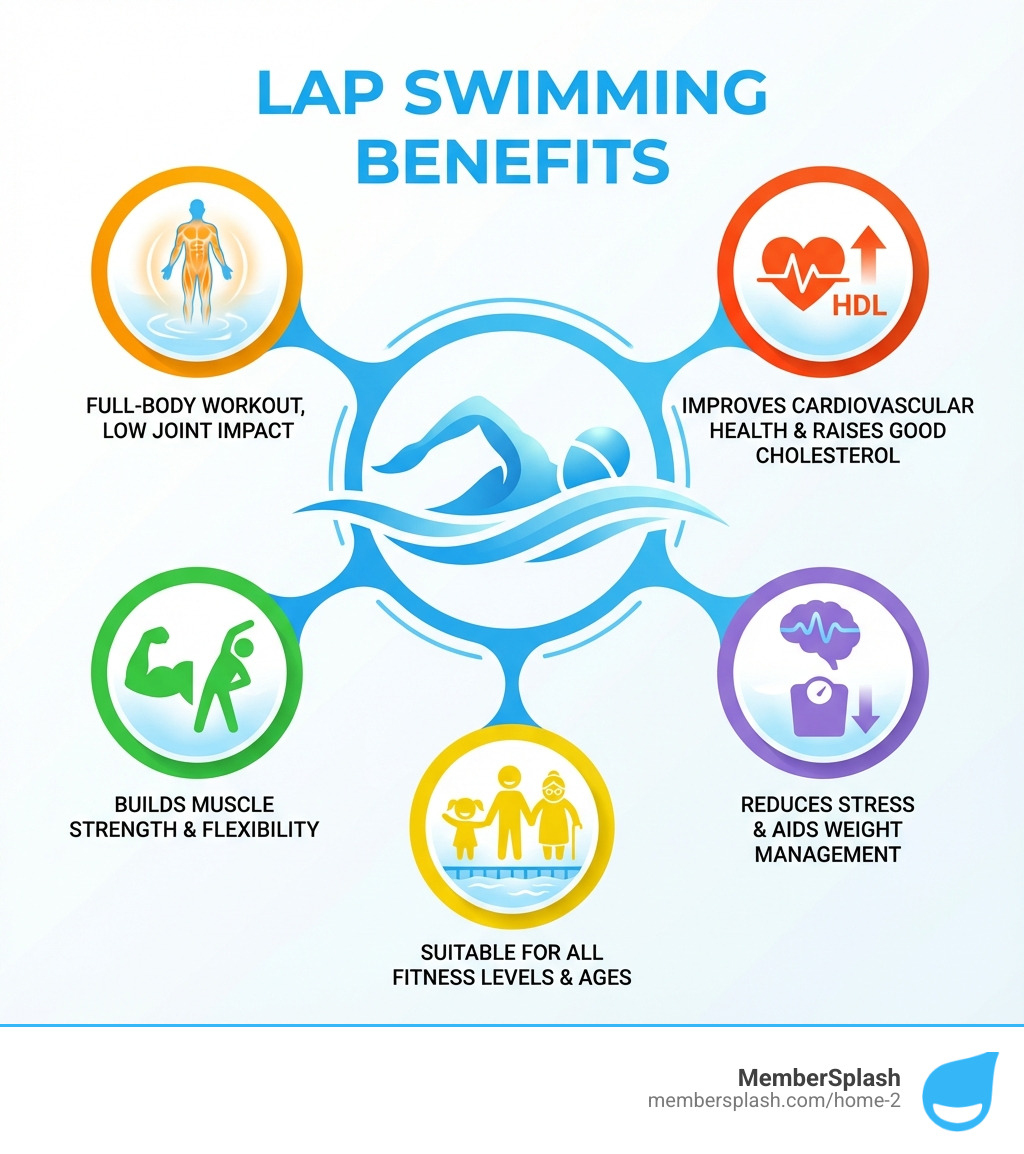
infographic showing lap swimming benefits: full-body workout with low joint impact, improves cardiovascular health and raises good cholesterol, builds muscle strength and flexibility, reduces stress and aids weight management, suitable for all fitness levels and ages - lap pool membership near me infographic

Why Choose Lap Swimming? Unpacking the Benefits

Lap swimming isn’t just a leisurely activity; it’s a powerful, full-body workout with a myriad of health benefits. We often hear about the importance of regular exercise, and swimming consistently ranks as one of the most effective and enjoyable ways to stay fit.

Here’s why we believe you should consider diving into a lap pool:

  • Full-body Workout: Every stroke engages multiple muscle groups, from your core and back to your arms and legs. It’s an efficient way to tone and strengthen your entire physique without putting undue stress on any single area.
  • Low-Impact on Joints: Unlike high-impact activities like running, swimming in a lap pool offers buoyancy, reducing the strain on your joints. This makes it an ideal exercise for people of all ages, including those recovering from injuries or managing chronic conditions like arthritis.
  • Cardiovascular Health: Lap swimming is an excellent aerobic exercise that gets your heart pumping, strengthening your cardiovascular system. Studies have shown that just 15 to 30 minutes of swimming, three to four times a week, can significantly improve heart health and help raise your HDL (good cholesterol) levels, aiding in the fight against heart disease.
  • Muscle Toning and Strength: The natural resistance of water provides a constant challenge to your muscles, helping to build endurance and sculpt a lean physique. From powerful kicks to strong arm strokes, you’ll feel the burn and see the results.
  • Stress Relief: The rhythmic nature of swimming, combined with controlled breathing, can be incredibly meditative. It’s a fantastic way to clear your mind, reduce stress, and improve your mood after a long day.
  • Weight Management: As a calorie-burning activity, lap swimming can be a valuable tool in your weight management strategy. The intensity can be easily adjusted, allowing you to burn more calories with faster, more vigorous sessions.
  • Improved Flexibility: The expansive movements required in swimming help improve your range of motion and flexibility in your shoulders, hips, and spine.

Whether you’re a seasoned athlete or just starting your fitness journey, lap swimming offers a comprehensive approach to health and wellness. It’s a refreshing way to challenge your body and calm your mind.
swimmer's powerful stroke underwater - lap pool membership near me

Decoding Membership Options: Types, Costs, and Discounts

When searching for a lap pool membership near me, understanding the various options and their associated costs is crucial. Facilities like the Arundel Olympic Swim Center in Annapolis, MD, or Coppermine Meadowbrook in Baltimore, MD, offer different membership structures designed to fit diverse needs and budgets.

Common Membership Tiers

We’ve observed several common types of lap pool memberships available across various facilities:

  • Daily Passes: Perfect for occasional swimmers or those wanting to try out a pool before committing. These typically range from $5 to $10 per visit, though some facilities might charge slightly more. For example, some aquatic centers might have a $7.50 daily pass fee.
  • Punch Cards or Visit Scan Cards: These offer a bundle of visits at a reduced per-entry rate. You might find options like 25-visit cards for around $120 or 50-visit cards for $225, often with discounted rates for specific groups.
  • Monthly Memberships: A popular choice for regular swimmers, offering unlimited access for a recurring fee. Individual monthly passes can be around $35, while family monthly passes might be $60.
  • Annual Memberships: The most cost-effective option for dedicated swimmers. An individual annual pass could be $350, with family annual passes ranging up to $600 or more. Some clubs, like the Calverton Swim Club in Maryland, offer annual family memberships around $700, with one-person memberships for $490. These often come with additional perks.
  • Family vs. Individual Plans: Most facilities offer different rates based on the number of people covered. Family plans usually include all individuals residing full-time at the same residence. Some clubs even have specific “Empty Nest” memberships for long-term owners or “Joint” memberships for two people.
  • Specialty Memberships: You might encounter unique options such as “Inactive” memberships, allowing you to freeze your membership for a period while retaining benefits like voting rights for a reduced fee (e.g., $150).

To get a comprehensive overview of how clubs manage these varied membership options, we encourage you to see how clubs manage memberships.

Understanding the Cost of a Lap Pool Membership Near Me

The actual cost of a lap pool membership near me goes beyond just the headline fee. Here are some factors to consider:

  • Price Ranges: As mentioned, prices vary significantly based on the type of membership (daily, monthly, annual), the facility (public, private, YMCA), and the number of people covered.
  • Joining Fees: Many private clubs or YMCAs require a one-time joining fee when you first sign up. For instance, some clubs might have a joining fee of $250 for new members.
  • Late Fees: Be aware of deadlines for annual dues. Missing them can incur late fees, sometimes $75 or more.
  • Add-on Costs: Consider any extra fees for additional family members, nannies ($120/season is an example), or adult children who don’t reside at your primary address ($240/season for an “Associate” add-on). Guest fees, typically $5-$10 per person, are also common if you plan to bring friends.
  • Online Payment Options: Many modern facilities offer convenient online payment processing, allowing you to manage your membership and payments easily. To learn more about streamlined payment solutions, you can explore online payment options. For a deeper dive into how different pricing models compare, check out this pricing comparison.

Finding Discounts and Special Offers

We understand that budget is often a key consideration. Fortunately, many facilities offer ways to make a lap pool membership near me more affordable:

  • Early Bird Specials: Many swim clubs, especially seasonal ones, offer significant discounts for registering early in the year. These can save you a substantial amount compared to regular or late-season rates.
  • Refer-a-Friend Programs: Some organizations, like the YMCA, incentivize members to refer new sign-ups, sometimes offering a free month of membership for each successful referral. These programs are a win-win for both current and new members. Learn about referral programs to see how they can benefit you.
  • Corporate Wellness Plans: Check if your employer participates in any corporate wellness programs that offer discounted gym or pool memberships.
  • Insurance-Paid Memberships: For seniors, programs like Renew Active (through UnitedHealthcare Medicare) and Silver Sneakers are often accepted at facilities like YMCAs and other aquatic centers, potentially covering the cost of your membership. Some facilities also accept Prime Fitness.
  • Military Discounts: Many organizations, including the YMCA, show appreciation for military families by waiving join fees and offering discounts on monthly dues (e.g., 10% off monthly membership dues). Some clubs also offer a flat discount on annual dues ($50 for active duty military).

Always ask about available discounts, as they can significantly reduce your overall membership cost.

How to Find the Perfect Lap Pool Membership Near Me

Finding the right lap pool membership near me requires a bit of research and knowing what questions to ask. We’re here to guide you through the process of locating and evaluating the best swimming facilities in your area, particularly if you’re in Annapolis or Baltimore, MD.
person searching for local pools on a phone map interface - lap pool membership near me

Where to Look for a Lap Pool Membership Near Me

Several types of facilities commonly offer lap pools:

  • Community Centers: Often run by local government or non-profit organizations, these facilities typically offer affordable memberships and may include other amenities. The Arundel Olympic Swim Center in Anne Arundel County, MD, is a great example of a public aquatic center offering lap swim.
  • Private Fitness Clubs: Gyms like Life Time in Annapolis or Coppermine Meadowbrook in Baltimore often feature state-of-the-art lap pools as part of their comprehensive fitness offerings.
  • YMCAs: Known for their community focus, YMCAs across the United States provide diverse aquatics programs, including lap swimming, water fitness classes, and swim lessons for all ages. They often have both indoor and outdoor pools.
  • City/County Aquatic Centers: Many municipalities operate dedicated aquatic facilities. For instance, in Baltimore, you might find options like the Roland Park Pool. These centers are specifically designed for swimming and often have multiple pools and dedicated lap lanes.
  • Swim Clubs: Independent swim clubs, often seasonal, focus primarily on swimming and related social activities. The Calverton Swim Club in Maryland, for example, offers various membership tiers for families and individuals.

Using Online Tools and Local Resources

Our digital age makes the search for a lap pool membership near me much simpler:

  • Google Maps Search: The most straightforward approach is to open Google Maps and search for “lap pool near me,” “aquatic center,” “YMCA,” or “swim club” in your specific area (e.g., “lap pool Annapolis MD”). This will provide you with a visual map of local options, their addresses, and often their contact information and operating hours.
  • Facility Websites: Once you have a list of potential facilities, visit their websites. Look for dedicated aquatics sections, membership pages, pool schedules, and information on amenities.
  • Local Community Forums/Social Media Groups: Online community groups for Annapolis or Baltimore can be invaluable. Ask residents for recommendations, reviews, and insights into local pools.
  • Parks and Recreation Department Websites: Your local city or county Parks and Recreation department website is a prime resource for public aquatic centers and community pools. They will often list schedules, programs, and membership details.

Questions to Ask Before You Join

Before committing to a lap pool membership near me, we recommend asking these key questions to ensure the facility meets your needs:

  • Lane Availability: How many lap lanes are available? Are they typically crowded during your preferred swimming times? Some facilities, like the Arundel Olympic Swim Center, might have a 56-meter competition pool, offering ample space. Other clubs may offer a 4-lane or 6-lane lap pool.
  • Reservation System: Does the facility require reservations for lap lanes, or is it first-come, first-served? If reservations are needed, how far in advance can you book, and what system do they use? Learn about reservation systems to understand how they work.
  • Pool Temperature: What is the average water temperature? Many lap pools maintain temperatures between 80°F and 84°F, which is comfortable for exercise. If you prefer warmer or cooler water, this is an important detail.
  • Pool Length: What is the length of the lap pool? Common lengths are 25 yards, 25 meters, or 50 meters. Knowing the length is important for tracking your distance.
  • Cleanliness and Maintenance: How often is the pool cleaned and maintained? What are their water quality standards? A clean pool is essential for a pleasant swimming experience.
  • Staff Qualifications: Are lifeguards certified? Is there qualified staff available for questions or assistance?
  • Guest Policies: If you plan to bring guests, what are the rules and fees?

Asking these questions upfront will help you make an informed decision and find a lap pool that fits your routine perfectly.

What to Expect: Pool Etiquette, Hours, and Amenities

Once you’ve found a potential lap pool membership near me, it’s helpful to know what to expect in terms of pool types, operating hours, rules, and available amenities. This knowledge will help you integrate seamlessly into the swimming community and make the most of your membership.

Lap Pool vs. Recreational Pool: What’s the Difference?

While both are pools, lap pools and recreational pools serve distinct purposes:

  • Lap Pool Characteristics: Lap pools are typically long, rectangular, and designed specifically for continuous swimming. They feature lane lines on the bottom and floating lane dividers to separate swimmers. The water depth is usually consistent, and the temperature is often kept in the 80°F to 84°F range, suitable for active swimming. The focus is on exercise and structured swimming.
  • Recreational Pool Characteristics: These pools are often freeform in shape, may have varying depths, and are designed for leisure, play, and relaxation. They might include features like play structures, water slides, splash pads, and shallow entry areas. Water temperatures can sometimes be warmer, catering to more casual use.
  • Shared Use Policies: Many facilities, especially community centers or YMCAs, might have both a lap pool and a recreational pool, or a main pool that accommodates both. During certain hours, a multi-purpose pool might be divided, with specific lanes designated for lap swimming while other areas are open for family recreation. Facilities like the Cameron Family YMCA, for example, offer both a lap pool and a recreational pool, with the latter often featuring play structures and operating seasonally.
  • Water Temperature Differences: Lap pools generally maintain a cooler temperature to keep swimmers comfortable during exertion, while recreational pools might be warmer for comfort during less active play.

Typical Operating Hours and Schedules

Operating hours for lap pool membership near me can vary widely, but we’ve observed some common patterns:

  • Early Morning Hours: Many facilities open very early, sometimes as early as 5:00 AM or 6:00 AM, to accommodate lap swimmers before work.
  • Mid-Day Availability: Weekdays often have mid-day hours (e.g., 9:00 AM – 1:00 PM or 1:00 PM – 5:00 PM) for adult lap swimming, which tend to be less crowded.
  • Evening Hours: Most pools offer evening lap swimming, often until 7:00 PM or 9:00 PM.
  • Weekend Schedules: Weekend hours typically start a bit later (e.g., 10:00 AM) and might run until late afternoon or early evening (e.g., 5:00 PM).
  • Blockout Times: Be aware that pools often have blockout times for scheduled classes (like aqua aerobics), swim lessons, or swim team practices. For example, a pool might close lap lanes during Aqua Classes on Monday, Wednesday, and Friday mornings or for Swim Lessons on Saturday mornings. It’s always best to check the facility’s specific schedule, which you can often find linked to a calendar.

Essential Lap Swimming Rules and Etiquette

To ensure a smooth and enjoyable experience for everyone, lap pools have certain rules and etiquette:

  • Circle Swimming: When a lane is shared by more than two people, it’s customary to “circle swim.” This means you swim down on one side of the lane and back on the other, staying to the right of the black line on the bottom of the pool.
  • Lane Speed Designation: Many facilities designate lanes as “slow,” “medium,” or “fast.” Choose the lane that matches your pace to avoid frustration for yourself and others.
  • Passing Etiquette: If you need to pass a slower swimmer, do so safely and quickly, often by gently tapping their feet or waiting until they reach the wall.
  • Showering Before Entry: For hygiene, most pools require swimmers to shower before entering the water.
  • Proper Swimwear: Facilities typically enforce proper swim attire. This means no denim shorts, cutoffs, jeans, long/loose shirts, thong swimwear, or undergarments. Non-toilet trained children must wear swim diapers and rubber pants.
  • Breaks: Some pools implement 15-minute breaks every hour, during which no one under 16 is permitted in the pool.
  • No Horseplay: Lanes are for swimming, not for playing or diving unless specifically in a designated diving area. Lane ropes are for separation and safety, not for hanging on.

Common Amenities and Other Pool Uses

Beyond just lap swimming, a lap pool membership near me often comes with a range of amenities and opportunities for other activities:

  • Locker Rooms and Showers: Essential facilities for changing and rinsing off before and after your swim.
  • Whirlpool/Spa and Sauna: Many fitness clubs and aquatic centers offer these for relaxation and muscle recovery. Studies suggest that 15-30 minutes in a sauna three to four times a week can significantly increase overall wellness.
  • Water Walking: Many lap pools provide dedicated times or lanes for water walking, a low-impact exercise that offers resistance and therapeutic benefits.
  • Aqua Fitness Classes: These include water aerobics, Aqua Surge, and other water-based workouts that leverage water resistance for a cardiovascular workout, improving heart health and strengthening muscles.
  • Swim Lessons: Facilities often provide swim lessons for all ages and skill levels, from toddlers to adults looking to improve their technique.
  • Family Swim: During designated times, the lap pool area might be opened for family recreation, allowing for more casual swimming and play.

These additional offerings can greatly improve the value of your membership and provide a holistic aquatic experience.

Frequently Asked Questions about Lap Pool Memberships

We understand you might have more specific questions as you explore a lap pool membership near me. Here are some common inquiries we encounter:

Can I try a pool before committing to a membership?

Absolutely! We strongly recommend trying a facility before making a long-term commitment. Many places offer day passes, guest passes, or even free trial periods so you can experience the pool, check the atmosphere, observe lane availability, and gauge the cleanliness before signing up. Always ask the front desk about trial options or day rates. Some facilities might even deduct the cost of a day pass from your membership if you decide to join.

What should I bring for my first lap swim?

For your first lap swim, we suggest bringing a few essential items to ensure a comfortable and productive session:

  • Swimsuit: Choose one designed for athletic use that allows for a full range of motion.
  • Goggles: Crucial for protecting your eyes from chlorine and improving underwater visibility.
  • Towel: A quick-drying towel is always a good idea.
  • Flip-flops or Sandals: For walking on the pool deck and in locker rooms, maintaining hygiene and preventing slips.
  • Swim Cap: Highly recommended to protect your hair from chlorine, keep it out of your face, and reduce drag for a more efficient swim.
  • Water Bottle: Staying hydrated is just as important in the water as it is during other workouts.
  • Kickboard/Pull Buoy (Optional): If you’re looking to focus on specific aspects of your stroke or add variety to your workout, these can be useful.

How are lap lanes typically reserved?

The method for reserving lap lanes can vary significantly from one facility to another.

  • First-Come, First-Served: Many pools operate on this traditional model, where you simply arrive and find an open lane. If all lanes are occupied, you might be expected to share a lane with another swimmer, usually by circle swimming.
  • Physical Sign-Up Sheets: Some facilities use a clipboard or whiteboard at the pool entrance where you can sign up for a specific lane and time slot.
  • Modern Online Reservation Systems: Increasingly, facilities are adopting advanced digital solutions. These allow you to book a lane in advance through a website or a dedicated app, often showing real-time availability. This is particularly common in larger fitness clubs or aquatic centers. For a deeper understanding of how these systems work and their benefits, you can explore features of a reservation system.

We advise checking with the specific facility about their reservation policy when you inquire about a membership.

Conclusion: Dive Into Your New Fitness Routine

Finding the right lap pool membership is a fantastic investment in your health and well-being. By understanding the types of memberships, costs, and what to look for in a facility, you can confidently find the perfect “lap pool membership near me.” Lap swimming offers a unique blend of cardiovascular benefits, muscle strengthening, and stress relief, all in a low-impact environment.

We’ve explored the various membership tiers, from daily passes to annual family plans, and highlighted how to find discounts like early bird specials, military rates, and insurance-paid programs. We’ve also guided you through the process of locating facilities in areas like Annapolis and Baltimore, MD, and armed you with key questions to ask before you commit.

Whether you’re practicing circle swimming etiquette, enjoying the amenities like a whirlpool spa, or simply appreciating the consistent 80-84°F water temperature, finding a dedicated lap pool will help you achieve your fitness goals.

For clubs and aquatic centers looking to provide a seamless experience for their members, MemberSplash offers software that simplifies everything from online payments and reservations to member management and guest tracking. We help facilities streamline operations, handle complex pricing, and maximize revenue, allowing them to focus on what matters most: their swimmers.
Start managing your club better today!

Maryland’s Aquatic Adventures: Clubs, Lessons, and Teams Galore!

Why Maryland Swim Clubs Offer Something for Everyone

Maryland swim club options span from Olympic-level training facilities to neighborhood social pools, serving families, competitive athletes, and community members across 21 counties. Whether you’re seeking elite athletic development, summer fun, or learn-to-swim programs, Maryland’s aquatic landscape has you covered.

Quick Guide to Maryland Swim Club Types:

  • Competitive Year-Round Clubs – Elite training programs like North Baltimore Aquatic Club (14 Olympic athletes, 50+ medals since 1984) and Rockville Montgomery Swim Club (1,700+ swimmers, 80+ coaches across 5 sites)
  • Collegiate Club Teams – University programs like UMD Club Swim Team, the only on-campus option since the varsity team ended in 2009
  • Community & Social Clubs – Limited-membership pools like Watermont Swim Club (350 family cap, 2-3 year waiting lists) offering summer leagues and social events
  • Learn-to-Swim Programs – Organizations like 4M Swim Club, which has taught more African-Americans to swim in Baltimore than any other entity since 1972

Maryland Swimming serves as the local governing body for USA Swimming programs in 21 of Maryland’s counties, excluding Prince George’s and Montgomery. The state’s clubs range from internationally recognized powerhouses producing Olympians and NCAA champions to intimate neighborhood pools with bonds systems and barbecue socials.

The diversity is real. You’ll find clubs with $800 annual dues and $600 bond purchases, programs accepting beginners through former national-level athletes, and teams competing everywhere from local Central Maryland Swim League dual meets to Olympic trials.

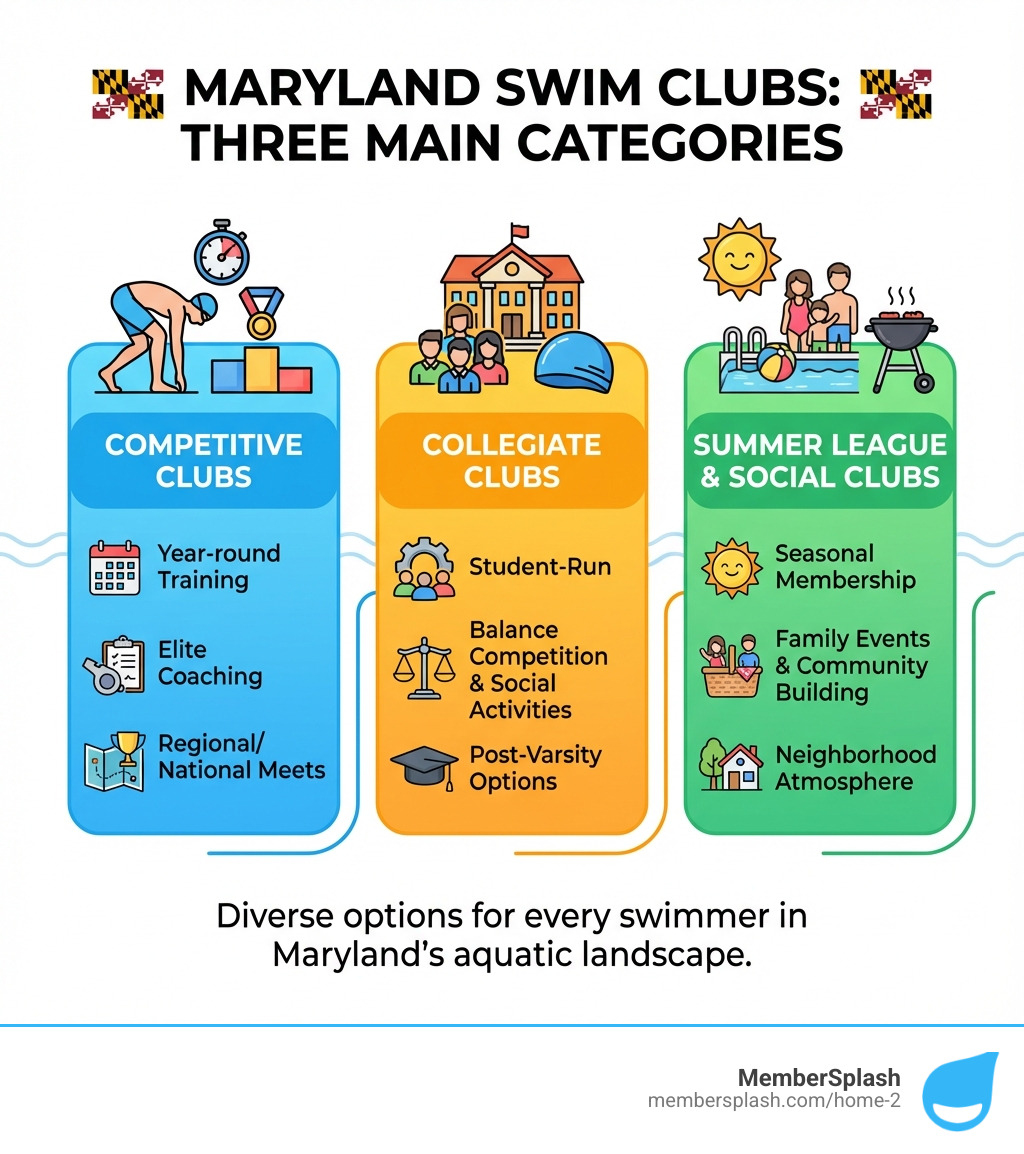
Infographic showing three main categories of Maryland swim clubs: Competitive Clubs (year-round training, elite coaching, regional/national meets), Collegiate Clubs (student-run, balance competition and social activities, post-varsity options), and Summer League/Social Clubs (seasonal membership, family events, community building, neighborhood atmosphere) - Maryland swim club infographic

The Landscape of Maryland Swim Clubs: From Competitive Powerhouses to Community Pools

When we dig into Maryland swim club options, we quickly realize the sheer variety available. It’s not a one-size-fits-all scenario; instead, we see a rich mix of aquatic communities catering to diverse needs and aspirations. From intense year-round competitive training to laid-back summer fun, Maryland has fostered a vibrant swimming culture.

At the heart of the state’s competitive swimming scene is Maryland Swimming, the local governing body for USA Swimming competitive swimming programs across 21 of Maryland’s counties. This organization plays a crucial role in overseeing meets, setting standards, and providing resources for clubs, coaches, and athletes. It’s affiliated with Eastern Zone Swimming and USA Swimming, ensuring that our local competitive swimming adheres to national guidelines and offers pathways to higher levels of competition. Maryland Swimming’s mission is clear: “To make swimming the sport of choice for Maryland,” by providing opportunities for athletes to participate, reach their full potential, and develop life-long skills.

Beyond the governing bodies, we find various club categories:

Competitive Swim Clubs

These are the powerhouses of the Maryland swimming world, offering year-round training and a relentless focus on athlete development. Clubs like the North Baltimore Aquatic Club (NBAC) and Rockville Montgomery Swim Club (RMSC) exemplify this category. Their programs are designed for swimmers of all ages who are serious about competitive swimming, emphasizing skill progression, rigorous training, and participation in local, regional, and even national meets. These clubs often boast state-of-the-art facilities and highly experienced coaching staff dedicated to nurturing talent from a young age through to elite levels.

Collegiate Club Teams

For students who want to continue swimming after high school without the intense commitment of a varsity program, collegiate club teams are a fantastic option. The UMD Club Swim Team is a prime example of this, serving as the only place on campus for Terps to swim since the varsity team was cut in 2009. These student-run organizations provide a platform for swimmers of all skill levels, from beginners to former varsity or national-level athletes, to practice, compete, and socialize. They balance competitive opportunities with a strong social component, often participating in regional and national club swimming championships while also organizing team-building activities like barbecues and community service. It’s a wonderful way to maintain fitness, enjoy the sport, and build camaraderie during college years.

Summer League and Social Clubs

For many families, summer means sun, fun, and the neighborhood pool. Summer league and social clubs embody this spirit, offering a more relaxed, family-oriented atmosphere. These clubs, like Watermont Swim Club, typically operate seasonally and are centered around community building. They often feature summer swim teams that compete in local leagues, such as the Central Maryland Swim League, providing a taste of competition in a supportive environment. Beyond the lanes, these clubs are social hubs, hosting family events, movie nights, and adult socials. They are about creating memories, fostering friendships, and enjoying the communal joys of summer.

Diving into Maryland’s Elite: A Look at Top Competitive Teams

When we talk about competitive swimming in Maryland, we’re not just discussing local meets; we’re talking about a legacy that has produced Olympic champions and set national records. Our state is home to some truly remarkable clubs that have shaped the landscape of American swimming.

Notable Maryland Competitive Clubs

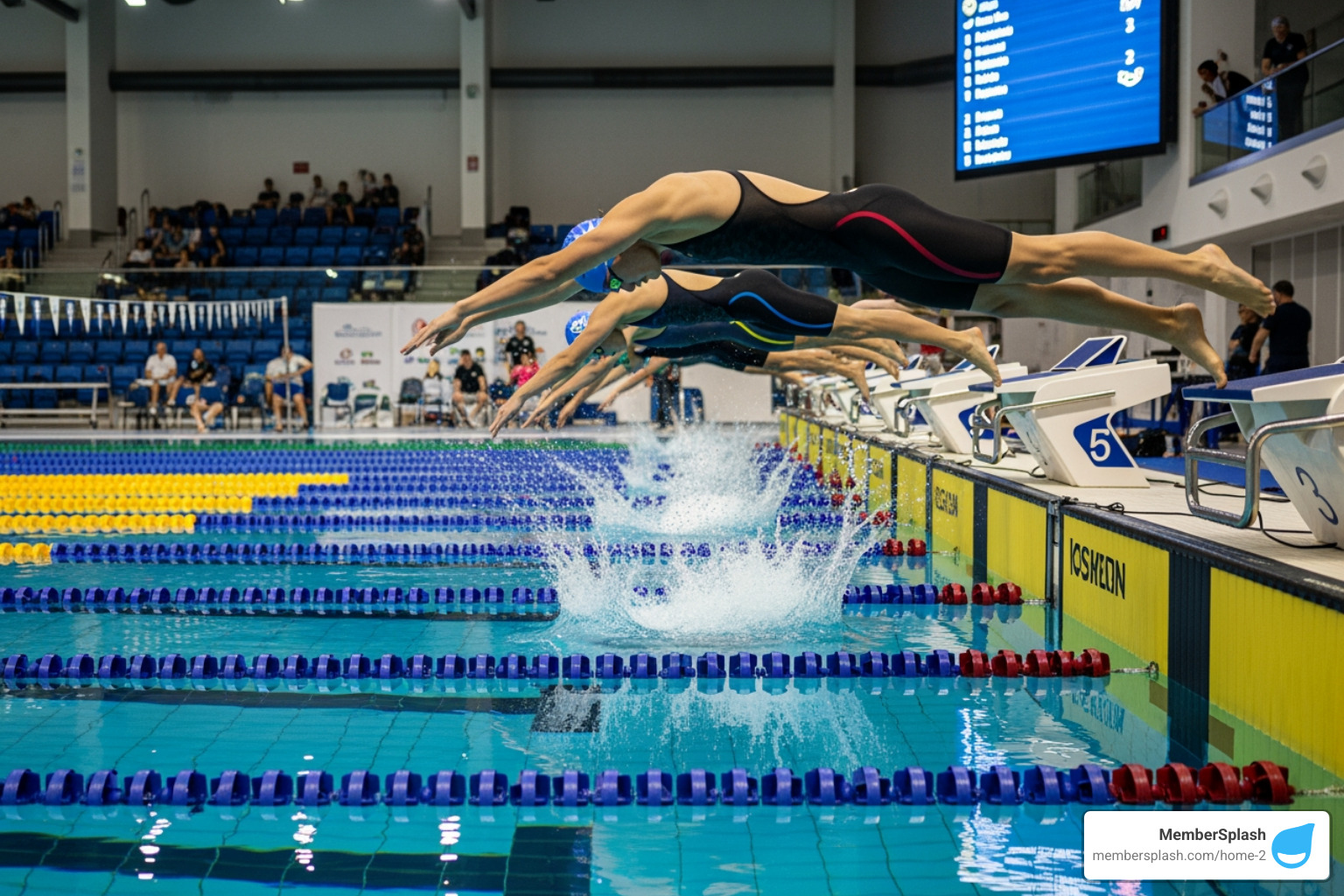
Swimmers diving off starting blocks at a competitive meet - Maryland swim club

Maryland’s competitive clubs are synonymous with excellence. They are breeding grounds for talent, where young swimmers hone their skills under the guidance of elite coaches, often dreaming of Olympic glory.

The North Baltimore Aquatic Club (NBAC) is a name that resonates far beyond Maryland. Established in 1968, NBAC has a mission to support the regional swimming community in developing outstanding young men and women. Their core values of opportunity, development, and fellowship have fueled a legacy of excellence. NBAC’s achievements are simply astounding: they’ve developed 14 Olympic and Paralympic athletes who have accumulated over 50 medals since 1984, with at least one gold won in each of the last five decades. They boast hundreds of National Age Group, American, and World Records. NBAC’s approach to athlete development is phased, progressing from “Findy” for the youngest swimmers to “Imagination,” “Challenge,” and finally “High Performance” for elite athletes. What might be considered extraordinary elsewhere, they say, occurs daily at NBAC. They train at multiple top-tier facilities, including Loyola University and Goucher College, and were ranked #16 on the USA Swimming / ASCA Top 100 Age Group Teams List.

Another titan in the state is the Rockville Montgomery Swim Club (RMSC). Operating as a joint program between the City of Rockville and Montgomery County Recreation, RMSC is recognized as one of the most successful age group and senior level swim teams in the United States. With over 80 coaches and more than 1700 swimmers across five sites, RMSC offers a comprehensive program for every competitive level, from mini-team to national caliber. Their mission emphasizes individual progress, team unity, and family participation, all while being committed to excellence and dedicated to developing “world-class citizens and world-class athletes.” RMSC has produced thousands of high-quality swimmers, numerous national age group record holders, and alumni who have become Olympians, NCAA, and international champions. They’ve been named a USA Swimming Gold Medal Club, a testament to their consistent high performance.

These clubs engage deeply with USA Swimming, adhering to its standards and participating in its programs, which include Safe Sport initiatives to ensure a healthy and positive environment for all athletes. Their success is built on structured programs, dedicated coaching, and a strong community focus that supports both athletic and personal growth.

Other Regional Standouts

While NBAC and RMSC lead the charge, other competitive clubs across Maryland also make significant contributions to the swimming community.

The Annapolis Swim Club (ASC) and Cape St. Claire Swim Club in Annapolis are key players, providing competitive opportunities and developing local talent. These clubs, like their larger counterparts, offer structured training and participate in regional competitions, fostering a love for the sport and competitive spirit among their members.

These clubs, whether they are producing Olympians or nurturing regional champions, share a common thread: a commitment to the sport, athlete development, and community engagement. They often integrate character-building into their training philosophy, recognizing that the lessons learned in the pool extend far beyond the water.

More Than Just Laps: Community-Focused and Social Swim Clubs

Beyond the pursuit of medals and records, Maryland swim club options also shine as vibrant community hubs, offering a blend of aquatic enjoyment, social interaction, and vital life skills. These clubs are often the heart of their neighborhoods, providing a safe and fun environment for families to connect and cool off during the warmer months.

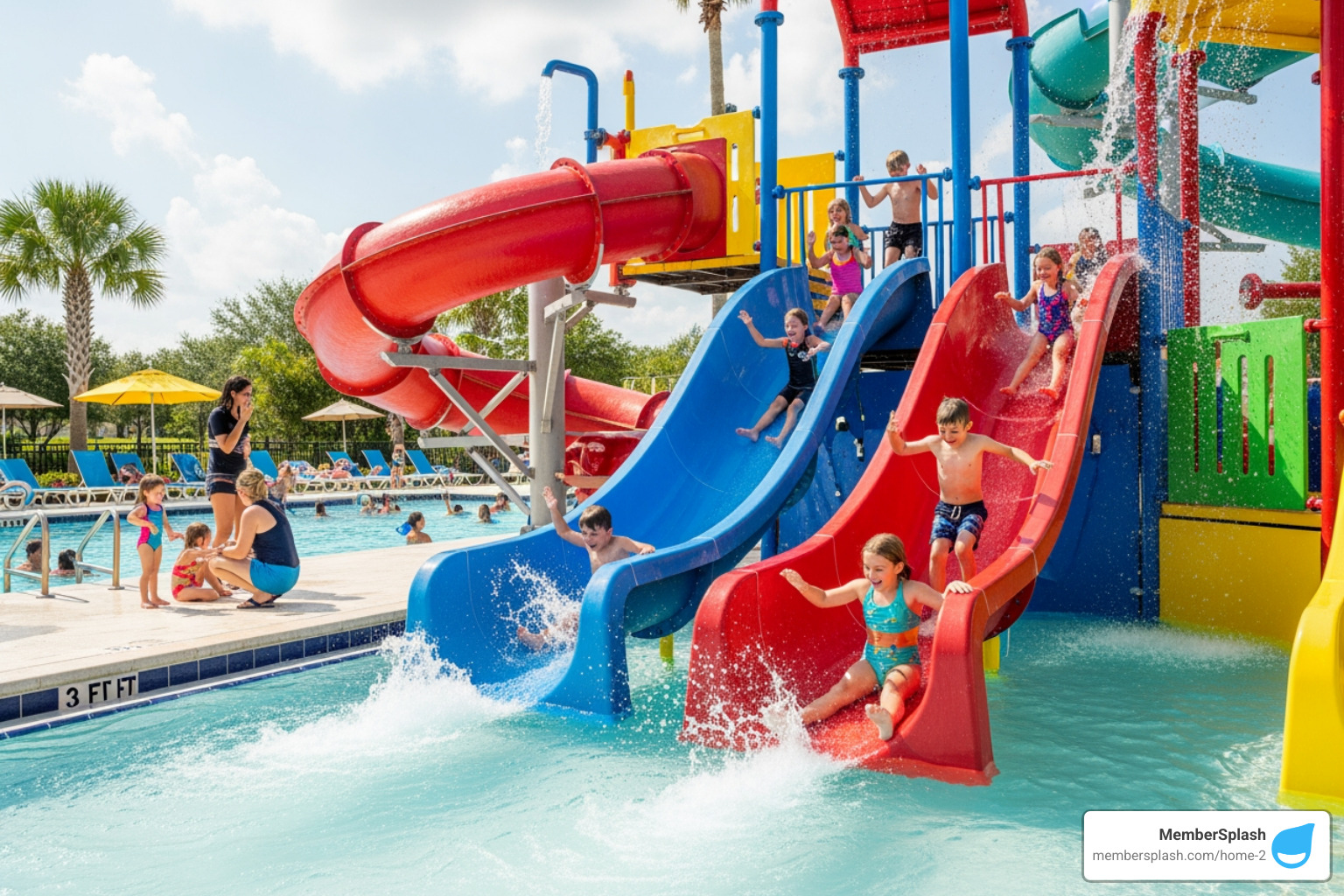
Children playing on a waterslide at a community pool - Maryland swim club

A Mission to Teach: Community Swim Initiatives

One of the most impactful roles of community-focused swim clubs is teaching water safety and swimming skills. The 4M Swim Club in the Baltimore Metropolitan area stands out with its powerful mission: “Fulfilling the dream of no child drowning since 1972.” This club has taught more African-Americans how to swim in the Baltimore area than any other learn-to-swim entity. Their long-standing commitment to this critical life skill is truly commendable. 4M Swim Club offers programs for all ages, including youth and adult swim sessions, competitive teams (the Yellowjackets), and even Masters Swimming. Their focus on creating a culture around swimming for the entire community highlights the broader social responsibility that many swim clubs accept. They are affiliated with US Masters Swimming and USA Swimming, demonstrating their commitment to recognized standards even within their community-centric approach.

The Baltimore Swim & Social Club also contributes to the social fabric of the city, focusing on creating a “Dine + Swim + Vibe” experience that blends recreation with community engagement. These initiatives demonstrate how swim clubs can be powerful agents for positive change, extending their reach beyond mere recreation.

The Social Hub: A look at a typical Maryland swim club

Many Maryland swim club facilities operate with a strong emphasis on community and social interaction, often employing unique membership models to foster a close-knit atmosphere.

The Watermont Swim Club, for example, is a not-for-profit organization that prides itself on a “welcoming family-feel.” To maintain this, they limit their membership to 350 families. This limited capacity means that new members often face a waiting list; as of May 2024, there were 112 families on the list, with new applicants expected to wait until 2026 or 2027 for an offer.

Their membership structure includes a non-refundable application fee, a one-time capital improvements fee, annual dues ($800 in 2024), and a bond purchase ($600). The bond is refunded when a member leaves and it’s sold to the next person on the waiting list, creating a sustainable model for the club. Watermont doesn’t have residency requirements, making it accessible to a broader community.

Beyond the structured membership, Watermont offers a vibrant social calendar. Their Bullfrogs swim team participates in the Central Maryland Swim League (CMSL), competing in dual meets with other Division 1 teams. But the fun isn’t just in the races; the club hosts family-friendly events like movie nights and adult socials, boasting amenities such as a 25-meter pool with a deep well, diving board, waterslide, toddler pool, clubhouse, and picnic areas. These features, combined with their active membership and constant facility improvements since their founding in 1967, ensure that Watermont remains a cherished “home away from home” for its members.

These social clubs remind us that swimming is not just an individual sport but a communal activity that strengthens neighborhood ties and provides cherished seasonal enjoyment.

Finding Your Fit: Programs for Every Age and Skill Level

One of the most appealing aspects of Maryland swim club offerings is the sheer breadth of programs available, ensuring that everyone, from a nervous toddler taking their first dip to a seasoned adult looking for fitness, can find their aquatic niche. Our goal is always to foster a lifelong love for swimming, and the diverse programs across the state make that possible.

Learn-to-Swim and Youth Programs

For many, the journey into the water begins with learn-to-swim programs. These initiatives are foundational, focusing on water safety fundamentals, basic stroke mechanics, and building confidence in the water. Clubs like the 4M Swim Club, with its mission of “no child drowning,” are at the forefront of these efforts, offering youth sessions that introduce children to the joys and safety of swimming. Pre-team groups often bridge the gap between lessons and competitive swimming, allowing young swimmers to gain comfort with structured practices before committing to a full team.

Competitive Age Group and Senior Teams

As swimmers develop, they can transition into competitive age group and senior teams. These programs are designed for athletes seeking to improve their technique, endurance, and speed. They adhere to competitive standards set by organizations like USA Swimming and Maryland Swimming, preparing swimmers for local, regional, and national meets. Clubs like NBAC and RMSC offer highly structured pathways for progression, with dedicated coaching and advanced training methodologies. For many high school swimmers, these teams also serve as a crucial pathway for college recruitment, showcasing their talents at various events and aspiring to compete at the NCAA level. The UMD Club Swim Team, for instance, accommodates a wide range of skill levels, from beginners to former national-level athletes, allowing college students to continue their competitive journey.

Masters Swimming and Adult Programs

Swimming isn’t just for the young! Masters Swimming and adult programs provide fantastic opportunities for adults to maintain fitness, refine their strokes, and even compete. Whether you’re a former collegiate swimmer looking to get back in the water or an adult seeking a challenging and social workout, these programs offer flexible practice schedules and a supportive community. Many competitive clubs, such as 4M Swim Club, offer Masters Swimming, and social clubs often have dedicated lap swimming times or adult-focused events. It’s a wonderful way to enjoy the health benefits and camaraderie of swimming throughout adulthood.

The Nuts and Bolts: Joining and Managing a Maryland Swim Club

Navigating Maryland swim club memberships can seem complex, but understanding the typical structures, costs, and processes makes it much clearer. From annual dues to bond purchases, and increasingly, the role of technology, we’ll break down what you need to know.

Understanding Membership and Costs

Membership models vary significantly between competitive, collegiate, and social clubs. Competitive clubs typically have program fees based on squad level and training intensity, often requiring annual registration with USA Swimming. Collegiate clubs like UMD Club Swim Team usually have lower fees, primarily covering operational costs and meet entry fees, as they are student-run.

Social and community clubs, on the other hand, often feature a family-centric model. Watermont Swim Club offers a clear example of this:

  • Application Fee: $150 (non-refundable, credited to bond purchase).
  • Bond Purchase: $600 (refunded upon sale when leaving the club). This system ensures long-term investment in the club.
  • Capital Improvements Fee: $100 (one-time).
  • Annual Dues: $800 (for 2024).
  • Guest Fees: $10 per person, or a book of 10 for $75.

For new members at Watermont in 2024, the total initial cost would be approximately $1450. Many popular social clubs, like Watermont, have limited memberships (e.g., 350 families) and can have extensive waiting lists, sometimes several years long. This indicates high demand and the value members place on the community aspect.

Here’s a simplified comparison of typical costs and commitments:

Feature Competitive Clubs (e.g., NBAC, RMSC) Social/Community Clubs (e.g., Watermont) Collegiate Clubs (e.g., UMD Club Swim Team)
Commitment Year-round, multiple practices/week, frequent meets Seasonal (summer), optional swim team, social events Semester-based, 2-3 practices/week, few competitions
Primary Focus Athlete development, competitive success, technique refinement Family recreation, community building, summer fun Fitness, camaraderie, continued competitive outlet
Typical Costs Higher annual fees (can be $1000s), USA Swimming registration, gear Annual dues ($500-$1000+), bond purchase, application fees, guest fees Lower fees ($100-$300/semester), meet fees, travel costs
Membership Open to all skill levels, but structured progression Limited family memberships, waiting lists, no residency requirements University students only, wide skill range

How Technology Streamlines the Experience

In today’s world, Maryland swim club management increasingly relies on technology to improve efficiency and member experience. We see clubs adopting sophisticated platforms for various operational needs:

  • Online Registration: Clubs use online portals to simplify the signup process for new and returning members.
  • Digital Payment Processing: Secure systems allow for easy collection of dues, fees, and event payments, offering convenience for members and streamlining financial management for clubs. This is where solutions for digital payment processing really shine.
  • Communication Platforms: Bulk email systems and text alerts keep members informed about practice changes, meet schedules, and social events. Watermont Swim Club, for example, uses RainedOut for text alerts.
  • Member Database Management: Comprehensive systems manage member profiles, contact information, and participation history, providing clubs with a central hub for all member data. This is crucial for efficient member database management.
  • Automated Waitlist Management: For clubs with limited memberships and high demand, technology can automate waitlist processes, ensuring fairness and reducing administrative burden. Explore tools for automated waitlist management.
  • Check-in and Access Control: Some facilities use smart technology, like biometric or mobile-enabled access, to ensure quick and secure entry, monitor attendance, and streamline operations, reducing the need for constant staff oversight.

These technological advancements are vital for streamlining club operations and allowing staff to focus more on member engagement rather than administrative tasks.

The Joining Process for a Maryland Swim Club

Joining a Maryland swim club typically involves a few key steps:

  1. Scheduling a Placement or Tryout: For competitive clubs, this assesses a swimmer’s skill level and places them in the appropriate training group. Social clubs usually don’t require tryouts, but some may have an interview process or require sponsorship from existing members (like the Westminster Riding Club, which we’ve excluded due to location, but it’s a common practice).
  2. Completing Registration Forms: This involves providing personal information, health details, and signing waivers. Online portals have made this process much smoother.
  3. Reviewing Team Handbooks: Clubs often provide comprehensive handbooks outlining policies, expectations, practice schedules, and codes of conduct.
  4. New Member Orientation: Some clubs offer sessions to welcome new families, explain club culture, and answer any questions.

Regardless of the club type, our aim is to make the joining process as welcoming and efficient as possible, ensuring that every new member feels like a part of our aquatic community from day one.

Conclusion

Maryland’s aquatic scene truly offers something for everyone. From the rigorous training and Olympic aspirations fostered by competitive powerhouses like the North Baltimore Aquatic Club and Rockville Montgomery Swim Club, to the vibrant community spirit and summer fun found at social clubs like Watermont Swim Club, our state is a swimmer’s paradise. Collegiate teams like the UMD Club Swim Team provide a continued outlet for student-athletes, while vital initiatives like the 4M Swim Club in Baltimore ensure that life-saving swim skills are accessible to all.

We’ve explored the diverse missions, from developing world-class athletes and citizens to preventing child drowning and fostering lifelong connections. We’ve seen how clubs cater to all ages and skill levels, from learn-to-swim programs and youth teams to competitive age-group and Masters swimming. And we’ve highlighted how modern technology is increasingly vital in managing memberships, processing payments, and streamlining communications, making the club experience smoother for everyone involved.

Finding the right Maryland swim club means balancing your personal goals—whether they’re competitive, social, or skill-based—with the community and programs each club offers. We encourage you to dive in and find the incredible aquatic adventures that await you in Maryland!

Explore management solutions for swim and tennis clubs.

The Ultimate List of 24-Hour Indoor Pools for Every Schedule

Why Finding a 24 Hour Indoor Pool Near Me Changes Everything

24 hour indoor pool near me searches are increasing as people look for flexible fitness options that fit their unpredictable schedules. Whether you work night shifts, travel frequently, or just prefer swimming when crowds are minimal, 24-hour pool access offers the best convenience.

Quick Answer: Where to Find 24-Hour Indoor Pools

  • National Gym Chains: 24 Hour Fitness, Life Time Fitness, and select locations of other major chains
  • Hotels with Guest Access: The Ramsey Hotel (Pigeon Forge), select Crowne Plaza locations
  • Private Rentals: Swimply app for hourly bookings of private indoor pools
  • Community Centers: Some facilities like acac Midlothian offer extended hours (though not always 24/7)
  • Check Specific Hours: Most facilities have varying hours by location and may close temporarily for maintenance or classes

Truly 24-hour indoor pools are rare. Most facilities claiming “24-hour access” mean extended hours, like 4 AM to midnight. However, many gyms and hotels still offer early morning and late-night access that can fit your schedule.

Swimming offers incredible health benefits. The CDC notes that regular physical activity like swimming can prevent numerous premature deaths and cases of serious diseases like cancer, diabetes, and heart disease, saving billions in annual healthcare costs.

Finding the right pool means balancing convenience, cost, and the specific amenities you need. This guide will help you find your options and understand what to expect from 24-hour pool facilities.

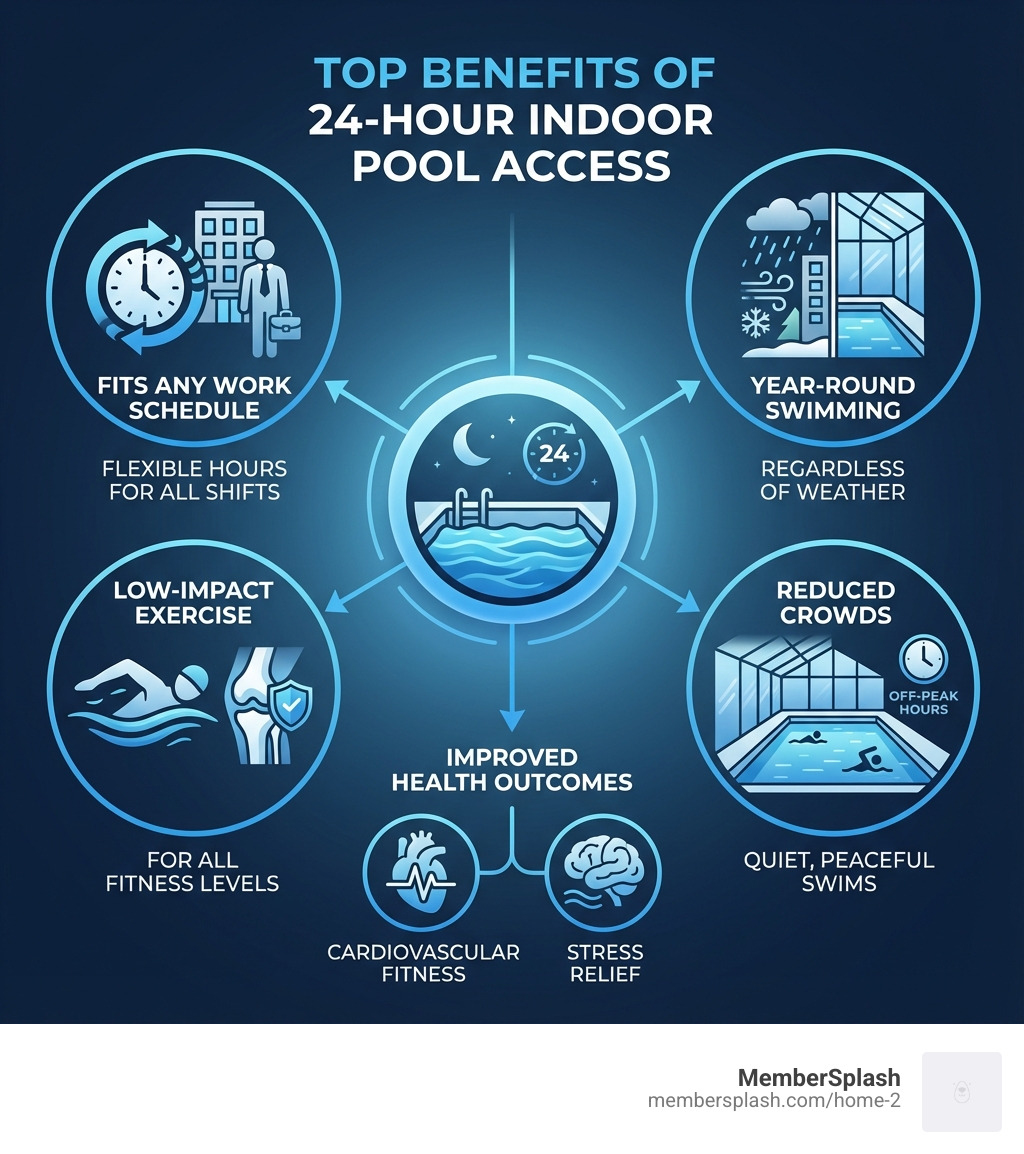
Infographic showing the top benefits of 24-hour indoor pool access: fits any work schedule with flexible hours, year-round swimming regardless of weather, low-impact exercise for all fitness levels, reduced crowds during off-peak hours, and improved health outcomes including cardiovascular fitness and stress relief - 24 hour indoor pool near me infographic

The Best Benefits of 24/7 Pool Access

Imagine slipping into a heated indoor pool at 3 AM after a long night shift. That’s the magic of 24/7 pool access—reclaiming your time and prioritizing your well-being on your own terms.

The benefits extend far beyond simple convenience:

  • Convenience: Swim on your schedule without rushing to beat closing times. The pool is ready when you are.
  • Stress Relief: A late-night or early-morning swim is therapeutic. The calming effect of water and physical exertion is a powerful stress reducer.
  • Low-Impact Exercise: Swimming is renowned for being gentle on the joints while still providing a full-body workout. It’s perfect for all ages and fitness levels, from recovery to intense training.
  • Year-Round Fitness: No matter the weather outside – be it scorching summer heat or a chilly winter day – an indoor pool provides a climate-controlled sanctuary for your aquatic workouts.
  • Muscle Recovery: Many facilities also have whirlpools or hot tubs, perfect for soothing sore muscles.
  • Improved Sleep: Regular physical activity, especially swimming, can significantly improve sleep quality. A late-night dip can help signal your body it’s time to wind down.

As the CDC highlights, physical activity saves lives and money. For pool operators, offering flexible amenities improves the value for members. Our MemberSplash platform helps facilities manage access efficiently so members can enjoy their pool time. You can find out more about how MemberSplash benefits different roles within a facility here.

Fit for Any Schedule

A 24 hour indoor pool near me adapts to diverse lifestyles, as life doesn’t always follow a 9-to-5 schedule.

  • Shift Workers: For nurses, first responders, or anyone working irregular hours, a 24-hour pool is a godsend. You can swim before or after a night shift, offering a crucial outlet for physical and mental well-being when most other facilities are closed.
  • Parents: Juggling kids’ schedules, work, and household duties often leaves little time for personal fitness. With a 24-hour option, parents can sneak in a swim during early morning hours before the kids wake up or late at night once everyone is asleep, without needing childcare.
  • Students: Late-night study sessions can be draining. A quick dip can help clear the mind, reduce stress, and re-energize for more studying or provide a much-needed break.
  • Travelers: Whether you’re dealing with jet lag or just looking to maintain your routine on the road, hotels with 24-hour pools offer a consistent fitness option, no matter what time zone you’re in.
  • Overcoming Crowded Gym Times: Let’s be honest, nobody enjoys swimming in a crowded lane. Extended hours mean you can often find times when the pool is less busy, allowing for a more peaceful and productive workout.
  • Workout Consistency: When your pool is always open, there are fewer excuses to skip a workout. This consistent access fosters better adherence to your fitness goals, making it easier to build and maintain a healthy habit.

A Boost for Overall Wellness

Access to a 24 hour indoor pool near me also boosts overall wellness, offering a holistic approach to health.

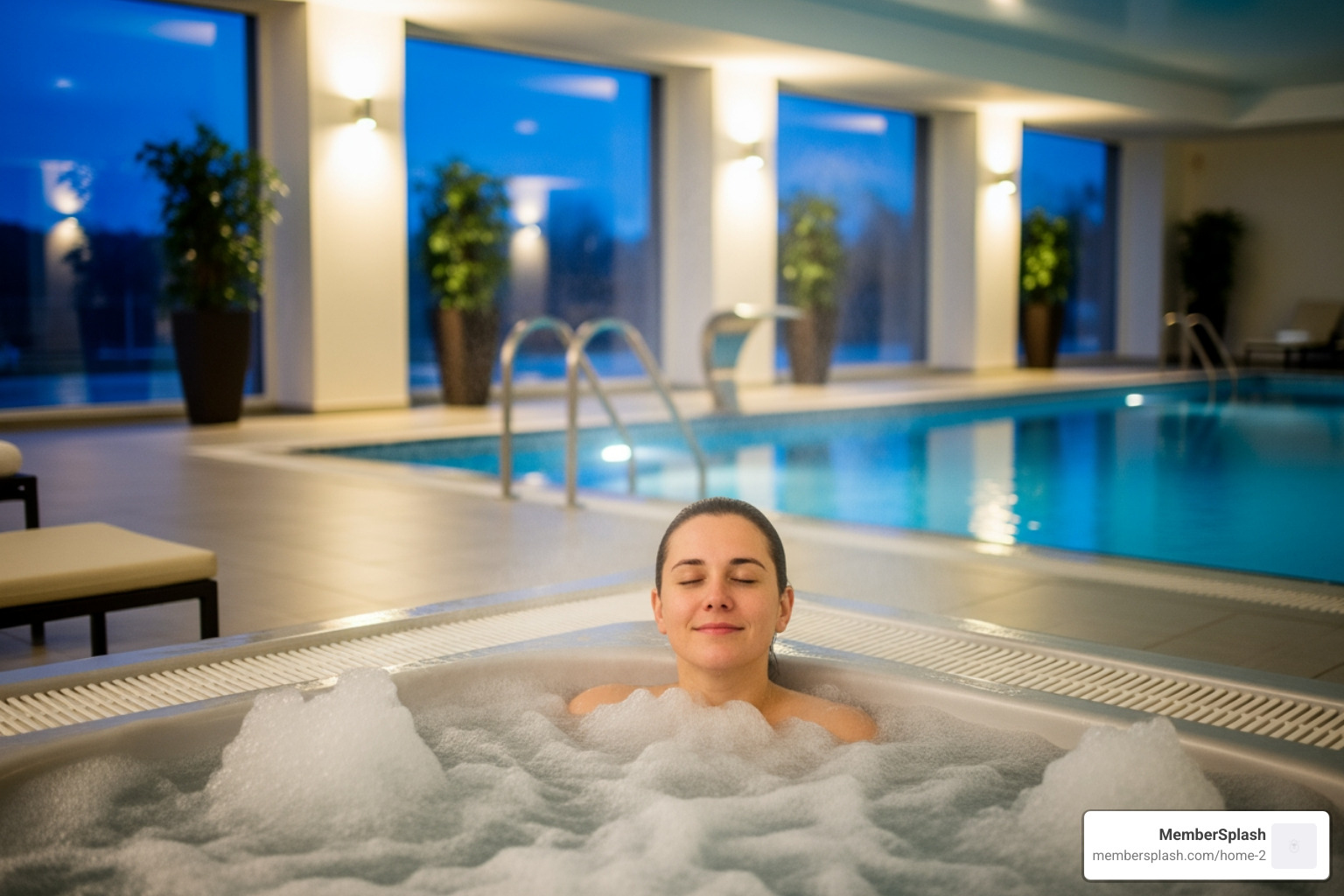
Person relaxing in a whirlpool next to a pool - 24 hour indoor pool near me

  • Mental Clarity: The rhythmic motion of swimming and the quiet environment of an uncrowded pool can be meditative. It’s a fantastic way to clear your head, reduce anxiety, and gain mental clarity, especially during those peaceful late-night or early-morning hours.
  • Hydrotherapy: Warm water pools and whirlpools offer therapeutic benefits, easing muscle tension, improving circulation, and providing relief from aches and pains. It’s a natural way to refresh your body.
  • Joint Health: The buoyancy of water reduces the impact on joints, making swimming an ideal exercise for individuals with arthritis or those recovering from injuries. It allows for a full range of motion without strain.
  • Cardiovascular Fitness: Swimming is an excellent cardiovascular workout, strengthening the heart and lungs, improving stamina, and contributing to overall heart health.

The U.S. Department of Health and Human Services notes that physical activity reduces the risk of many chronic diseases. Swimming is a fantastic way to gain these benefits. For more details, consult this comprehensive guide: What Are the Benefits of Gym Membership with Us?.

How to Find a 24 hour indoor pool near me

Finding a 24 hour indoor pool near me requires some detective work, as true 24/7 access is a premium feature. The right approach can uncover facilities with hours suited to your schedule.

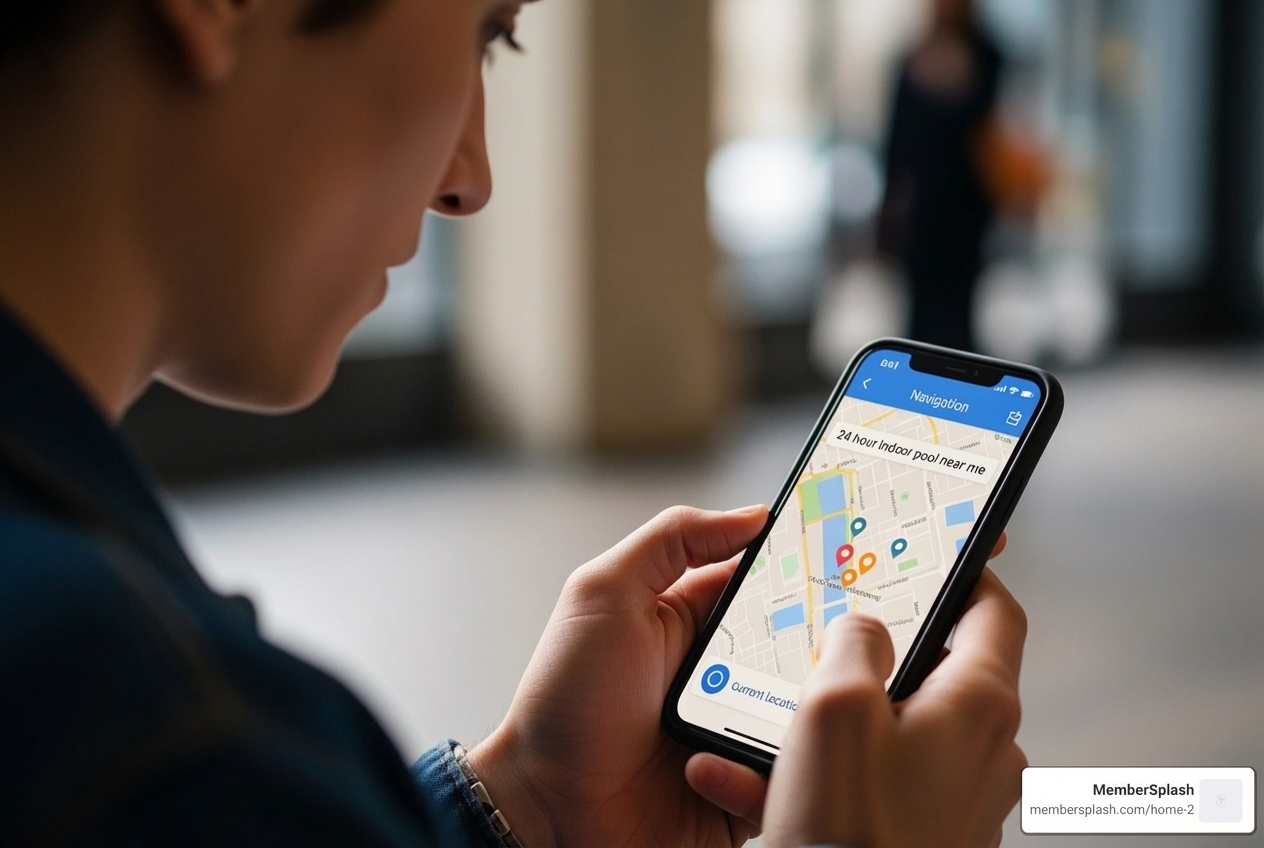
Person using a smartphone to search for pools - 24 hour indoor pool near me

Start your search with a simple online query. Use terms like “24 hour indoor pool Baltimore,” “late night swim Annapolis,” or “gyms with pools near me open late.” Supplement this with:

  • Gym Locators: Most major gym chains have comprehensive online locators.
  • Hotel Booking Sites: Filter searches for hotels with “indoor pool” and then check their specific amenity details for hours.
  • Private Pool Rentals: Apps like Swimply are revolutionizing how people access private aquatic spaces.
  • Community Centers & YMCAs: While less likely to be 24/7, many offer extensive early morning and late evening hours. Check their websites directly.

Always double-check the specific hours for the pool itself, as club hours might differ from aquatic facility hours.

National Gym Chains

Many national gym chains offer impressive aquatic facilities with extended or 24-hour access. In areas like Baltimore or Annapolis, these are often your best bet for finding a 24 hour indoor pool near me.

Common gym amenities you might find alongside pools include:

  • Lap lanes for serious swimmers
  • Whirlpools or hot tubs for relaxation and recovery
  • Saunas and steam rooms
  • Locker rooms with showers
  • Family-friendly leisure pools
  • Aqua fitness class areas

24 Hour Fitness aims to provide facilities around the clock. While not every pool is open 24/7, many offer extended hours. Their website highlights pools and whirlpools as key amenities. To find a location and check specific pool hours, use their locator: Gym Locations Near Me – 24 Hour Fitness. We recommend calling ahead, as hours can vary due to classes or maintenance.

Other national chains, like Life Time Fitness, are known for their luxurious and comprehensive facilities, often including multiple indoor and outdoor pools, whirlpools, and dedicated lap lanes. While specific 24-hour access for pools might not be universal across all their locations, they typically offer very early morning and late evening hours.

When considering a gym membership, pay close attention to the membership tiers and pool access policies. Some memberships might offer broader access or include amenities like towel service, while others might have restrictions. For facilities, managing these different membership types and ensuring smooth access is crucial. That’s where solutions like our online payment processing come in handy for efficient membership management: More info about online payment processing.

Hotels and Resorts

Hotels and resorts are excellent short-term sources for a 24 hour indoor pool near me. While not all offer 24-hour access, many provide extended hours for early risers and night owls.

Hotel amenities often include:

  • Heated indoor pools
  • Comfortable lounging areas
  • Poolside service (at some higher-end establishments)
  • Whirlpools or hot tubs

Access is typically restricted to guests, making it a more private experience. It’s often seen as a significant travel perk, especially during off-season months when outdoor pools are closed.

In our local area, the Crowne Plaza Annapolis is an example of a hotel that offers an indoor pool. While the research doesn’t specify 24-hour operation for their pool, many Crowne Plaza hotels aim to provide excellent amenities for their guests, making them a good starting point for inquiries about extended hours. Always check directly with the hotel for their current pool operating hours.

When booking, we always advise contacting the hotel directly to confirm pool hours, especially if 24-hour or late-night access is a priority for you. Hotel websites are a great starting point, but a quick phone call can save you disappointment.

Private Pool Rentals

For a private and flexible experience, private pool rentals are a popular, innovative solution. This option lets you book a pool by the hour, giving you complete control over your swim time.

The Swimply app is at the forefront of this trend. Think of it as an Airbnb for pools. Owners list their private pools, hot tubs, saunas, and even entire backyard spaces for rent. This means you could potentially find a 24 hour indoor pool near me that’s a private residence, offering a serene and exclusive environment.

Here’s why private pool rentals are appealing:

  • Hourly Rentals: Pay only for the time you use, making it cost-effective for short, focused swims.
  • Private Experience: Enjoy the pool without crowds or distractions. It’s just you (and your invited guests, if allowed).
  • Variety of Amenities: Beyond just pools, you might find listings that include hot tubs, saunas, or even unique “Igloo” collections for winter enjoyment.
  • Flexibility: Many hosts offer flexible booking times, and some may accommodate very early or very late requests.

To explore private indoor pools available for rent in your area, you can download the Swimply app: Download the app. This is an excellent option if traditional gyms or hotels aren’t meeting your specific needs for privacy or exact timing.

What to Expect: Amenities, Policies, and Safety

Once you find a potential 24 hour indoor pool near me, it’s important to understand its amenities, policies, and safety measures. Facilities with extended or 24-hour access have specific protocols for a smooth, secure experience.

Typically, you’ll gain access via a key card or a digital membership pass. Membership rules will dictate who can use the facility and when. Pool maintenance schedules are also vital to be aware of, as even 24-hour pools will have designated cleaning or treatment times. Always look for clearly displayed safety equipment. For pool operators, managing these aspects—from member access to reservation systems—is streamlined with modern software. Our MemberSplash platform, for instance, helps facilities implement efficient reservation systems to manage pool usage and ensure fair access: More info about reservation systems.

Typical Amenities and Features

A quality indoor pool with extended hours often includes features to improve your experience.

  • Lap Lanes: For those focused on fitness, dedicated lap lanes are a must. These are usually clearly marked and sometimes have specific rules regarding speed or direction.
  • Whirlpools/Hot Tubs: Perfect for warming up before a swim or relaxing muscles afterward, whirlpools are a popular addition. They offer hydrotherapy benefits, promoting relaxation and recovery.
  • Saunas and Steam Rooms: Many upscale gyms and hotels include saunas and steam rooms near their pool areas, offering additional relaxation and detoxification benefits.
  • Locker Rooms: Clean, well-maintained locker rooms with showers, changing areas, and secure lockers are standard.
  • Towel Service: Some facilities offer complimentary towel service, while others require you to bring your own. Always check beforehand! (As 24 Hour Fitness noted, they don’t offer towels but sometimes sell them if you forget!)
  • Comfortable Lounging Areas: Even for a quick dip, having a place to sit, relax, or wait for others can make a big difference.

While we can’t list amenities for every Baltimore or Annapolis location, inquire about these general features. For example, Life Time’s Garden City location shows dedicated hours for various pools and whirlpools, highlighting the variety of amenities available: Club Hours at Garden City | Life Time.

Access, Rules, and Special Hours

Even 24-hour facilities have rules and schedules for safety and enjoyment. These policies are crucial for a 24 hour indoor pool near me.

  • Age Restrictions: Most facilities have age limits for unaccompanied minors, especially during unstaffed or late hours. Children 12 and older might be allowed to be members, but often need a guardian present. Always clarify these policies if you plan to bring younger swimmers.
  • Guest Policies: Bringing a guest usually involves specific rules, such as signing them in, paying a day pass fee, or having them adhere to certain hours. Our MemberSplash platform helps facilities manage these complexities with features like guest tracking and payment: More info about guest tracking and payment.
  • Family Swim Times: While a pool might be 24-hour, dedicated “family swim” or “open swim” times might be restricted to specific hours, particularly at community-oriented facilities.
  • Aqua Classes: Pools often host scheduled aqua fitness classes, during which lap lanes or certain areas of the pool may be unavailable for general use. These are usually listed on an events calendar, which our MemberSplash platform can help facilities manage: More info about events calendar.
  • Maintenance Closures: All pools require regular cleaning and maintenance. Even 24-hour facilities will have scheduled downtimes for deep cleaning, chemical balancing, or repairs. These are usually communicated in advance.

It’s always best to check the specific facility’s website or call them directly to understand their full schedule and policies. This helps avoid disappointment and ensures you can make the most of your membership.

Safety Measures at Unstaffed Hours

Swimming at 3 AM raises safety questions. Facilities with 24-hour access implement measures to protect members, especially when no lifeguard is on duty.

  • No Lifeguard on Duty: This is a critical point. Many 24-hour pools operate without a dedicated lifeguard during off-peak hours. Facilities will typically have clear signage stating “Swim at Your Own Risk.”
  • Emergency Phones: Look for emergency call boxes or phones directly connected to security or emergency services, usually located poolside.
  • CPR-Trained Staff on-site: While a lifeguard might not be watching the pool, the facility should have staff members (like front desk personnel or gym attendants) who are trained in CPR and first aid and can respond to emergencies.
  • Security Monitoring: Many 24-hour facilities use surveillance cameras in and around the pool area, monitored by security personnel, to ensure member safety and deter inappropriate behavior.
  • Pool Rules Signage: Comprehensive and clearly visible signage detailing all pool rules, emergency procedures, and safety guidelines is a must. These rules often include no diving, no running, and restrictions on alcohol or glass containers.
  • Check-in and Access Control: Robust access control systems, often involving key cards or biometric scanners, ensure that only authorized members can enter the facility. Some systems even use photo verification upon check-in, which our MemberSplash platform supports, adding an extra layer of security: More info about check-in photo verification.

When using a 24-hour pool, it’s advisable to swim with a buddy if possible, especially during unstaffed hours. Always be aware of your surroundings and understand the emergency procedures.

Frequently Asked Questions about 24-Hour Indoor Pools

We understand you might have more questions before diving into 24 hour indoor pool near me. Here are some common inquiries we encounter:

Are 24-hour indoor pools actually open 24/7?

This is a common question with a nuanced answer. “24-hour” doesn’t always mean the pool itself is open 24/7.

  • Most are not strictly 24/7: Many facilities that advertise “24-hour access” for their gym might have slightly different hours for their pool area. For example, a gym might be open 24 hours, but the pool could close from midnight to 4 AM for cleaning or maintenance.
  • Exceptions for Cleaning: Pools require regular chemical balancing, vacuuming, and deep cleaning. These activities often necessitate temporary closures, typically during late-night or early-morning hours when usage is lowest.
  • Maintenance Periods: Beyond routine cleaning, pools periodically require more extensive maintenance or repairs, which will lead to planned closures.
  • Special Events: The pool might be reserved for aqua classes, swim lessons, or special events during certain times, limiting general access.

Our best advice is to check the specific schedule for the pool. Don’t assume its hours are identical to the gym’s. For instance, Life Time’s Castle Creek location has different hours for the club and its amenities: Club Hours at Castle Creek | Life Time. A quick call or schedule check will clarify any ambiguities.

What should I look for when choosing a gym with a 24 hour indoor pool near me?

When choosing a membership, here’s what we recommend considering:

  • Cleanliness: This is paramount. Inspect the pool area, locker rooms, and showers during your visit. A clean facility indicates good management and a healthy environment.
  • Water Temperature: Some prefer cooler water for intense lap swimming, while others enjoy a warmer, more therapeutic soak. Ask about the pool’s typical temperature to ensure it aligns with your preference.
  • Amenities: Does it offer lap lanes, a leisure area, a whirlpool, sauna, or steam room? Consider what additional features are important for your wellness routine.
  • Cost vs. Value: Evaluate the membership fees against the amenities offered, the hours of operation, and the overall quality of the facility. Don’t forget to ask about any initiation fees or long-term contract requirements.
  • Member Reviews: Check online reviews or ask current members for their opinions on the pool, staff, and overall experience.
  • Access Policies: Confirm the exact pool hours, especially during the times you plan to swim. Inquire about age restrictions, guest policies, and any potential closures for classes or maintenance. Also, ask about the security measures in place during unstaffed hours.

For residents in Baltimore and Annapolis, consider visiting local options like Merritt Clubs in Downtown Baltimore or the Arundel Olympic Swim Center. While they may not all offer 24-hour pool access, they are reputable facilities where you can inquire about their specific indoor pool hours and amenities.

Can I bring my kids or a guest to a 24 hour indoor pool near me?

Policies for bringing children or guests vary significantly by facility. It’s crucial to understand them beforehand to avoid surprises.

  • Varies by Location: Each gym, hotel, or private rental host will have its own set of rules. A family-oriented gym might be more accommodating than a boutique hotel or a private rental.
  • Guest Policies: Most facilities allow guests, but often with specific requirements. This might include:
    • Sign-in Procedures: Guests usually need to be signed in by a member or hotel guest.
    • Day Pass Fees: A fee is commonly charged for guests, which can vary widely.
    • Limited Visits: Some memberships might include a certain number of free guest passes per month or year, or limit how often the same guest can visit.
  • Age Restrictions: For children, age limits are very common, especially during late-night or unstaffed hours. Many facilities require minors to be accompanied by an adult, and some may have a minimum age for using the pool at all. For example, 24 Hour Fitness generally welcomes children 12 and older as members to use their pools, but recommends minors are accompanied by a guardian.
  • Supervised Hours: Even if a pool is open late, specific “family swim” or “children’s hours” might be designated, meaning children are only allowed during these times.
  • Private Rentals: With services like Swimply, guest policies are set by the individual host. Some allow many guests for an additional fee, while others prefer a more intimate experience.

It’s always best to check the facility’s specific guest and age policies before your visit. For facilities themselves, managing these diverse guest policies and member accounts is a complex task. Our MemberSplash platform helps streamline this by providing a robust member account database and guest tracking features, ensuring smooth operations and clear communication for all: More info about member account database.

Conclusion

Finding a 24 hour indoor pool near me is a game-changer for your fitness routine. The flexibility to swim anytime lets you fit exercise into a demanding schedule, reaping health benefits year-round. From late-night stress relief to an early morning workout, these facilities offer unparalleled convenience.

While true 24/7 pool access is rare, many gyms, hotels, and private rentals offer extended hours. Whether you explore 24 Hour Fitness, Crowne Plaza Annapolis, or a Swimply rental, a solution likely exists. Always verify the specific pool hours, amenities, and safety protocols for any location you consider.

For pool operators, offering these premium amenities means attracting a wider range of members and enhancing satisfaction. Streamlining access, managing memberships, and communicating policies efficiently are key to providing an exceptional experience. That’s precisely where MemberSplash excels. Our software helps facilities handle complex pricing, manage guest tracking, and ensure smooth operations, saving time and costs while maximizing revenue.

Ready to transform your pool management and offer your members the flexibility they deserve?
Discover our pool management solutions

Member Splash and SquadLocker’s Heart for Fundraising: Recognizing its Pivotal Role in the Success of Clubs and Organizations

Dive into Efficiency: SquadLocker and Member Splash Revolutionize Swim Club Fundraising


Swimming clubs are the heartbeat of the swimming community – nurturing talent, instilling a passion for the sport, and shaping future athletes. However, running a swimming club can sometimes feel like navigating treacherous waters. From managing memberships to sourcing custom apparel, the list of responsibilities can seem endless. But fear not! Enter the dynamic duo of SquadLocker and Member Splash, here to simplify club operations and let clubs focus on what truly matters – their members.

Picture this: A user-friendly interface that effortlessly handles membership management, saving precious time and money. That’s where Member Splash shines. Tailored specifically for swim clubs, this powerhouse platform understands the unique pricing structures, account types, and club rules that clubs deal with. Say goodbye to administrative headaches and hello to streamlined efficiency.

SquadLocker Merchandise Now, let’s talk about SquadLocker, the unrivaled champion of custom apparel and e-commerce solutions. Their mission? To revolutionize how organizations personalize and distribute custom goods. With their cutting-edge online tools, SquadLocker empowers swimming clubs to effortlessly create, manage, and distribute custom apparel. From sleek uniforms to spirited team gear, SquadLocker offers a staggering selection of over 16,000 products from top brands like Wilson, Under Armour, Adidas, and Nike. In other words, the possibilities are endless, allowing clubs to showcase their unique brand identity. And here’s an exciting tidbit: SquadLocker’s SquadStudio design tool will soon unveil sublimated swim uniforms, taking style to new depths.

But that’s not all. SquadLocker’s true strength lies in their lightning-fast service. No more waiting for ordering windows or dealing with minimum order quantities. With SquadLocker, club members can enjoy the convenience of round-the-clock online stores, where they can order anytime, anywhere. And thanks to SquadLocker’s seamless payment and fulfillment process, the journey from selection to delivery is as smooth as a perfectly executed butterfly stroke.

SquadLocker Fundraising But wait, there’s more! SquadLocker goes above and beyond custom apparel. They have a heart for fundraising, recognizing its pivotal role in the success of clubs and organizations. Thanks to SquadLocker’s fundraising feature, clubs can display a SquadLocker Store Banner on their Club Website and effortlessly earn funds with every purchase. It’s as simple as flicking a switch, allowing clubs to raise funds to cover expenses such as new equipment, maintenance, upgrades, and those unexpected repairs. Talk about a win-win situation!

To wrap it all up, the partnership between SquadLocker and Member Splash presents swimming clubs with an all-encompassing solution for their membership management and custom club apparel needs. With SquadLocker’s unrivaled expertise in custom apparel and e-commerce and Member Splash’s unwavering focus on streamlining swim club operations, clubs can sail smoothly through their daily tasks, saving valuable time and resources. Together, SquadLocker and Member Splash are redefining the game and empowering swimming clubs to make waves. It’s time to make a splash!