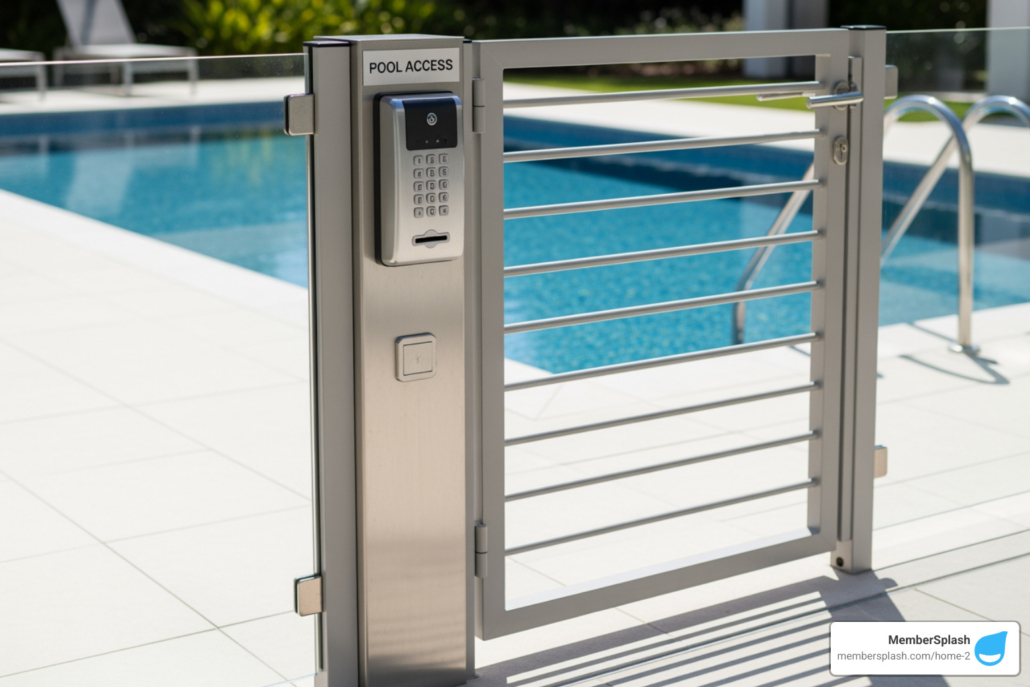
Beyond the Lock: Why Pool Access Control is Essential for Safety
Why Pool Access Control Matters for Safety and Operations
Pool access control systems are technology solutions that manage who can enter your pool facility and when. They replace traditional locks with electronic systems like keypads, key fobs, mobile credentials, or biometric scanners—giving you better security, automated tracking, and remote management capabilities.
Quick Answer: What Pool Access Control Can Do For You
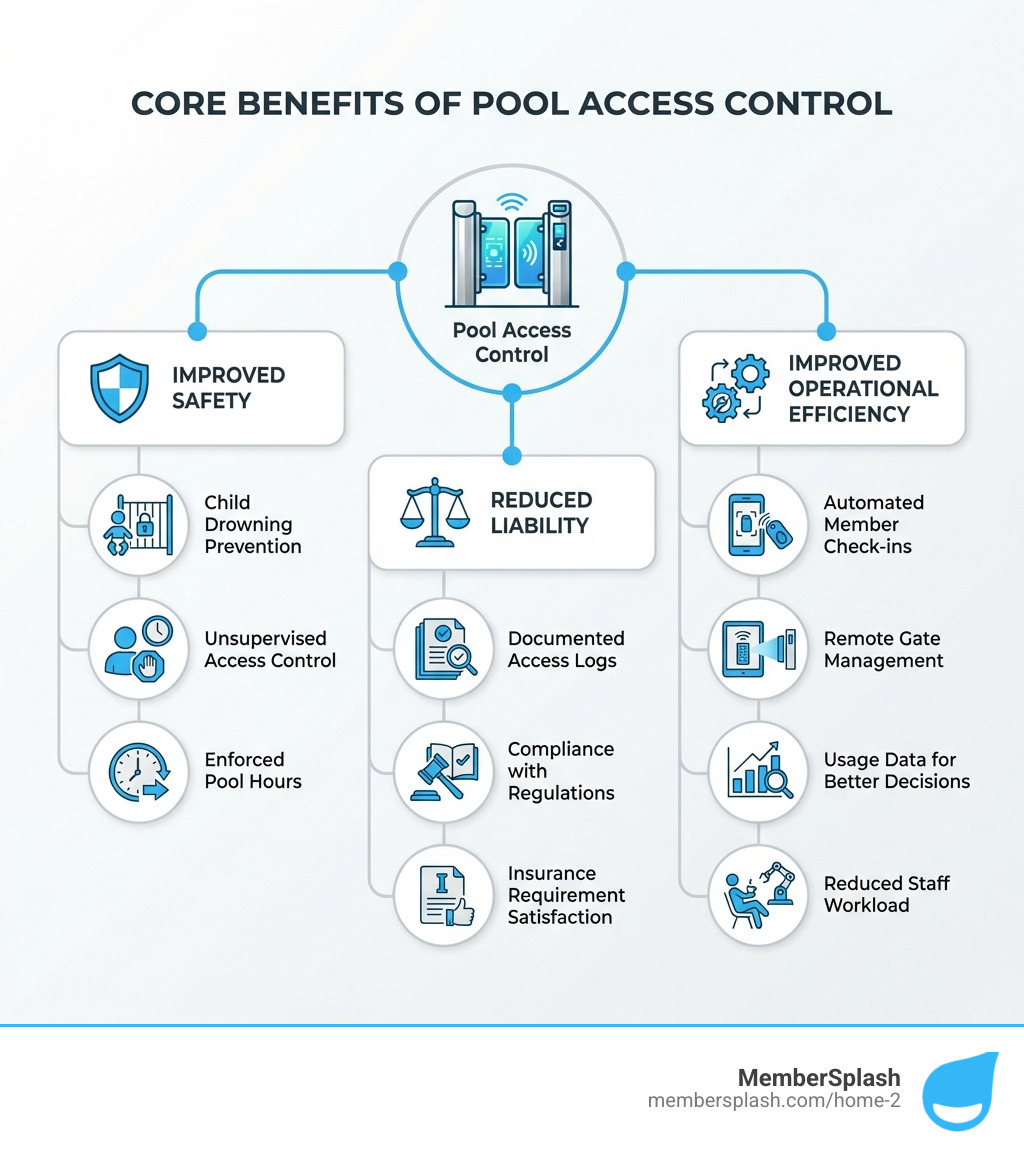
- Improve Safety: Prevent unsupervised child access and unauthorized entry
- Reduce Liability: Document who enters your facility and when
- Save Time: Automate check-ins and eliminate manual gate monitoring
- Enforce Rules: Restrict access based on membership status or payment
- Generate Data: Track usage patterns for better staffing and maintenance decisions
With 10.4 million private pools and 309,000 public and community swimming pools in the United States, the stakes are high. Unsecured pools create serious liability risks—from drowning accidents to trespassing incidents that can cost property managers and HOAs thousands in legal fees and insurance claims.
The traditional approach of simple padlocks or manually checking IDs at the gate doesn’t cut it anymore. These methods are time-consuming, prone to human error, and impossible to audit. When a child slips through an open uped gate or an unauthorized guest causes damage, you have no way to prove what happened or who was responsible.
Modern access control systems solve these problems by creating a digital record of every entry, automatically enforcing your facility rules, and giving you real-time visibility into who’s using your pool. As one pool manager put it: “Gone are the days of paper records, and here are the days of digital ease.”
Whether you manage an HOA community pool, a private swim club, or multiple facilities, access control has become essential infrastructure—not a luxury feature.
Why Your Pool Needs More Than a Simple Gate Lock
We all love a refreshing dip on a hot day, but swimming pools, especially those in community centers or residential complexes, require robust management to ensure they remain safe, clean, and enjoyable for everyone. That’s where pool access control systems come in, offering far more than just a simple lock and key. They are critical for managing capacity, ensuring only authorized users have access, and even maintaining optimal water quality.
Overcrowding, for instance, can quickly lead to safety hazards and degrade the experience for users. Imagine a busy pool where everyone can just waltz in; chaos, right? Uncontrolled access also risks contamination and drives up maintenance costs, not to mention the potential for vandalism and the depletion of valuable amenities.
A comprehensive pool access control system provides improved security by restricting entry to authorized individuals, deters trespassing, and protects your amenities from misuse. It’s about creating a secure perimeter that ensures peace of mind for property managers and residents alike, changing your pool from a potential headache into a well-managed oasis. Investing in such a system is an essential step towards optimizing usage and maintaining a pleasant environment for all.
Enhancing Safety and Preventing Accidents
At the heart of any pool management strategy is safety. This is where pool access control truly shines. The primary goal is to prevent unsupervised access, especially by children and pets, which dramatically reduces the risk of accidents and tragic drownings. A properly secured pool gate acts as the first line of defense.
Our systems ensure that only authorized individuals can enter, effectively enforcing pool hours and keeping little ones from venturing into the pool area unattended. This isn’t just about gates; it’s about intelligent control. If the gate hardware includes a locking function that requires a key or fob for entry, child safety is inherently addressed by the locking mechanism itself, allowing for more flexible hardware placement within accessible ranges while maintaining security.
Property managers can rest easy knowing that their pool areas are protected, significantly reducing the potential for accidents and fostering a safer community environment. This peace of mind is invaluable, allowing us to focus on creating enjoyable experiences rather than constantly worrying about security breaches.
Managing Liability and Ensuring Compliance
Beyond immediate safety, pool access control is a powerful tool for managing liability and ensuring compliance with local regulations. Unauthorized access could result in significant liability issues for property managers and HOAs. Non-compliance with pool gate regulations can lead to hefty fines, legal liabilities, and increased risks.
For instance, while specific regulations vary by state and municipality, the general purpose remains consistent: to ensure safety and prevent unauthorized access. Many jurisdictions, including those in Maryland, will have specific requirements for pool barriers, such as minimum height, and mandate self-latching and self-closing gates. Our systems help you meet these critical requirements.
A robust pool access control system provides a comprehensive audit trail, carefully documenting who enters and exits the pool area, when, and for how long. This data is invaluable for liability protection, helping us investigate incidents, verify compliance with rules, and even defend against false claims. By integrating access control with our member account database, we can prevent incidents from unauthorized guests and ensure that only current, approved members have access. This digital record is far more reliable than any manual logbook and can be crucial evidence should a legal dispute arise.
More info about member account database
Choosing Your System: A Breakdown of Pool Access Control Technologies
When we talk about pool access control, we’re no longer just discussing a simple padlock. Modern technology offers a spectrum of solutions, each with its own advantages. The key is finding a system that balances security, convenience, and durability, especially given the challenging outdoor pool environment.
One critical consideration for any outdoor pool system is its ability to withstand the elements. Outdoor systems must be robust, weatherproof, and resistant to rust and corrosion. We’ve all seen those sad, rusty gate latches that seize up after a season or two. High-quality latches and electronic components are designed to resist such wear and tear, ensuring reliable operation year after year. Many locks fail in outdoor environments due to corrosive effects of salt or chemicals, leading to compromised functionality and costly replacements. We aim for solutions that are built to last, protecting your investment and maintaining seamless access.
Traditional vs. Modern Access Methods
The evolution of pool access control has moved us far beyond the traditional key. Today, we have a range of options, each offering different levels of security and convenience:
- Keypads and PIN codes: These are a cost-effective and easily reprogrammable solution. Members enter a numerical code to gain access. They’re great for situations where you need to change access codes frequently or for temporary guests.
- Key fobs and access cards (RFID): These are ideal for community pools with many users. Members simply tap or swipe their fob or card to enter. They offer a good balance of security and convenience, and can be easily deactivated if lost or stolen.
- Biometric systems (fingerprint/facial recognition): Offering the highest level of security, biometrics ensure that only the authorized individual can gain entry. While more of an upfront investment, they eliminate the need for physical credentials altogether and provide seamless, touchless access.
- QR codes for temporary access: A fantastic modern solution, QR codes can be generated and sent via email for guests or short-term users. They can be time-limited, ensuring access only for the duration needed, making guest pass management a breeze.
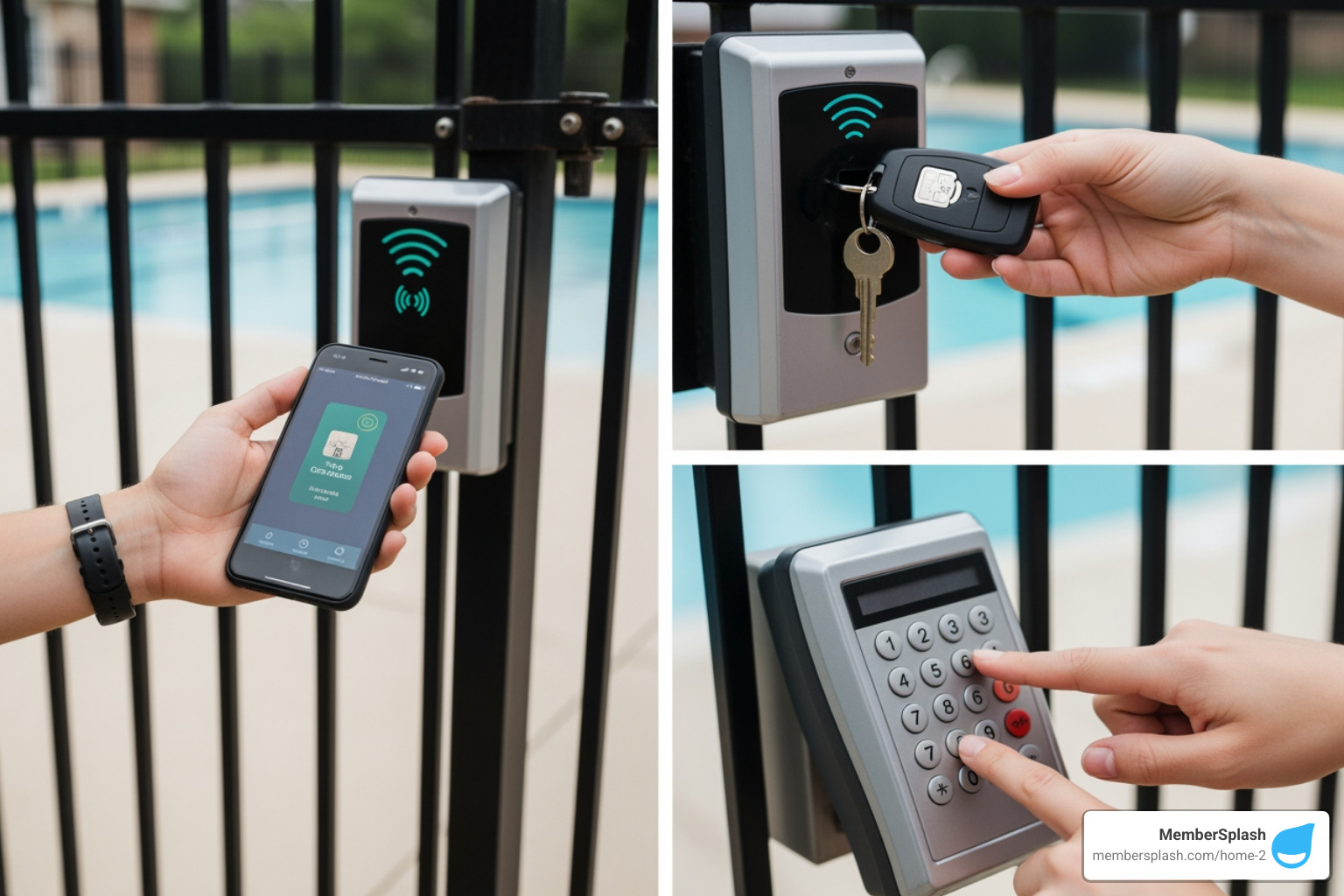
When selecting a method, we consider factors like user volume, desired security level, and ease of management. For instance, a system where members can issue temporary QR codes for their guests simplifies the process immensely, as we detail further in our guest tracking and payment solutions.
More info about guest tracking and payment
The Rise of Mobile Credentials and Cloud-Based Systems
The biggest game-changer in pool access control has been the rise of mobile credentials and cloud-based systems. Imagine accessing your pool with just your smartphone – no more fumbling for keys or fobs! Mobile credentials leverage smartphone technology (like NFC or Bluetooth) to grant access, offering unparalleled convenience. Users are far less likely to lend their personal devices than a plastic fob, making them inherently more secure.
Mobile credentials also offer contactless, hygienic access, a feature that has become increasingly valued. We can issue and revoke these credentials remotely from any internet-connected device, providing instant updates and saving us the cost and hassle of replacing physical fobs. This flexibility is a huge advantage for managing dynamic access schedules or for situations where credentials need to be changed quickly.
Cloud-based access systems are truly revolutionizing how property managers and developers manage pool access. They provide granular control over access levels, allowing us to differentiate between residents, guests, and staff. Remote management of pool gates enables real-time access monitoring, instant notifications for unauthorized attempts, and flexible permission management. Plus, all reporting is cloud-based, simplifying compliance and auditing. Cloud-connected systems eliminate the need for on-site monitoring, freeing up our team to focus on providing an excellent member experience.
| Feature | Mobile Credentials | Key Fobs |
|---|---|---|
| Convenience | High (smartphone always on hand, contactless) | Moderate (physical item to carry) |
| Security | High (less likely to share, instant revocation) | Moderate (can be lost/stolen, easily shared) |
| Cost | Lower (no physical item to purchase/replace) | Moderate (cost of fob, replacement fees) |
| Management | Remote, instant updates/revocation | Manual distribution/collection, slower revocation |
| Durability | Tied to smartphone durability | High (physical, durable plastic) |
| Hygiene | High (contactless) | Moderate (physical contact with reader) |
| Integration | Seamless with cloud platforms, apps | Often requires specific hardware readers |
For improved security, especially in high-traffic areas, we even integrate check-in photo verification, adding another layer of visual confirmation to ensure that the person entering matches the credential holder.
More info about check-in photo verification
How to Select and Implement the Right System for Your Facility
Choosing the right pool access control system for your facility can feel like a big decision, but with a clear understanding of your needs and the available options, it becomes a straightforward process. We’re here to help guide you through it. The goal is to find a system that not only meets your security requirements but also fits your budget, offers user convenience, and can grow with your facility.
Key Factors in Selecting a Pool Access Control System
When we assess which system is best for you, we look at several key factors:
- Facility Size and Type: Are you managing a small HOA pool, a busy community center, or a private swim club? A small private facility might prioritize 24/7 access control, while a larger facility with staff at entry points might find a simple fob or key card system useful. For HOAs, apartment, and condo associations, simple, custom membership management software is often ideal.
- Number of Users: A system designed for a few dozen users will differ significantly from one catering to hundreds or thousands. We need to consider user volume and how many credentials will be actively managed.
- Desired Security Level: Do you need basic entry control, or advanced security with real-time alerts and audit trails? Biometric systems offer the highest level of security, while keypads provide a cost-effective solution.
- Budget and Total Cost of Ownership: This isn’t just about the initial purchase price. We consider installation costs, ongoing maintenance, and the cost of replacing lost fobs or cards. Cloud-based solutions, for example, often offer a lower total cost of ownership due to reduced hardware and maintenance needs.
- Integration Capabilities: Can the system integrate seamlessly with your existing membership management software, payment processing, or even CCTV cameras? A well-integrated system streamlines operations and maximizes efficiency.
More info about pricing comparison
Understanding Pool Gate Regulations and Installation
Navigating pool gate regulations can be tricky, as they often vary by state and even local municipality. However, their core purpose is consistent: to ensure safety and prevent unauthorized access. These regulations typically specify requirements such as minimum gate height (often at least four feet), and that gates must be self-closing and self-latching. It’s crucial to ensure compliance to avoid hefty fines and legal liabilities.
Installation of pool access control systems also needs careful consideration, especially regarding hardware mounting heights and ADA compliance. For example, standard door hardware must be installed between 34 and 48 inches above the finished floor. However, there’s an exception for pool gate hardware: the release of the latch on self-latching devices can be mounted up to 54 inches, provided it’s not also a self-locking device operated by a key, electronic opener, or combination lock. If the gate hardware also has a locking function (requiring a key/fob), child safety is addressed by the lock, and the hardware can be within the 34-48 inch accessible range.
It’s also paramount that egress from pool areas is always free and does not require a key or special knowledge, aligning with NFPA Life Safety Code. For complex systems, we always recommend professional installation to ensure correct function and compliance.
Swimming Pool Access Control code requirements
Best Practices for Installing and Maintaining Your Pool Access Control
Once you’ve selected and installed your pool access control system, ongoing maintenance is key to its effectiveness and longevity. We believe in proactive care to keep your system running smoothly.
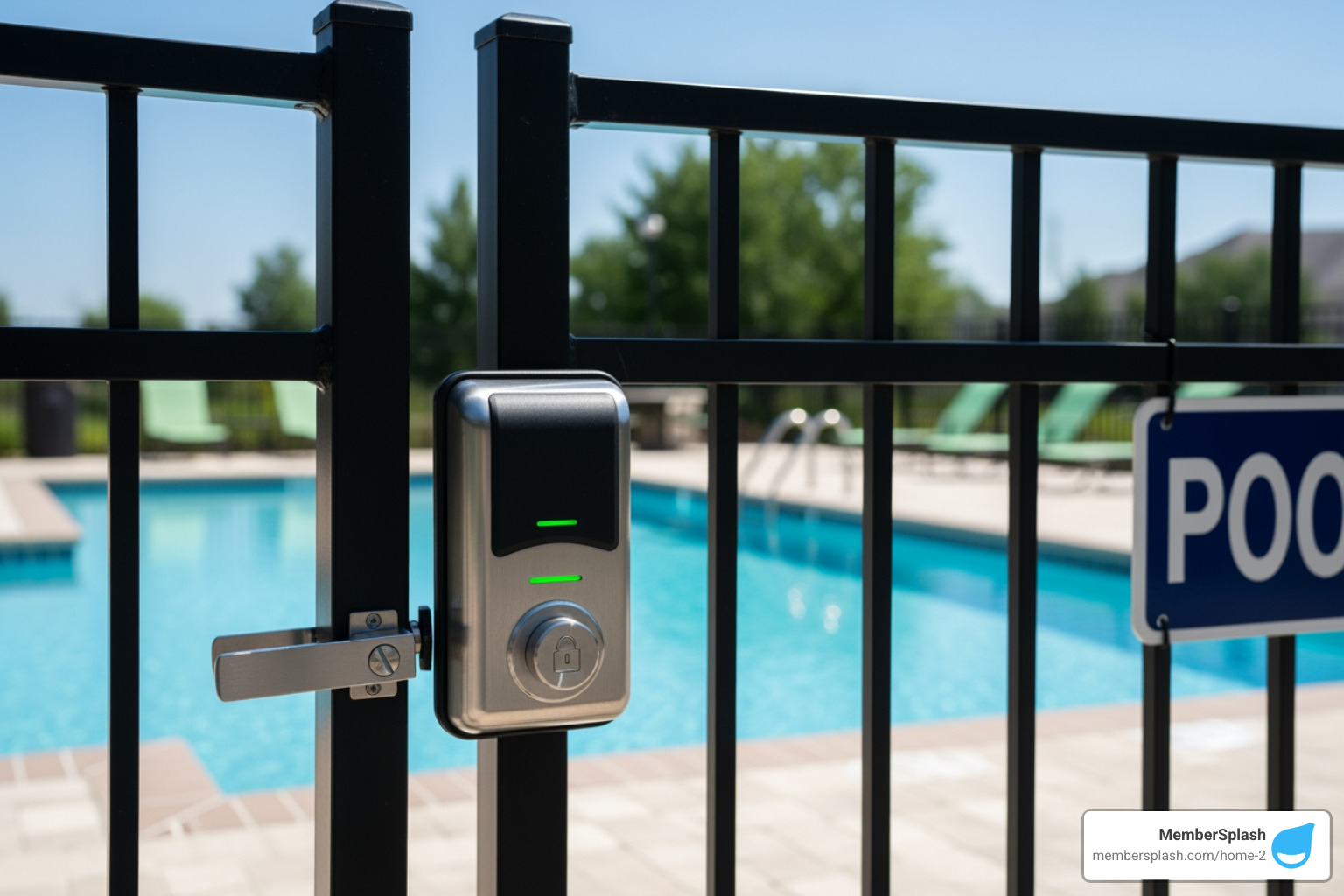
Here are our best practices for installation and maintenance:
- Regular Hardware Checks: Periodically inspect all physical components, including gates, latches, and electronic locks. Ensure self-latching mechanisms are functioning correctly and that there’s no wear and tear that could compromise security.
- Software Updates: For digital systems, keeping software up-to-date is crucial for security patches, new features, and optimal performance.
- Cleaning Readers and Locks: Outdoor environments can be harsh. Regularly clean card readers, keypads, and biometric scanners to prevent debris buildup and ensure accurate readings.
- Auditing Access Logs: Regularly review access logs to monitor entry trends, identify suspicious activity, and ensure all entries are legitimate. This data is invaluable for operational improvements and compliance.
- Weatherproofing Verification: Confirm that all outdoor components are robust, weatherproof, and resistant to rust and corrosion. This prevents failures due to moisture, salt, or chemicals, which are common culprits in pool environments.
- Professional Installation: While some smaller systems might seem DIY-friendly, professional installation is always recommended for complex systems to ensure correct function, proper wiring, and adherence to all safety codes.
By following these best practices, we ensure your pool access control system remains a reliable guardian of your facility, year after year.
More info about supported implementation
Opening up Efficiency: Integrating Access Control with Management Software
In today’s world, efficiency is paramount. For HOAs and swim clubs, this means not just securing your pool but also streamlining its management. This is where the magic happens: integrating your pool access control system with comprehensive management software. The operational benefits are immense, leading to streamlined administration, reduced staff workload, and the power to make data-driven decisions.
Access control systems contribute significantly to efficient property management. Think about it: automation frees up staff time, allowing them to focus on member experience and facility upkeep rather than manually checking IDs. Cloud-connected systems eliminate the need for on-site monitoring and simplify report generation, giving us a holistic view of operations from anywhere. We can review usage patterns, such as peak hours or user groups, to make informed decisions about staffing, maintenance schedules, and even future amenity planning.
The Power of Integration
The true power of modern pool access control lies in its ability to integrate with other essential systems. When we connect access control with your membership databases, we open up a new level of automation and security:
- Automating Access Based on Payment Status: Imagine a system that automatically denies access to members whose dues are unpaid. Administrators and office managers can easily deny access to members that have not paid their dues, eliminating awkward conversations and ensuring fair use of amenities.
- Seamless Online Payment Processing: Integrating with online payment processing allows members to manage their accounts and payments easily, which then automatically updates their access privileges.
- Syncing with CCTV for Improved Security: Integrating CCTV provides improved monitoring by syncing footage with access logs. This means visual confirmation and evidence for every entry, aiding in incident resolution. If suspicious activity is detected, such as someone attempting to force open a gate, the system can be configured to trigger immediate alerts. Video recordings combined with access data make it significantly easier to investigate and resolve disputes.
- Centralized Reporting: All access data, membership information, and payment records are consolidated into one platform. This provides a comprehensive audit trail for compliance, helps us understand facility usage, and informs strategic decisions. Cloud-based access control systems offer scalability and ensure compatibility with emerging technologies, safeguarding your investment.
More info about online payment processing
Streamlining Operations for HOAs and Swim Clubs
For HOAs and swim clubs, pool access control integrated with management software is a game-changer. Our MemberSplash software, for example, is designed to streamline operations, handle complex pricing, and save time and cost while capturing revenue. It provides a customizable platform specifically for these needs.
- Automated Member Check-in: Gone are the days of paper records. Our systems allow for front desk check-in for members and guests, tracking facility usage with digital ease. Members warmly accept these systems, making it easier for our gate check-in staff and membership chairs to prepare for the season.
- Simplified Guest Pass Management: We can easily manage guest passes, whether through online applications, ePasses, Photo ID Passes, or even 1-Click Print & Mail Passes. This ensures that only authorized guests enter, often with time-limited access.
- Enforcing Amenity Rules: Access control systems allow us to set different access levels for members and guests, and even control access to other amenities like BBQs, fire pits, and jacuzzis, ensuring fair and regulated use.
- Generating Usage Reports for Board Meetings: Management companies can use cloud-based systems to generate detailed reports for compliance audits and incident reviews. These reports provide invaluable insights into usage patterns, helping boards make informed decisions about resource allocation, staffing, and future planning.
Our software is simple and easy for managing seasonal patrons after they receive training, and it’s been described as a “fantastic partner” with “easy applications, quick turnaround, reasonable prices, and exceptional customer service.” This comprehensive approach ensures that our facilities run smoothly, securely, and efficiently.
More info about reservation systems
Conclusion
We’ve explored how pool access control is far more than just a gate lock; it’s a fundamental component of modern pool management. From enhancing safety and preventing accidents to mitigating liability and streamlining operations, a robust access control system provides benefits that extend across your entire facility. We’ve seen how various technologies—from keypads and key fobs to advanced mobile credentials and biometric scanners—offer custom solutions for diverse needs, always with an eye on durability and weather resistance for our outdoor environments.
The integration of these systems with comprehensive management software, like MemberSplash, is where the real power lies. This synergy automates check-ins, manages guest passes, enforces amenity rules, and provides invaluable data for strategic decision-making. It frees up our staff, empowers our members, and creates a safer, more enjoyable environment for everyone. Investing in pool access control systems, while an initial expense, offers long-term benefits that far outweigh the costs, including reduced liability, improved user satisfaction, and efficient operations.
Looking ahead, the future of pool security is exciting, with emerging trends like blockchain technology for access management and AI-driven analytics tools expected to become commonplace for understanding usage patterns. These innovations will continue to improve the hospitality and overall visitor experience. By embracing these advancements, we transform our pools into well-managed, secure, and enjoyable spaces.
Ready to take your pool management to the next level?