
Talk of the Town: Essential HOA Communication Tools
Why Effective Communication is No Longer Optional for HOAs
HOA communication tools are platforms and systems that help homeowners associations share information with residents, board members, and committees. If you’re exploring these tools, here are the essential types you need to know:
- Dedicated websites and resident portals – Centralized hubs for documents, payments, and requests
- Email and digital newsletters – Cost-effective mass communication for updates and announcements
- Text messages (SMS) and automated calls – Urgent alerts and emergency notifications
- Traditional methods – Postal mail and notice boards for legal requirements and non-tech-savvy residents
- HOA management software – All-in-one platforms that combine multiple communication channels
Communication is the backbone of successful HOA management. Yet 91% of community leaders agree that communication is a major issue in their association. This isn’t just an inconvenience—it’s a crisis that affects resident satisfaction, property values, and board member sanity.
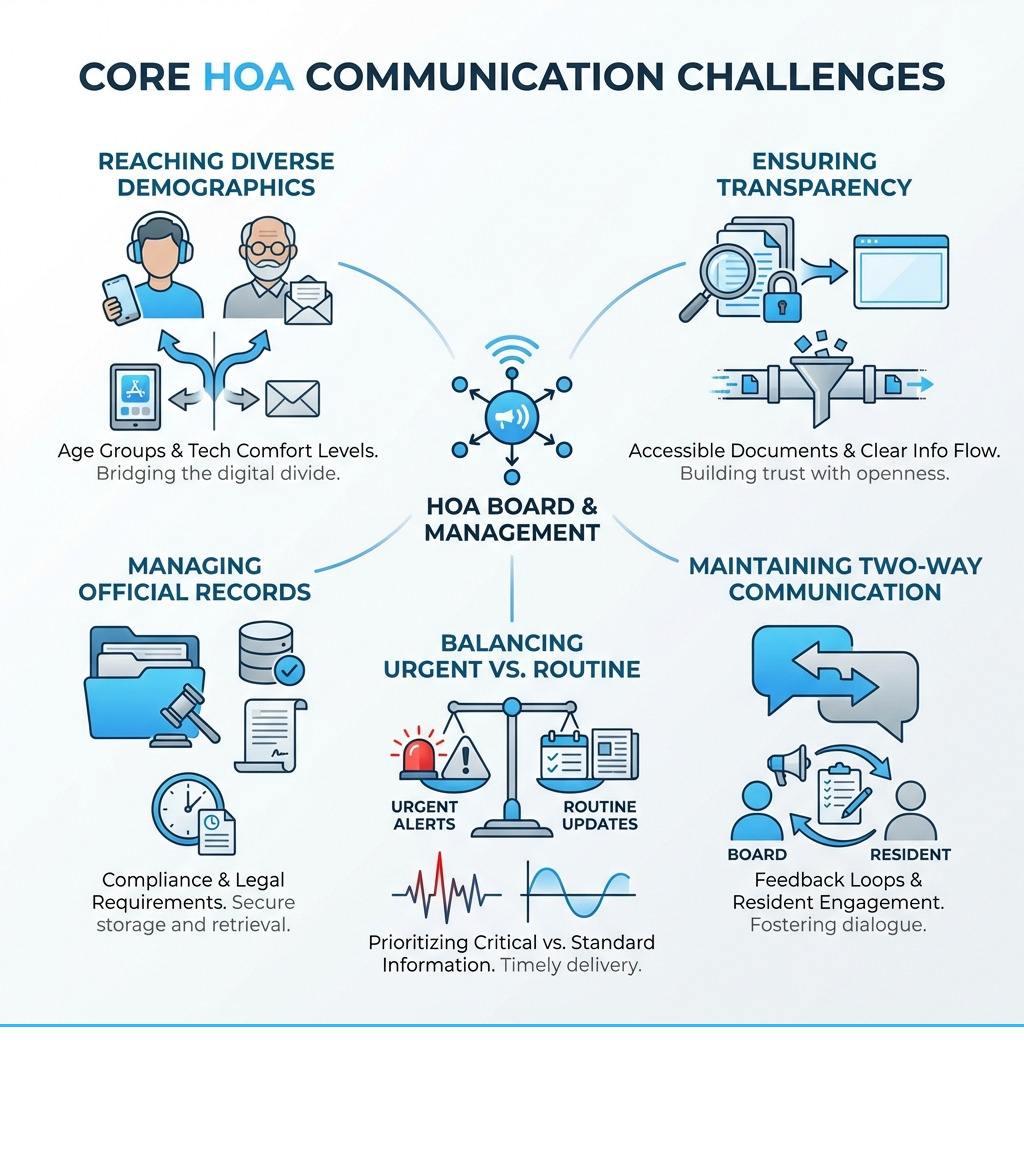
As more Americans are choosing to live in HOAs, the stakes for effective communication have never been higher. Communities are growing more diverse, spanning multiple generations with vastly different communication preferences. Meanwhile, board members and managers are drowning in administrative tasks, struggling to reach every resident while maintaining transparency and compliance.
The old ways aren’t working anymore. A Facebook group won’t cut it. Neither will random emails or hoping residents check a dusty bulletin board. Today’s HOAs need a strategic, multi-channel approach that meets residents where they are—whether that’s on their smartphone, in their mailbox, or on a community website.
The good news? The right tools can transform your community from frustrated and disconnected to informed and engaged.
The High Cost of Silence: Risks of Poor Communication vs. Rewards of Transparency
We’ve all heard the saying, “No news is good news.” But in an HOA, no news—or worse, bad news delivered poorly—is a recipe for disaster. Poor communication can quickly erode the very foundation of community living, leading to a host of problems that can plague boards and residents alike.
One of the most immediate risks is the spread of misinformation and rumors. When official channels are silent or unclear, residents will inevitably fill the void with speculation. As one community leader wisely noted, “Rumor is no way to manage any entity.” This can lead to unnecessary conflict and misunderstandings, creating a toxic environment where residents feel unheard and disconnected. For board members and managers, this often translates to a “toxic work environment,” characterized by constant complaints and a lack of accountability from residents who don’t feel informed.
Beyond internal strife, poor communication can have tangible negative consequences. It can result in an increase in violations, as residents may not be aware of rules or changes. More significantly, it can expose the HOA to legal liabilities. Clear, frequent communication is a powerful shield against potential lawsuits, ensuring that all residents are properly informed of their responsibilities and any community changes. Without it, boards risk resident mistrust and unmet expectations, which can quickly turn minor issues into major legal battles. This burden can also lead to board member burnout, as volunteers struggle under the weight of constant complaints and administrative inefficiencies.

Conversely, embracing transparency and effective HOA communication tools brings a wealth of rewards. When residents are well-informed, they are more likely to be engaged and satisfied. This isn’t just about good feelings; it has a direct impact on the community’s overall success. Happy residents are more likely to comply with rules, participate in community events, and even provide positive reviews to prospective buyers, which can contribute to increased property values.
Transparent communication fosters trust between the board and residents. When information is readily available and clearly communicated, residents feel respected and included in the decision-making process. This leads to higher engagement in community activities and meetings, making it easier to reach quorums and implement new initiatives.
Effective communication streamlines operations. By proactively addressing concerns and disseminating information efficiently, boards can reduce administrative burdens, allowing them to focus on value-adding work and community building. We understand the importance of maximizing efficiency in all aspects of HOA management, and robust communication is a cornerstone of that effort. You can find more info about maximizing efficiency here.
The Ultimate HOA Communication Toolkit: Key Channels for a Connected Community
To truly connect with every resident, an HOA needs a diverse arsenal of communication channels. Relying on a single method is like trying to catch fish with only one type of bait – you’ll miss a lot! Below, we explore the essential HOA communication tools that form a comprehensive toolkit.
Dedicated HOA Websites & Resident Portals
Imagine a central hub where every resident can find everything they need, 24/7. That’s the power of a dedicated HOA website or resident portal. These platforms serve as the digital cornerstone of your community’s communication strategy, offering unparalleled convenience and organization.
A well-designed portal acts as a comprehensive document repository, making it easy for residents to access governing documents, bylaws, meeting minutes, and financial reports at any time. No more frantic calls to board members for a copy of the CC&Rs! They also streamline administrative tasks such as amenity reservations, allowing residents to book pool slots, tennis courts, or clubhouse facilities with a few clicks. Online payment processing simplifies fee collection, offering residents convenient ways to pay dues and special assessments. Furthermore, residents can submit architectural requests, maintenance requests, or general inquiries directly through the portal, and often track their status, improving transparency and accountability.
The security and privacy offered by password-protected portals are crucial for sensitive HOA information. Unlike public social media, these platforms ensure that only authorized residents can access community-specific details. While a basic informational website design along with maintenance may cost around $2500 for one year, the efficiency gains and improved resident satisfaction often far outweigh this investment. At MemberSplash, we specialize in providing robust platforms that include features like reservation systems and online payment processing, designed to centralize and simplify these essential functions for HOAs in Annapolis, Baltimore, and beyond.
Email and Digital Newsletters
Email remains a workhorse in the field of HOA communication, offering a cost-effective and efficient way to reach a large audience instantly. For mass communication, email is hard to beat. It allows boards to disseminate widespread updates, event announcements, and important notices to the entire community (or specific segments) with ease.
Digital newsletters, delivered via email, are fantastic for sharing regular updates, showcasing community achievements, and promoting upcoming events. They strike a balance between formal announcements and more casual, community-building content. Email platforms often allow for document attachments, meaning you can easily include meeting agendas, budget summaries, or important forms directly in your message.
One of the key advantages of email is its trackable delivery, allowing boards to see if messages have been opened and read, which can be invaluable for ensuring accountability. Many professional email services offer robust features for managing subscriber lists and analyzing engagement. For HOAs looking to leverage this channel effectively, our platform includes bulk email communication capabilities, ensuring your messages reach the right residents at the right time.
Text Message (SMS) & Automated Calls
When urgency is paramount, text messages (SMS) and automated calls are your best friends. These HOA communication tools cut through the noise, delivering critical information directly and quickly.

Consider an unexpected maintenance issue, a safety alert, or an urgent community announcement – these are moments when every second counts. Text messages are incredibly effective for urgent alerts because of their astounding open rates: a remarkable 99% of all text messages are read within just 3 minutes of receiving them. This makes them ideal for emergency notifications, last-minute event changes, or maintenance reminders that impact daily life.
Automated calls, often referred to as “smart calls,” serve a similar purpose, particularly for emergencies like natural disasters or critical infrastructure failures. They can reach residents who might not be checking their phones for texts or emails, ensuring vital information is conveyed promptly. While less suitable for detailed discussions, their strength lies in their ability to deliver concise, high-priority information that demands immediate attention, making them indispensable for any HOA’s emergency preparedness plan.
Traditional Methods: Postal Mail & Notice Boards
In our increasingly digital world, it might seem old-fashioned, but traditional communication methods still hold significant value, especially for HOAs. Postal mail and physical notice boards play a crucial role in ensuring that all residents are informed, including those who are less tech-savvy or prefer tangible records.
For many HOAs, certain official notices and legal requirements still mandate delivery via postal mail. This ensures that important documents, such as annual reports or formal notices of rule changes, are received and can be kept as tangible records by residents. In fact, a study by DMA found that 56% of Americans actually like receiving direct mail, underscoring its continued relevance.
For older communities, or those with a significant population of seniors, relying solely on digital channels can exclude a large portion of residents. While 61% of American citizens over the age of 65 own a smartphone as of 2021, that still leaves a substantial percentage who may not, or who simply prefer traditional methods. Physical notice boards, strategically placed in common areas, can also serve as a reliable way to post community news, event flyers, and general announcements, reaching residents as they go about their daily routines. Combining these traditional methods with digital HOA communication tools ensures a truly inclusive approach.
Strategic Implementation of your HOA communication tools
Having a diverse toolkit of HOA communication tools is only half the battle; the real magic happens when you implement them strategically. A well-thought-out communication plan is essential for maximizing effectiveness, minimizing resident frustration, and ensuring your messages hit their mark every time.
The first step is to create a comprehensive communication plan with clear objectives. What are you trying to achieve with your communication? Is it to inform residents about an upcoming event, announce a new policy, or address a safety concern? Each objective will likely dictate the most appropriate channel.
Next, define which channels are best suited for specific message types. For instance, a text message is perfect for an urgent alert about a pool closure, but entirely inadequate for a detailed discussion of a new budget. Conversely, your resident portal is ideal for posting official documents, while an email newsletter can share broader community news. We can’t just throw every message into every channel; that leads to information overload and residents tuning out.
Finally, and crucially, involve your residents in the process. Conduct surveys to understand their preferred communication methods and what information they value most. This feedback is invaluable for tailoring your strategy and ensuring your efforts are well-received. Effective communication is a two-way street, and understanding your audience is key to success.
Reaching Every Resident: A Multi-Channel Approach
Our communities are wonderfully diverse, and so are our residents’ communication preferences. Trying to reach everyone with a single method is like trying to fit a square peg in a round hole – it just won’t work. This is why a multi-channel approach is not just a good idea, it’s essential.
Consider the demographics of your HOA in Annapolis or Baltimore. You likely have a mix of tech-savvy residents who live on their smartphones and those who prefer a good old-fashioned letter. For instance, while 61% of American citizens over the age of 65 own a smartphone as of 2021, that still means a significant portion may not be as digitally connected. In communities with many senior residents, for example, a purely digital strategy would leave many important people out of the loop. This highlights the need to combine digital tools like emails and resident portals with traditional methods like postal mail and notice boards.
Furthermore, remember to include all residents in your communication plan, including renters. While renters may not be owners, they are an integral part of the community and are responsible for adhering to HOA guidelines. Overlooking them can make policy enforcement difficult and even impact community safety. A well-rounded communication strategy ensures everyone, from owners to renters, from the most tech-savvy to the least, receives important information in a way that works for them. This inclusive approach builds a stronger, more harmonious community for all.
Social Media vs. A Dedicated HOA Portal
Many HOAs initially turn to social media platforms like Facebook for communication, drawn by their apparent ease of use and widespread adoption. However, while social media can be useful for informal discussions and community building, it presents significant drawbacks when used as a primary HOA communication tool for official business. Let’s look at a comparison:
| Feature | Social Media (e.g., Facebook) | Dedicated HOA Portal |
|---|---|---|
| Privacy | Limited; user profiles visible, public scrutiny, data shared with platform. | High; password-protected, private environment, HOA controls data. |
| Data Ownership | Platform owns data; HOA has limited control over content. | HOA owns and controls all data and content. |
| Document Storage | Poor; files hard to organize, no central repository. | Excellent; searchable, categorized, secure document library. |
| Moderation Control | Difficult; comments can escalate, misinformation spreads easily. | Robust; board/management controlled discussions, clear guidelines. |
| Professionalism | Informal; suitable for social events, less for official notices. | Professional; designed for official communications, structured. |
| Accessibility | Excludes non-users, requires platform account. | Accessible to all residents with login, no social media account needed. |
Social media platforms are built with the intent to foster connections among people and are best for informal discussions such such as yard sales or community events. However, the lack of privacy is a major concern. While groups can be set to “private,” users’ Facebook profiles are still visible, and the platform’s public nature means that confidential community discussions can quickly become exposed. There’s also the issue of data ownership; your HOA doesn’t own the content or data on Facebook, which can lead to disorganization and potential loss of important information if an administrator leaves or account access is compromised.
Furthermore, social media is notoriously poor for document storage. Crucial HOA documents like governing documents or architectural guidelines cannot be easily uploaded or pinned for quick access, forcing residents to sift through endless posts or contact board members directly. This inefficiency defeats the purpose of centralized information.
Perhaps the biggest drawback is that not everyone uses Facebook or other social media platforms. Relying solely on these channels excludes a segment of your community, putting them at a disadvantage for accessing vital information. A dedicated HOA portal, on the other hand, provides a secure, organized, and accessible platform for all residents, regardless of their social media habits. It ensures that official communications are handled with the professionalism and control that your HOA deserves. You can read more about how social media can be used effectively, but also its limitations, by exploring articles on social media in HOA contexts.
The Art of the Message: Best Practices for HOA Communications
Beyond choosing the right HOA communication tools, the effectiveness of your message ultimately hinges on how you communicate. Crafting clear, concise, and courteous messages is an art form, and mastering it can significantly improve resident engagement and satisfaction. We often refer to the “7 Cs of Communication” as a guiding principle:
- Clear: Be explicit and unambiguous. Avoid jargon or overly technical language that might confuse residents.
- Concise: Get straight to the point. Respect residents’ time by eliminating unnecessary words or lengthy explanations.
- Concrete: Provide specific facts, figures, and examples. Avoid vague statements that leave room for interpretation.
- Correct: Ensure all information, dates, times, and details are accurate. Errors erode trust.
- Coherent: Organize your message logically, with a clear flow of ideas.
- Complete: Provide all necessary information so residents don’t have to seek clarification elsewhere.
- Courteous: Maintain a positive and respectful tone, even when delivering difficult news.
The tone and professionalism of your communications are paramount. We encourage boards to “speak like a member of the community, not an authority.” This means incorporating empathy and a personal touch, and always striving for positive communication, which has a direct relationship to the kind of response you are going to get. A professional attitude, rather than “throwing weight around,” will foster a more cooperative environment.
It’s also crucial to set clear expectations. Establish a proper communication policy that outlines which channels will be used for what types of messages, the expected frequency of communications, and how residents should reach out with questions or concerns. This clarity prevents misunderstandings and manages resident expectations.
Finally, responsiveness is key. Aim to acknowledge resident inquiries promptly, even if it’s just to say you’ve received their message and are looking into it. When implementing new HOA communication tools or strategies, be patient. Change takes time, and some residents may need extra support or encouragement to adapt. Providing clear directions and training resources can go a long way in ensuring widespread adoption and success.
Conclusion: Unify Your Community with an All-in-One Solution
We’ve explored the myriad challenges HOAs face in communication, from the risks of misinformation and legal liabilities to the complexities of reaching diverse resident demographics. We’ve seen how dedicated websites, emails, texts, and even traditional mail each play a vital role, and why social media, despite its popularity, often falls short for official HOA business. The central takeaway is clear: effective communication is not merely an administrative task; it’s the lifeblood of a thriving community.
The key to overcoming these challenges isn’t to simply add more tools, but to adopt a unified, strategic approach. This means choosing integrated HOA communication tools that work together seamlessly, rather than operating in silos. An all-in-one solution streamlines operations, reduces administrative burdens, and ensures that every resident receives the right information, through the right channel, at the right time.
At MemberSplash, we understand the unique communication needs of HOAs in Annapolis and Baltimore. Our customizable platform provides a comprehensive suite of features designed to simplify membership management and foster vibrant communities. By bringing together essential HOA communication tools like resident portals, bulk email, and amenity reservation systems into one intuitive platform, we empower boards and managers to connect with residents more effectively. This integrated approach saves time and money, allowing your HOA to focus on what truly matters: building a happier, more engaged community. Find how our holistic approach to HOA management solutions can transform your community’s communication.